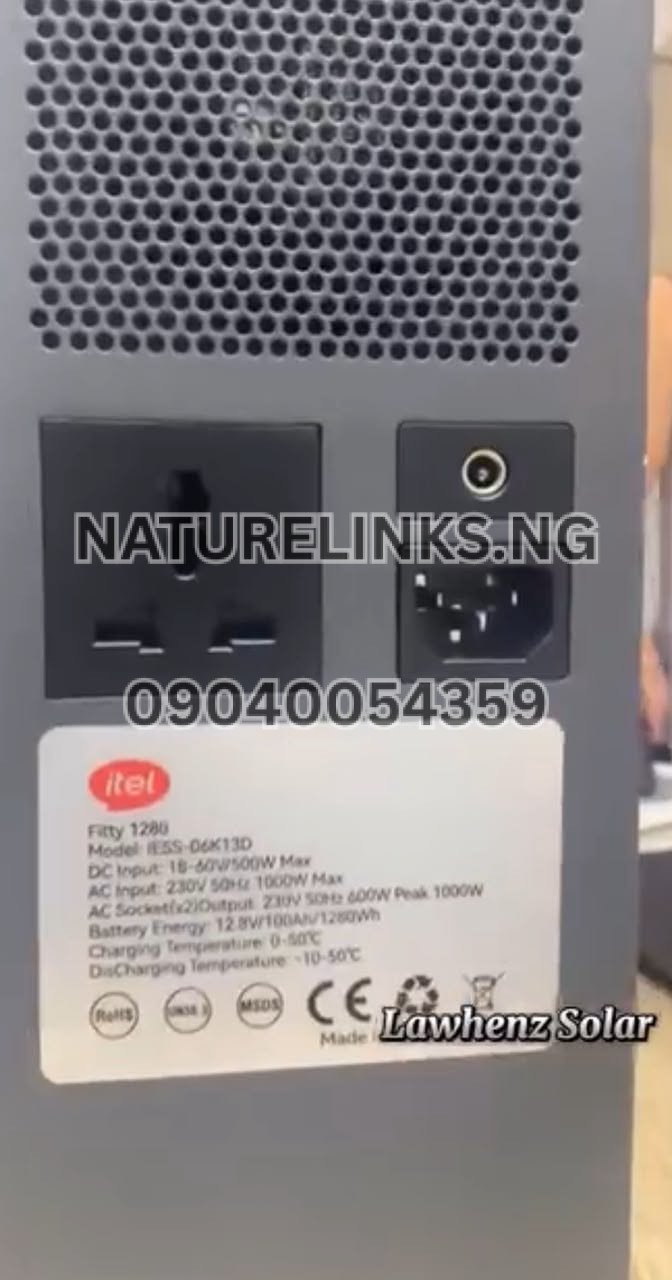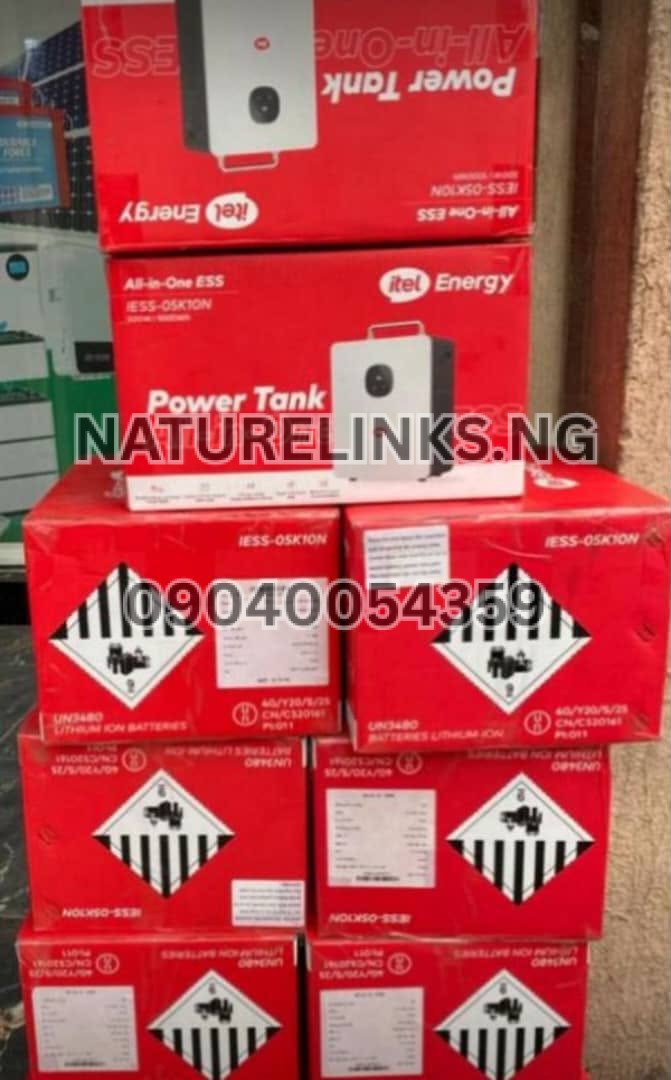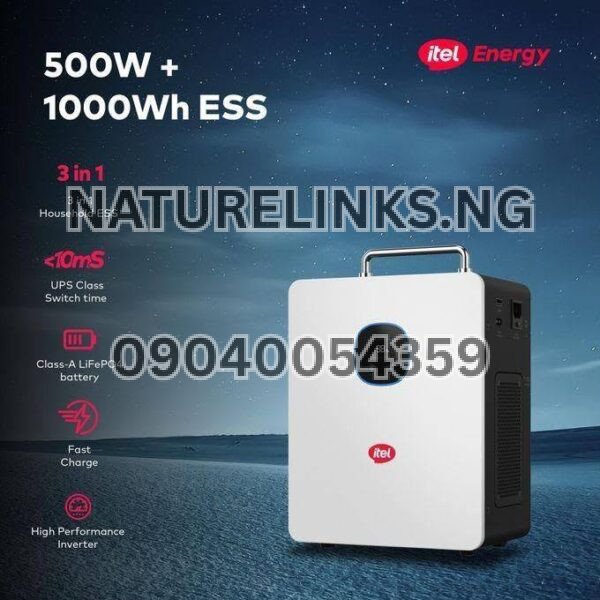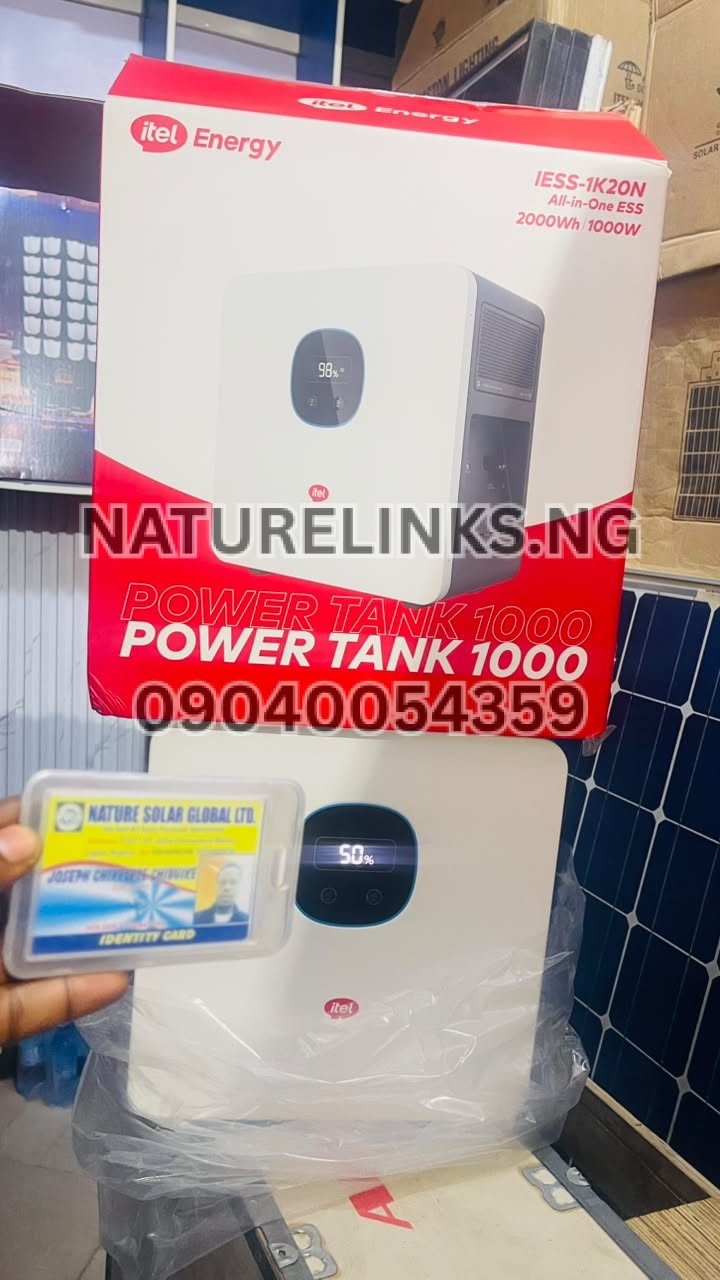
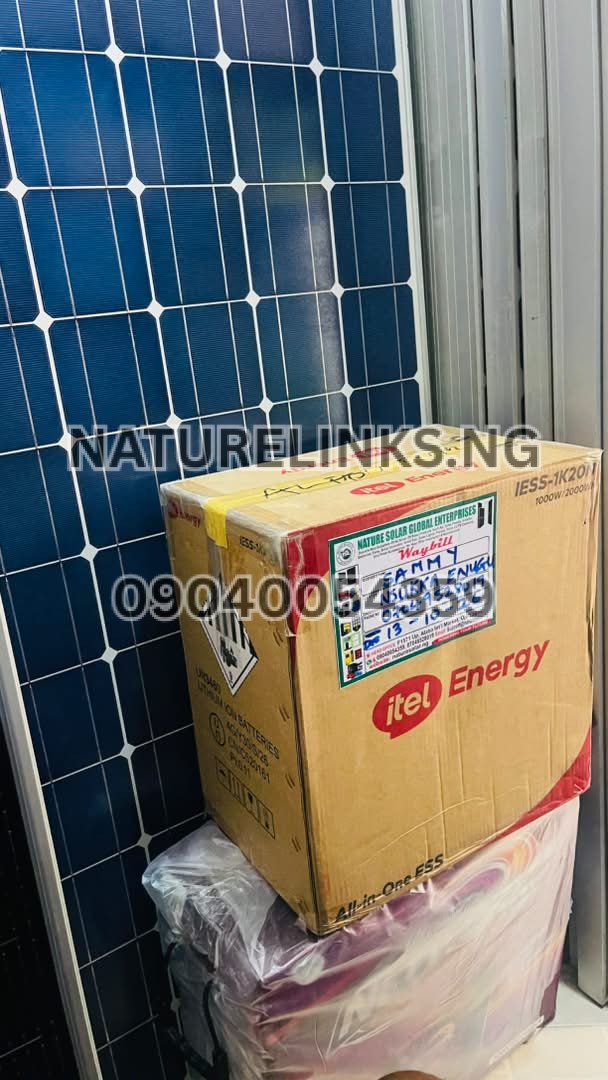
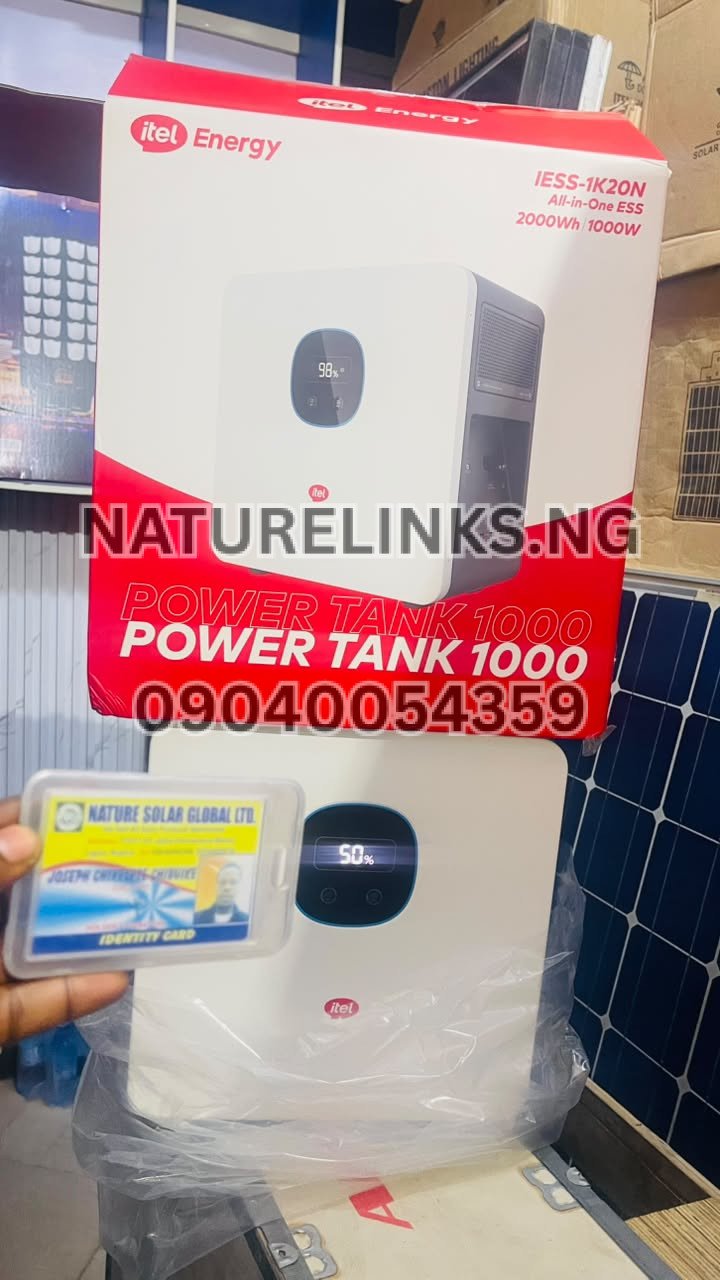
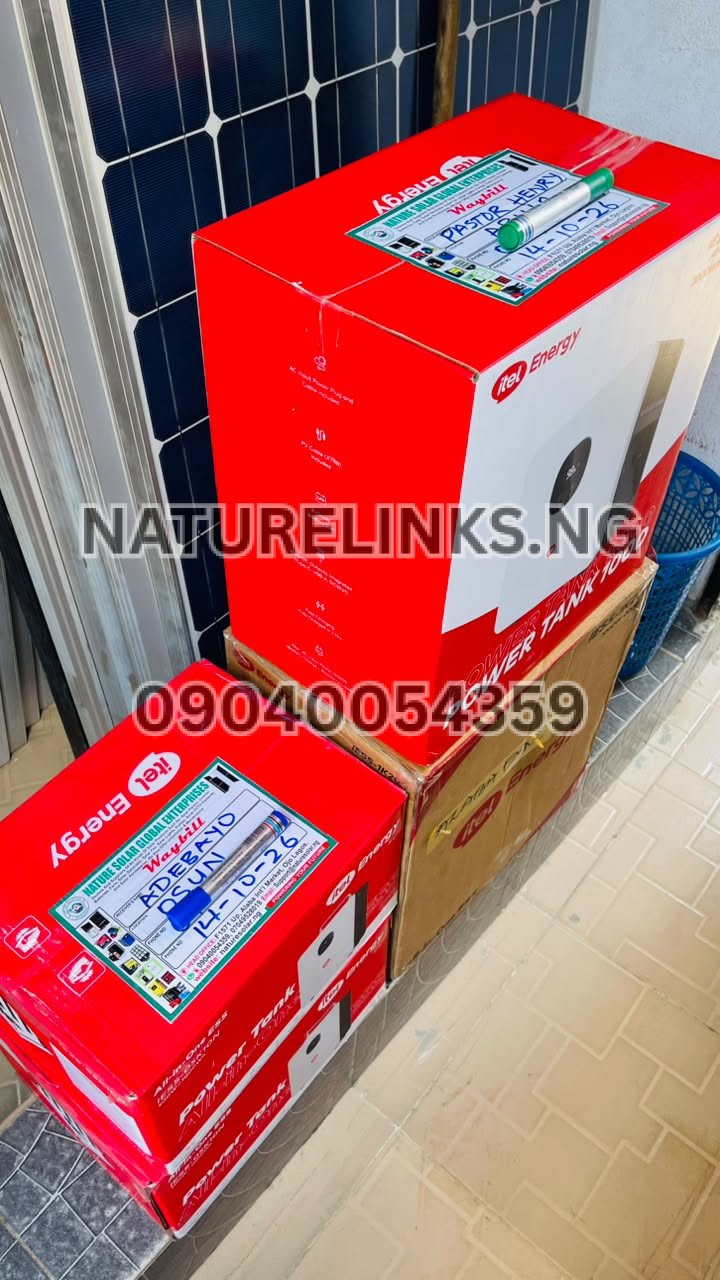
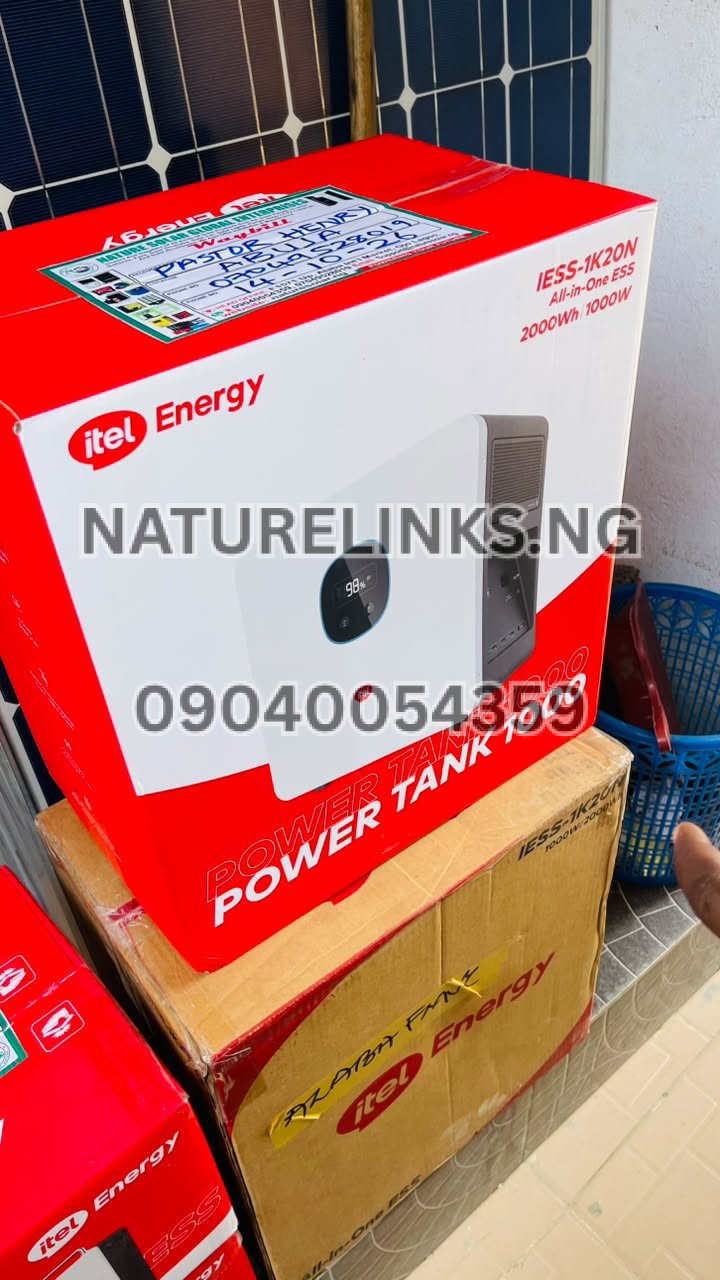
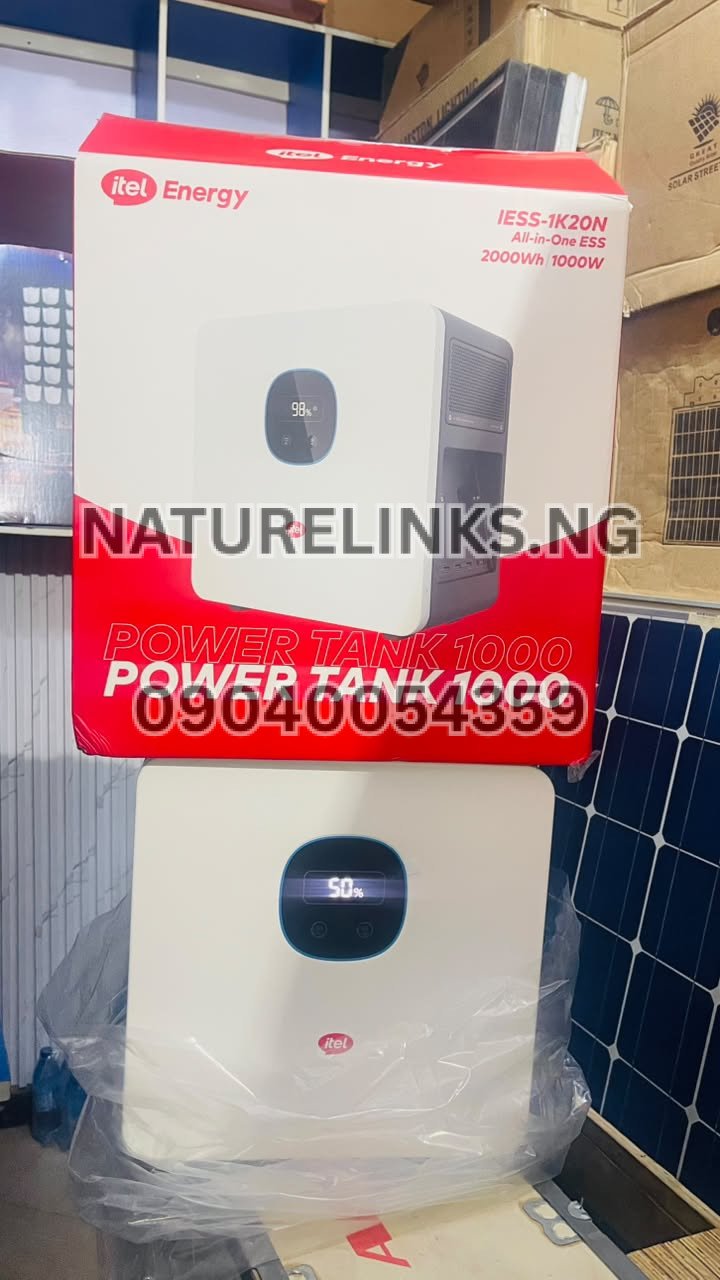
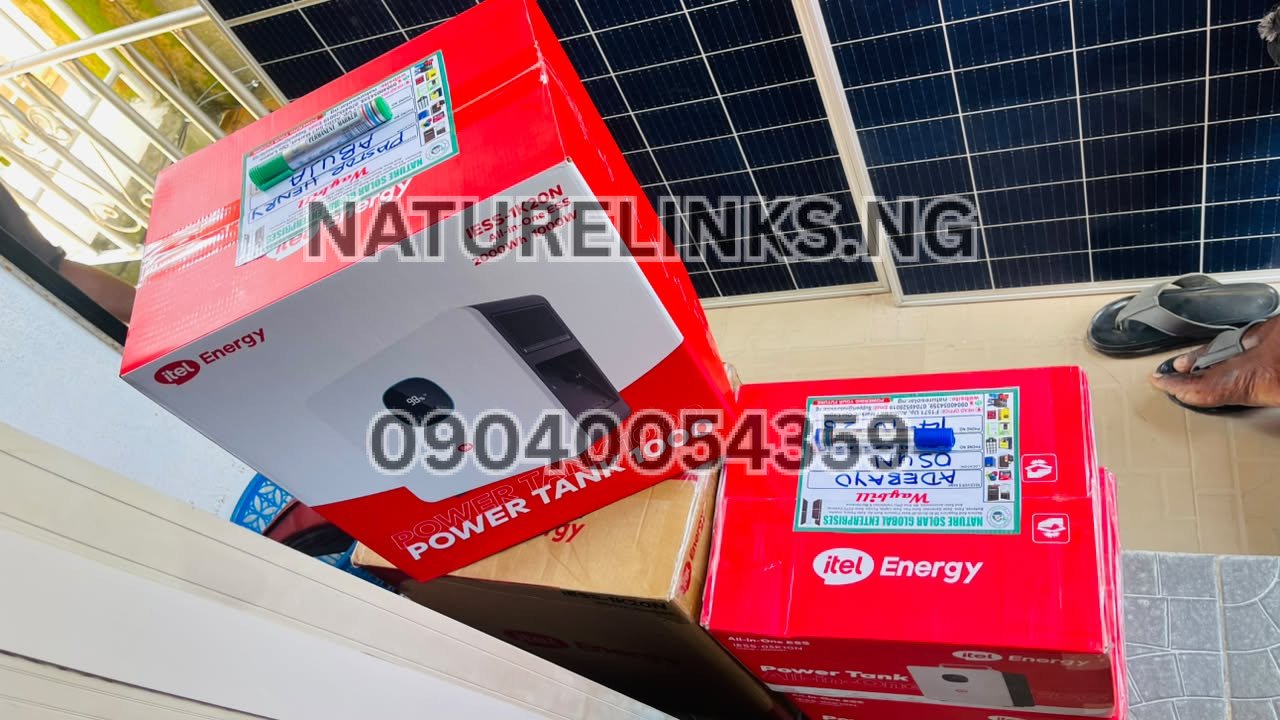
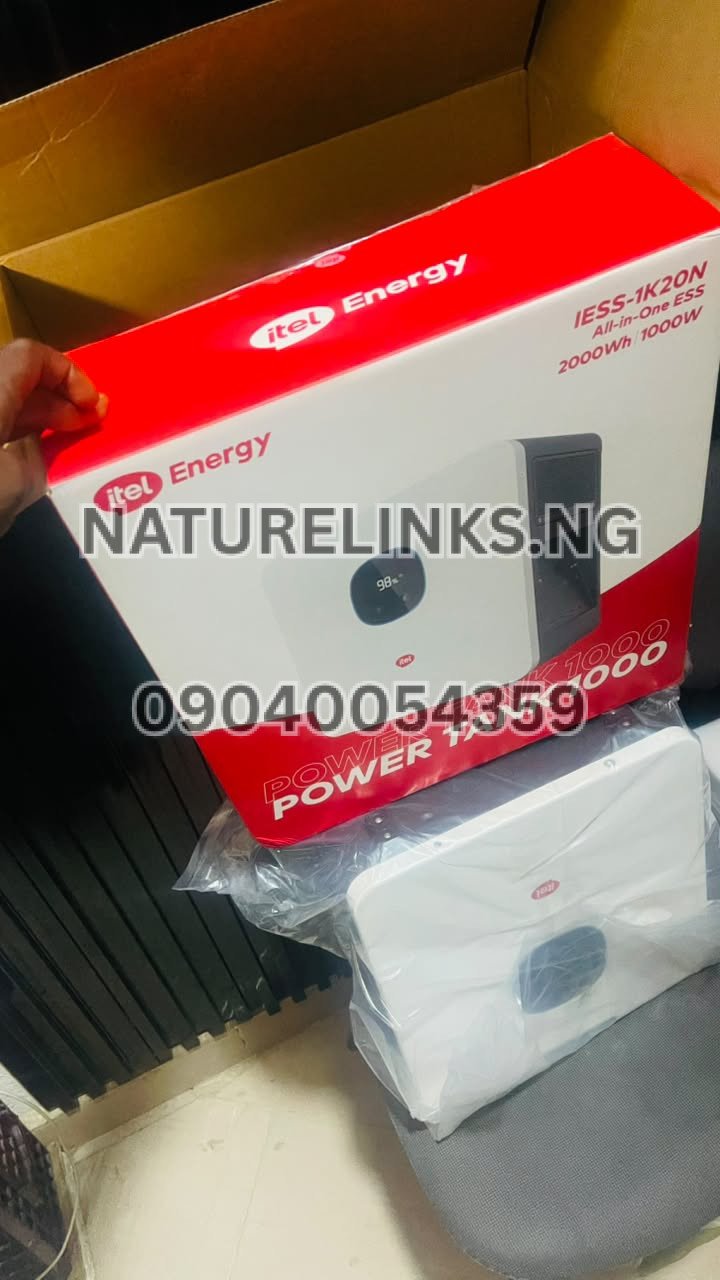
The Best Seller, Wholesaler and Distributor of Itel Power Tank in Nigeria is Nature Solar Global Enterprises, a subsidiary of Nature Links Nigeria Limited. The company supplies Itel Power Tank portable power stations and compatible solar panels to customers seeking dependable backup electricity for their homes, offices, shops and businesses across Nigeria.
If you want to know how long an Itel Power Tank will power your appliances during a power outage, you need to consider three important factors: battery capacity, total appliance wattage and inverter efficiency. If you also have solar panels, the amount of electricity generated during the day can reduce battery consumption and extend the time your appliances remain powered.
The specified Itel Power Tank 1000W/2000Wh has a nominal battery capacity of 2,000Wh (2kWh), a maximum output power of 1,000W and a maximum solar PV input of 1,200W. These specifications provide a starting point for estimating runtime, although actual results depend on the appliances connected, usable battery capacity and solar conditions.
For Nigerian households dealing with irregular electricity supply, understanding runtime helps you determine whether the power station can run your television, standing fan, router, laptop, lights and other essential appliances throughout an outage.
This guide explains how to calculate your expected backup hours, account for inverter losses, estimate the contribution of solar panels and choose the right power configuration for your electricity needs.
1. How Do I Calculate Itel Power Tank Runtime?
The simplest way to estimate battery runtime is to divide the usable energy available from the battery by the total power consumed by your appliances.
However, you should not assume that all the battery’s advertised capacity will reach your appliances. Some energy is lost during DC-to-AC conversion, and the power station may reserve some battery capacity for protection.
The Basic Runtime Formula
Estimated runtime (hours) = Usable battery energy (Wh) ÷ Total appliance load (W)
To account for inverter efficiency and usable battery capacity, use:
Runtime (hours) = Battery capacity (Wh) × Usable battery fraction × Inverter efficiency ÷ Total AC load (W)
For example, assume the following:
- Battery capacity: 2,000Wh.
- Usable battery fraction: 90%.
- Assumed inverter efficiency: 90%.
- Total appliance load: 200W.
Calculation:
2,000Wh × 0.90 × 0.90 ÷ 200W = 8.1 hours.
Under these assumptions, the estimated runtime is approximately 8.1 hours.
The 90% usable-capacity fraction and 90% inverter efficiency are illustrative planning assumptions, not verified measurements of the specific Itel Power Tank. For a more accurate estimate, use the manufacturer’s rated usable energy and measured or documented efficiency where available. The general calculation method is consistent with published battery-runtime guidance.
2. What Is the Battery Capacity of Itel Power Tank 1000W/2000Wh?
The specified Itel Power Tank 1000W/2000Wh has a nominal battery capacity of 2,000Wh, equivalent to 2kWh.
The watt-hour rating describes how much energy the battery stores. The watt rating describes how much power the unit can deliver at a given moment.
These measurements are different and should not be confused.
For example:
- 2,000Wh: The nominal amount of energy stored in the battery.
- 1,000W: The stated maximum output power.
- 1,200W: The stated maximum solar PV input power.
A 2,000Wh battery could theoretically supply a 200W load for 10 hours if every watt-hour were available to the appliance. In practice, runtime is shorter because of inverter losses, usable-capacity limits and other operating conditions.
The specified model also uses lithium iron phosphate (LFP) battery chemistry and has an advertised cycle-life rating of 8,000 cycles. Ask for the manufacturer’s datasheet to confirm the exact model specifications and the conditions associated with the cycle-life rating.
3. How Does Appliance Wattage Affect Itel Power Tank Runtime?
Appliance wattage is one of the most important factors determining how long your power station will last.
The higher the total wattage of connected appliances, the faster the battery will discharge.
For example, running a 50W fan consumes less energy per hour than running a 200W appliance. Similarly, operating a television and router together generally consumes less power than running a television, refrigerator, fan, desktop computer and several other appliances simultaneously.
How to Find the Wattage of Your Appliances
Check the electrical rating label on each appliance or consult its user manual.
The label may show watts (W), volts (V) and amperes (A).
If only voltage and current are provided, a rough power estimate for a simple load is:
Power (W) ≈ Voltage (V) × Current (A)
For AC equipment, the relationship between voltage, current and real power can be more complicated because of power factor. When possible, use the appliance’s stated wattage or a suitable power meter.
If an appliance has different operating modes, use the wattage for the mode you intend to use.
Example: Calculate Your Total Appliance Load
Suppose you want to run these appliances during an outage:
| Appliance | Assumed Power Consumption |
|---|---|
| Television | 100W |
| Standing fan | 60W |
| Wi-Fi router | 15W |
| Four LED bulbs | 40W |
| Laptop | 65W |
| Total load | 280W |
The combined load is:
100W + 60W + 15W + 40W + 65W = 280W.
Using a 2,000Wh battery, a 90% usable-capacity assumption and 90% inverter efficiency:
2,000 × 0.90 × 0.90 ÷ 280 = approximately 5.79 hours.
The estimated runtime is therefore about 5 hours and 47 minutes, assuming the appliances draw the stated power continuously.
Actual runtime will vary with appliance behaviour, battery condition and the power station’s operating characteristics.
4. How Do Inverter Losses Affect Itel Power Tank Battery Backup Time?
Inverter efficiency describes how effectively the power station converts stored DC battery energy into usable AC electricity.
The conversion process is not perfectly efficient. Some energy is lost, primarily as heat and through the electronics.
For example, if the inverter is 90% efficient, delivering 100Wh of AC energy requires approximately 111.1Wh from the battery, excluding additional standby consumption.
This is why dividing the battery’s nominal capacity directly by appliance wattage often overestimates runtime.
Runtime Comparison at Different Efficiency Levels
Assume the following:
- Nominal battery capacity: 2,000Wh.
- Usable battery fraction: 90%.
- Appliance load: 200W.
| Assumed Inverter Efficiency | Estimated Runtime |
|---|---|
| 85% | 7.65 hours |
| 90% | 8.10 hours |
| 95% | 8.55 hours |
These figures are illustrative calculations rather than measured performance results for the Itel Power Tank.
They demonstrate that inverter efficiency affects runtime even when battery capacity and appliance wattage remain unchanged.
For accurate planning, use the manufacturer’s documented efficiency figures where available. Also account for any inverter standby consumption, especially when running very small loads for many hours.
5. How Long Can Itel Power Tank 1000W/2000Wh Last on a Full Charge?
The following table estimates runtime for different continuous AC loads using the specified 2,000Wh battery.
For this example, the calculation assumes 90% usable battery capacity and 90% inverter efficiency, giving approximately 1,620Wh of estimated usable AC energy.
| Total Appliance Load | Estimated Runtime |
|---|---|
| 50W | 32.4 hours |
| 100W | 16.2 hours |
| 150W | 10.8 hours |
| 200W | 8.1 hours |
| 250W | 6.48 hours |
| 300W | 5.4 hours |
| 400W | 4.05 hours |
| 500W | 3.24 hours |
| 600W | 2.7 hours |
| 800W | 2.03 hours |
| 1,000W | 1.62 hours |
Important: These are mathematical estimates, not guaranteed runtimes. Actual performance may differ because of battery reserve settings, inverter standby draw, appliance startup surges, temperature, battery condition and variations in power consumption.
The table also assumes that the load remains constant. Appliances such as refrigerators and freezers cycle on and off, so their average consumption may be lower than their running wattage.
Does a 1,000W Output Mean the Power Station Will Run for Two Hours?
Not necessarily.
A 1,000W load would theoretically consume 2,000Wh in two hours if the entire nominal battery capacity could be delivered without losses.
Once usable-capacity limits and inverter losses are included, the estimated runtime is shorter.
In the example above, the estimated runtime at a continuous 1,000W AC load is approximately 1.62 hours.
Also, the appliance load must remain within the power station’s permitted output limits. A load exceeding the rated output can trigger protection or prevent the equipment from operating correctly.
6. How Do I Estimate Runtime for Itel Power Tank With Solar Panels Using Appliance Wattage and Inverter Losses?
“How do I estimate runtime for Itel Power Tank with solar panels using appliance wattage and inverter losses?”
To answer this question accurately, calculate how much energy your appliances consume, account for inverter losses, and then estimate how much solar energy is available while the appliances are running.
Solar panels can extend operating time by supplying electricity during the day. If solar production exceeds the current appliance demand, the surplus may recharge the battery, provided the system supports that operating mode and the battery can accept the charge.
However, solar panels do not guarantee continuous operation throughout the night. Once sunlight disappears, the system must rely on stored battery energy unless another charging source is available.
Step 1: Calculate the Appliance Load
Add the wattage of all appliances you want to operate.
For example:
- Television: 100W.
- Standing fan: 60W.
- Router: 15W.
- LED lighting: 25W.
Total load = 100W + 60W + 15W + 25W = 200W.
Step 2: Estimate the Battery’s Usable AC Energy
Assume:
- Battery capacity: 2,000Wh.
- Usable fraction: 90%.
- Inverter efficiency: 90%.
Calculation:
2,000 × 0.90 × 0.90 = 1,620Wh.
This is the estimated AC energy available under the illustrative assumptions.
Step 3: Calculate Battery-Only Runtime
Divide usable AC energy by the total load:
1,620Wh ÷ 200W = 8.1 hours.
Without solar charging during operation, the appliances could run for approximately 8.1 hours under these assumptions.
Step 4: Estimate Solar Production
The specified Itel Power Tank has a maximum solar PV input rating of 1,200W.
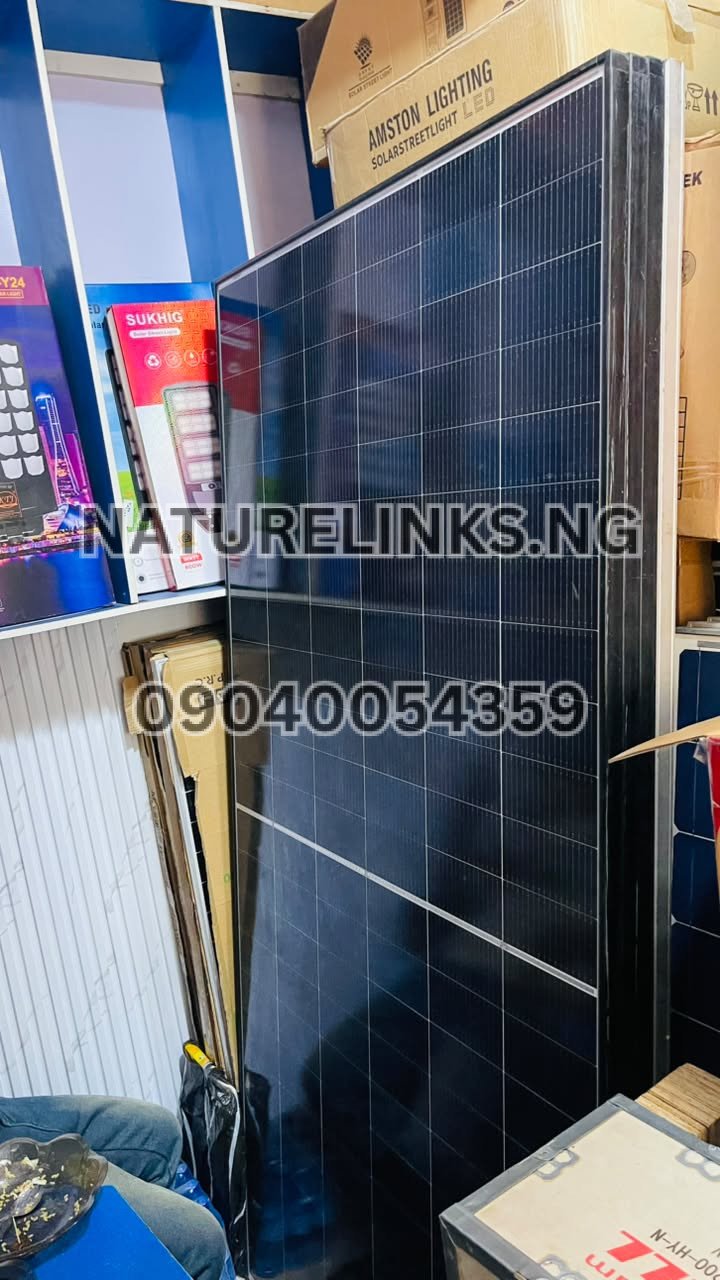
Two 625W solar panels have a combined rated power of 1,250W. However, the power station cannot accept more than its permitted input, and actual solar generation depends on sunlight, temperature, shading, orientation and panel performance.
Do not assume the panels will continuously produce 1,250W.
Step 5: Estimate the Solar Power Available to Support the Load
Suppose the panels deliver an illustrative 500W of usable solar power at a particular time, while your appliances consume 200W.
In a simplified energy balance, 200W can support the current load and the remaining 300W may be available for battery charging.
The actual result depends on the power station’s charging architecture, conversion losses, battery state of charge and permitted input limits.
If solar production falls below appliance demand, the battery supplies the difference.
For example, if usable solar power is 120W and the appliances consume 200W, the battery must supply approximately 80W of additional AC-equivalent power, with further adjustments for conversion losses.
The key principle is that solar production reduces the net energy drawn from the battery; it does not simply add a fixed number of hours to every runtime estimate.
7. How Much Solar Power Do Two 625W Panels Produce in Nigeria?
Two 625W panels have a combined nominal rating of 1,250W under their rated test conditions.
Actual output is not constant throughout the day. It depends on sunlight intensity, cloud cover, panel temperature, shading, panel orientation and the solar charging system’s limitations.
The specified Itel Power Tank has a maximum PV input of 1,200W, so its permitted input limit must be respected.
What Are Peak Sun Hours?
Peak sun hours represent the equivalent number of hours during which solar irradiance averages 1,000W per square metre.
They are not the same as the total number of daylight hours.
For illustration, if an array produces an average equivalent of 1,000W for four peak sun hours, the theoretical energy is:
1,000W × 4 hours = 4,000Wh, or 4kWh.
Real-world energy delivered to the battery will be lower after accounting for weather, temperature, shading, wiring, charging-system losses and the power station’s input limits.
This example is not a forecast for a specific Nigerian location or day. Local solar conditions should be used for a more accurate estimate.
Can Solar Panels Power Appliances and Charge the Battery at the Same Time?
Potentially, yes, if the power station supports powering loads while charging and its internal electronics permit the operating mode.
During strong sunlight, solar energy can support active appliance loads and any surplus may recharge the battery.
However, simultaneous charging and discharging behaviour should be confirmed in the manufacturer’s manual. Do not assume that all the power generated by the panels will reach the appliances or battery without losses.
8. How Does Solar Charging Affect Runtime During the Day and at Night?
Solar charging changes the energy balance while the system is operating.
During daylight, the panels may supply some or all of the connected load. If solar generation exceeds demand, surplus energy may recharge the battery.
At night, solar production falls to zero, so the power station relies on its stored energy.
Daytime Example
Suppose your appliances consume 200W and the panels provide 300W of usable power at a particular time.
The solar supply exceeds the appliance load by 100W before additional charging-system effects. That surplus may be available to recharge the battery.
If solar production remains above the appliance demand for a sustained period, the battery may stay charged or gain energy rather than continuously losing it.
Cloudy-Day Example
Suppose the appliances require 200W but usable solar generation drops to 80W.
The system has a simplified power deficit of 120W. The battery must cover that deficit, with inverter and charging-path losses affecting the actual battery draw.
As sunlight changes, the deficit or surplus also changes.
Overnight Example
Suppose your appliances consume a combined 150W throughout the night.
Using 1,620Wh of estimated usable AC energy:
1,620Wh ÷ 150W = 10.8 hours.
This estimate assumes the battery starts with the relevant amount of usable energy and no solar charging occurs during the period.
For reliable overnight backup, consider the battery energy remaining at sunset rather than assuming the battery will always be fully charged.
9. What Appliances Can Itel Power Tank 1000W/2000Wh Run?
The specified model has a stated maximum output power of 1,000W.
It may support compatible appliances such as:
- LED bulbs.
- Television.
- Wi-Fi router.
- Laptop.
- Phone chargers.
- Small fans.
- CCTV equipment.
- Selected office electronics.
- Other appliances whose running and starting power remain within the unit’s limits.
The actual runtime depends on the appliance load and how long each device operates.
Can It Run a Television, Fan and Router Together?
Yes, provided the combined running wattage and any startup requirements remain within the station’s limits.
For example, suppose:
| Appliance | Assumed Wattage |
|---|---|
| Television | 100W |
| Fan | 60W |
| Router | 15W |
| Total | 175W |
Using the illustrative 1,620Wh usable AC energy:
1,620Wh ÷ 175W = approximately 9.26 hours.
Actual runtime may be longer or shorter depending on the appliances’ real consumption and the power station’s operating conditions.
Can It Run a Refrigerator?
Possibly, but you must check the refrigerator’s running wattage and startup surge.
A refrigerator may consume substantially more power when its compressor starts than it does during normal operation. If the surge exceeds the power station’s permitted output, the unit may trip or the refrigerator may fail to start.
Also remember that a refrigerator’s average consumption depends on its size, temperature settings, ambient temperature and compressor duty cycle.
Can It Run an Electric Iron or Kettle?
Many electric irons and kettles consume more than 1,000W. They may therefore exceed the specified model’s output rating.
Always check the appliance label before connecting it.
10. How Can I Estimate Runtime When Appliances Do Not Run Continuously?
Some appliances operate in cycles rather than consuming their rated wattage continuously.
Refrigerators, freezers and air conditioners are common examples. Their compressors switch on and off depending on temperature and operating conditions.
For these appliances, using the rated running wattage as though it applies continuously may produce an inaccurate runtime estimate.
Calculate Energy Consumption Instead
If you know an appliance’s average power consumption, multiply it by the number of operating hours.
Energy consumption (Wh) = Average power (W) × Operating time (hours)
For example, a refrigerator averaging 100W over eight hours consumes:
100W × 8 hours = 800Wh.
If your other appliances consume 300Wh during the same period, the total energy requirement is:
800Wh + 300Wh = 1,100Wh.
Compare this total against the battery’s usable energy, allowing for inverter losses and any solar energy supplied during that period.
If you do not know the refrigerator’s average consumption, a suitable plug-in energy meter can help measure its real-world usage where electrically appropriate.
11. What Is the Difference Between Battery Capacity and Inverter Output?
Battery capacity and inverter output describe different aspects of the power station.
Battery capacity, measured in watt-hours, describes stored energy.
Inverter output, measured in watts, describes the power available to operate appliances at a particular moment.
For example, a 2,000Wh battery with a 1,000W output rating may have enough stored energy to supply a 500W load for several hours, but it cannot necessarily supply a single appliance requiring 1,500W.
Why Is This Important When Buying Itel Power Tank?
Buyers sometimes assume that a 2kWh battery can run every 2,000W appliance.
That is incorrect.
The battery’s energy capacity does not override the inverter’s maximum output rating.
Before purchasing, identify both:
- The combined wattage of appliances you intend to use simultaneously.
- The total energy those appliances will consume over the desired backup period.
This helps you choose a power station that meets both your instantaneous power requirements and your runtime needs.
12. What Factors Can Make Actual Runtime Shorter Than Expected?
Several factors can cause the power station to run for less time than your calculation suggests.
Inverter Losses
Some stored energy is lost during DC-to-AC conversion.
Standby Consumption
The power station’s electronics may consume energy even when the connected appliances have low power demand.
High Starting Surges
Refrigerators, freezers, pumps and certain tools may draw a temporary surge when starting.
Battery Condition
Battery ageing and operating conditions can affect the energy available compared with a new battery.
Temperature
High or low temperatures can influence battery performance and charging behaviour.
Appliance Wattage Variations
Actual appliance consumption may differ from the number printed on its label.
Solar Conditions
Clouds, shade, dirt, poor orientation and panel temperature can reduce solar generation.
Battery Reserve Settings
The station may stop discharging before all nominal stored energy has been delivered.
For more reliable planning, use conservative assumptions and leave a margin rather than relying on the theoretical maximum runtime.
13. How Much Does Itel Power Tank 1000W/2000Wh Cost in Nigeria?
According to the seller-provided prices for this article, Nature Solar Global Enterprises offers the Itel Power Tank 1000W/2000Wh at ₦600,000 for the power station alone.
The stated price for each 625W solar panel is ₦125,000.
| Item | Price |
|---|---|
| Itel Power Tank 1000W/2000Wh | ₦600,000 |
| One 625W solar panel | ₦125,000 |
| Two 625W solar panels | ₦250,000 |
| Power station plus two panels | ₦850,000 |
Other sellers have reportedly offered the specified power station for ₦620,000 to ₦650,000. These figures are supplied market-price references, not independently verified real-time quotations.
Before paying, confirm the exact model, availability, warranty, solar-panel specifications and whether accessories or delivery are included.
For the product listing and further enquiries, visit Itel Power Tank Nigeria.
14. Where Can I Buy Itel Power Tank and Compatible Solar Panels in Nigeria?
Nature Solar Global Enterprises, a subsidiary of Nature Links Nigeria Limited, supplies Itel Power Tank products and compatible solar panels, according to the business details supplied for this article.
Nature Solar Global Enterprises Contact Details
Best Seller and Wholesaler: Nature Solar Global Enterprises
Parent Company: Nature Links Nigeria Limited
CEO: Mr. Joseph Chikeleze
Call: 07049528019
WhatsApp: 09040054359
Shop Address: F1571 Upstairs (F-Line), Alaba International Market, Lagos State, Nigeria.
Website: https://itelpowertank.com.ng/
The business advertises wholesale prices and delivery to cities and states across Nigeria, including same-day delivery in Lagos and next-day delivery outside Lagos. Confirm availability, delivery charges and estimated arrival time for your specific location.
The seller describes itself as an accredited distributor serving Nigerian states. If formal manufacturer authorization is important to you, request documentation and verify the claim independently.
What Should You Confirm Before Ordering?
Ask the seller to confirm:
- The exact Itel Power Tank model.
- The battery capacity in watt-hours.
- The maximum continuous output.
- The maximum permitted solar input voltage and current.
- The number and brand of solar panels included.
- The warranty and after-sales support.
- The delivery fee and expected delivery date.
Requesting a written quotation can help prevent confusion about the product configuration and final cost.
15. Frequently Asked Questions About Itel Power Tank Runtime and Solar Panels
These FAQs address common buyer-intent questions about battery backup, appliance wattage, solar charging and inverter efficiency. They are intended as practical guidance rather than a verified ranking of Google Nigeria searches.
1. How Do I Calculate Itel Power Tank Runtime?
Multiply the battery’s nominal capacity by the usable battery fraction and inverter efficiency, then divide by the total appliance wattage.
For example, 2,000Wh × 0.90 × 0.90 ÷ 200W gives an estimated runtime of 8.1 hours.
2. How Long Can Itel Power Tank 1000W/2000Wh Last on a Full Charge?
It depends on the load. Using an illustrative 1,620Wh of usable AC energy, a 100W load could run for approximately 16.2 hours, while a 300W load could run for approximately 5.4 hours.
3. Does Inverter Efficiency Affect Itel Power Tank Runtime?
Yes. Energy is lost when the inverter converts DC battery power to AC electricity. Higher conversion efficiency generally means more of the stored energy reaches your appliances.
4. Can Solar Panels Extend Itel Power Tank Runtime?
Yes. Solar panels can support appliances during daylight and recharge the battery when solar generation exceeds the load and the power station supports that operating mode. Actual benefits depend on sunlight and system efficiency.
5. How Many Solar Panels Does Itel Power Tank 1000W/2000Wh Need?
The proposed configuration uses two 625W solar panels. The combined rated power is 1,250W, but the specified station’s maximum PV input is 1,200W. Confirm voltage, current and wiring compatibility before connecting the panels.
6. Can Itel Power Tank Run a Television, Fan and Router Together?
It can support these appliances if their combined power consumption and startup requirements remain within the station’s limits. Add their actual wattage to estimate runtime.
7. Can Itel Power Tank Run a Refrigerator?
Possibly. Check the refrigerator’s running wattage and compressor startup surge against the station’s permitted output. Its average energy consumption also determines how long the battery lasts.
8. Why Does My Itel Power Tank Run Out of Battery Faster Than Expected?
Possible reasons include higher-than-expected appliance wattage, inverter losses, standby consumption, battery condition, high starting surges and reduced usable capacity. Solar output may also be lower than expected because of clouds or shading.
9. Can Itel Power Tank Charge While Powering Appliances?
The system may support operation while charging, but you should verify the exact supported charging modes in the manufacturer’s manual. Actual results depend on solar input, appliance demand, battery state and the power station’s charging architecture.
10. How Much Is Itel Power Tank 1000W/2000Wh in Nigeria?
The supplied seller price is ₦600,000 for the power station alone. Each 625W solar panel is listed at ₦125,000, making the estimated equipment cost ₦850,000 for the station and two panels. Confirm current prices and availability before purchasing.
Conclusion: How Do I Estimate Runtime for Itel Power Tank With Solar Panels Using Appliance Wattage and Inverter Losses?
To estimate runtime accurately, begin with the Itel Power Tank’s battery capacity, add the wattage of all connected appliances, account for usable battery capacity and inverter efficiency, and then consider the energy supplied by solar panels during operation.
For the specified 1000W/2000Wh model, an illustrative calculation using 90% usable battery capacity and 90% inverter efficiency gives approximately 1,620Wh of usable AC energy. At a continuous 200W load, this represents around 8.1 hours of battery-only runtime before other real-world variations.
Solar panels can extend daytime operation by supplying the load and potentially recharging the battery, but actual solar production varies with weather, panel orientation, temperature and the power station’s input limits.
Nature Solar Global Enterprises, a subsidiary of Nature Links Nigeria Limited, supplies the specified Itel Power Tank and compatible solar panels according to the seller information provided.
For enquiries, call 07049528019 or WhatsApp 09040054359. The stated shop address is F1571 Upstairs (F-Line), Alaba International Market, Lagos State, Nigeria.
Visit itelpowertank.com.ng for product information and to confirm current prices, availability and delivery arrangements.
By understanding appliance wattage, inverter losses and solar production, you can estimate backup hours more realistically and choose a system that meets your electricity needs.