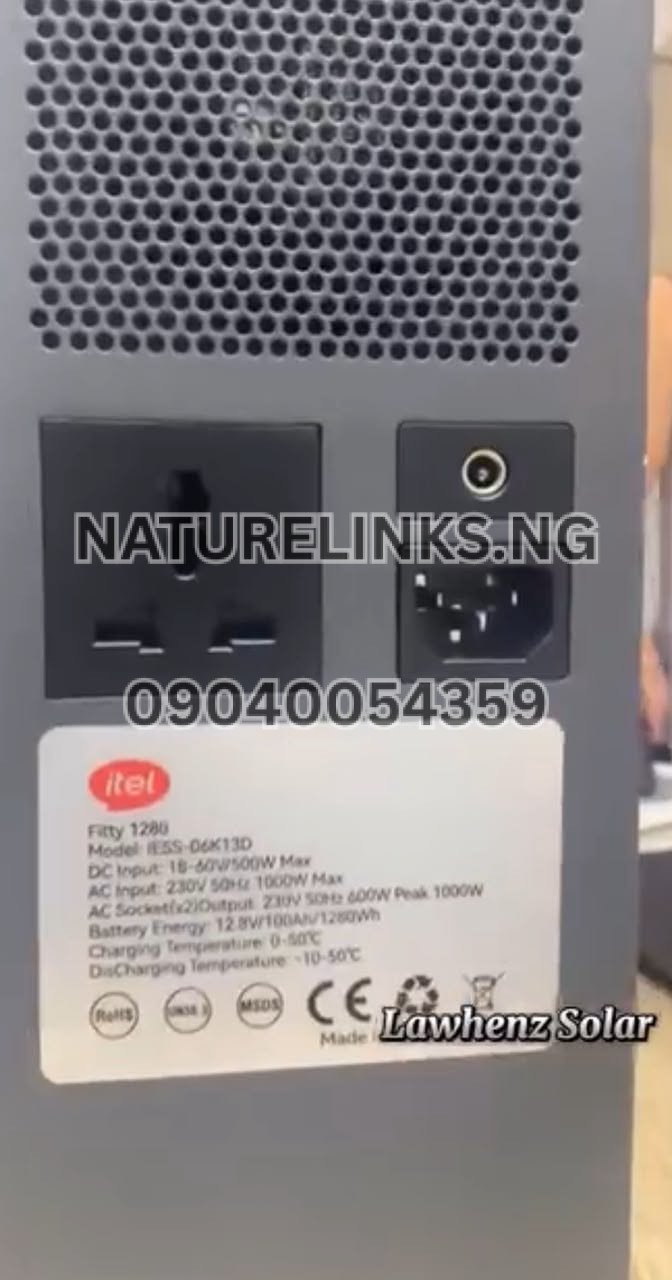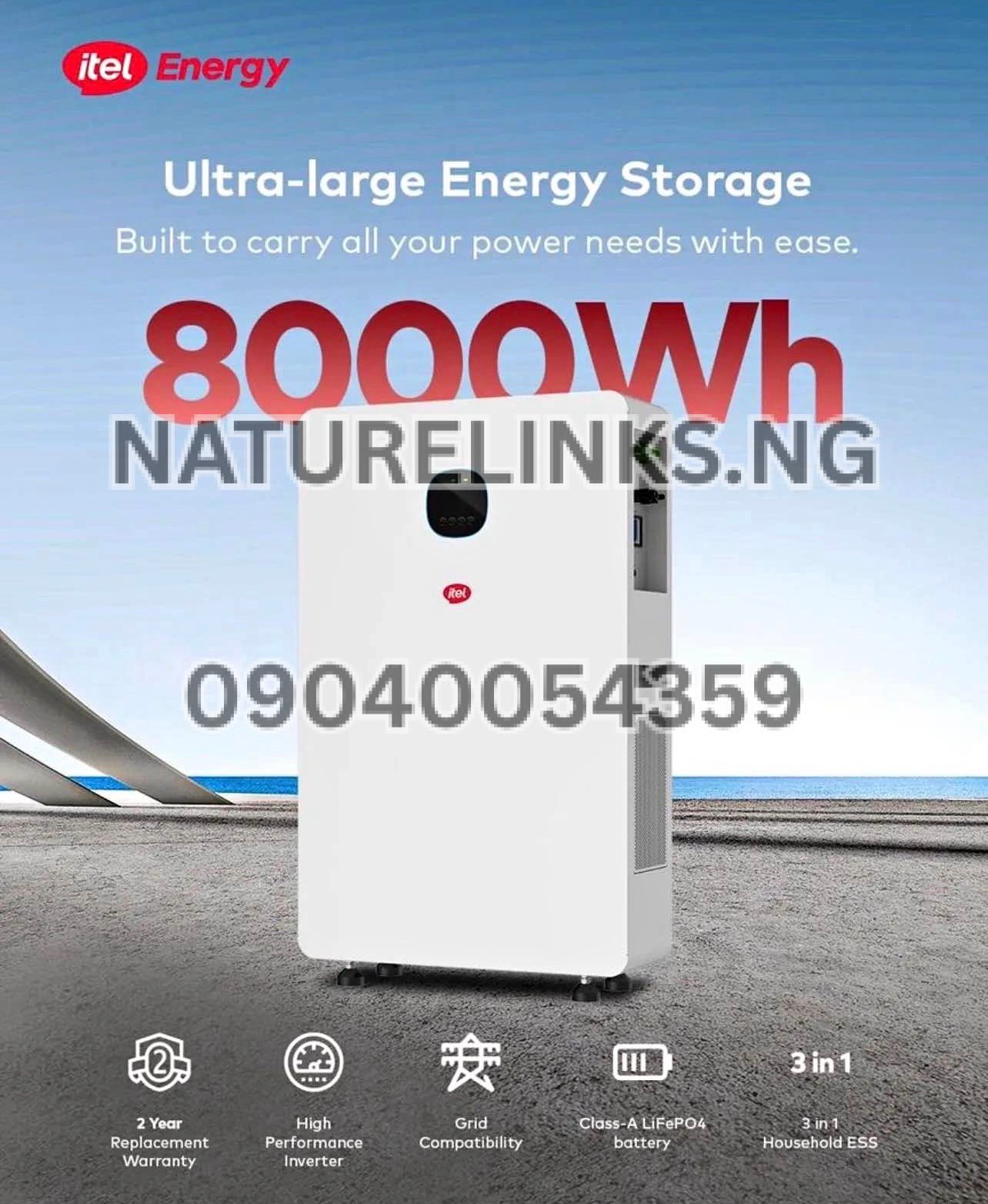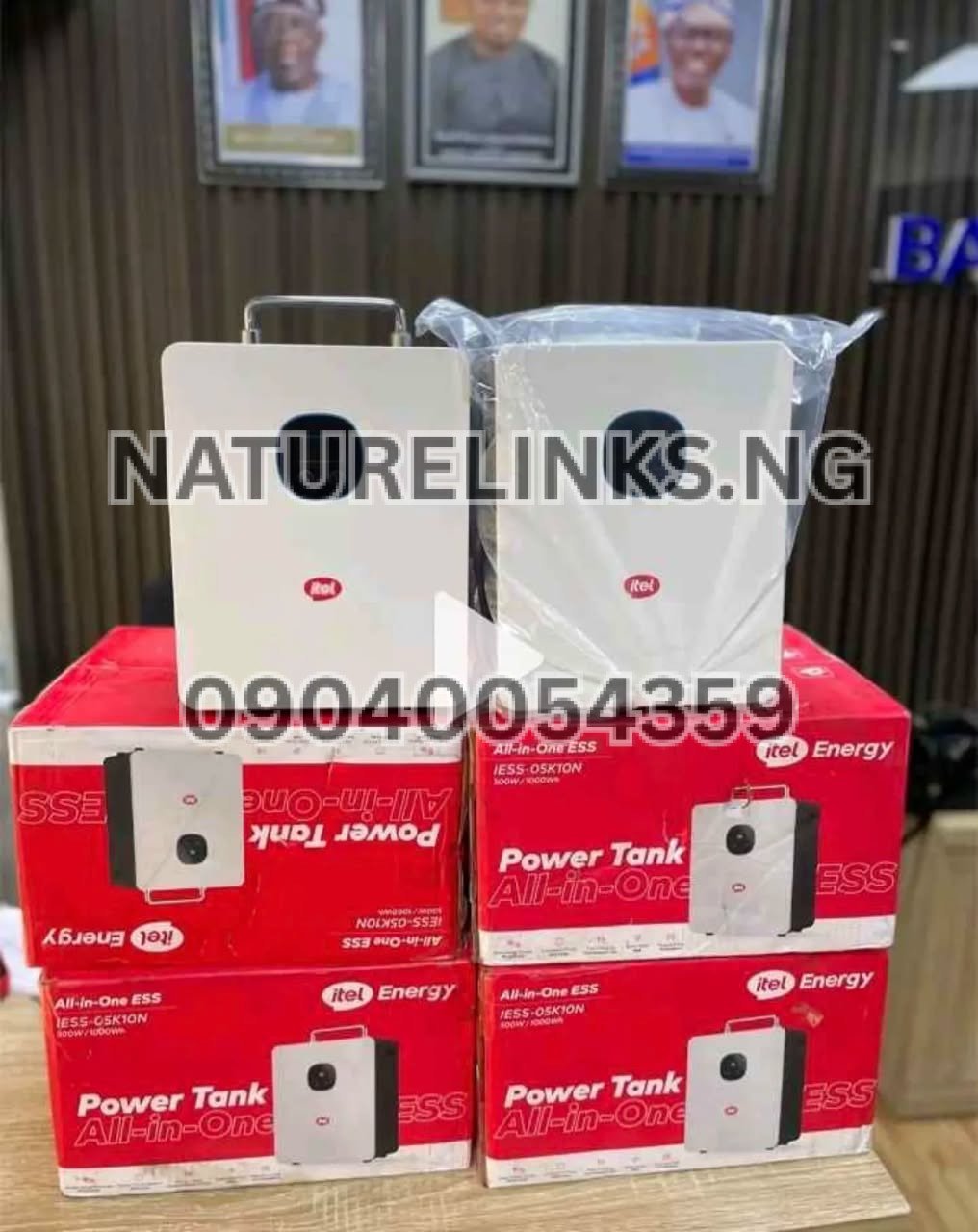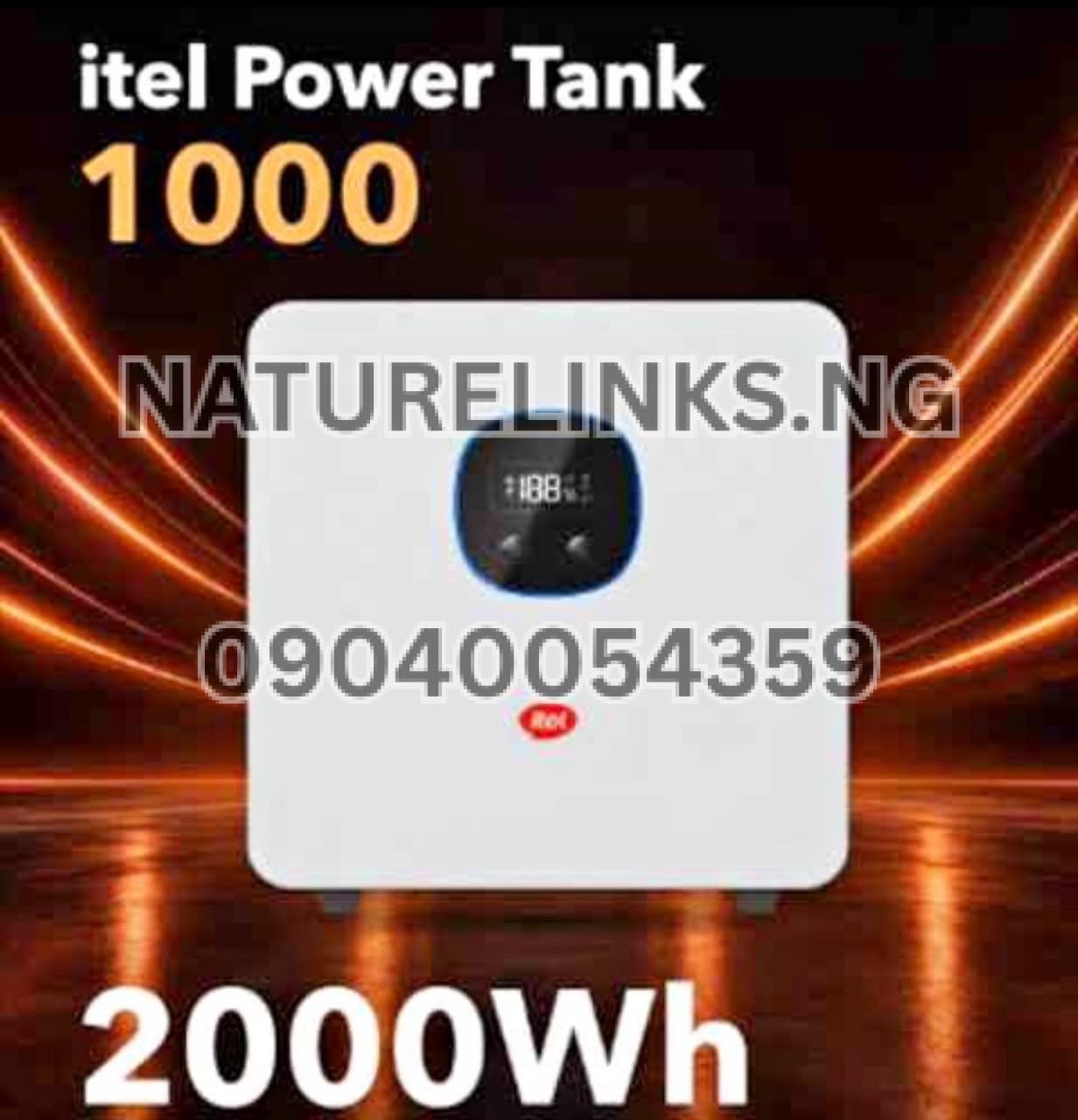
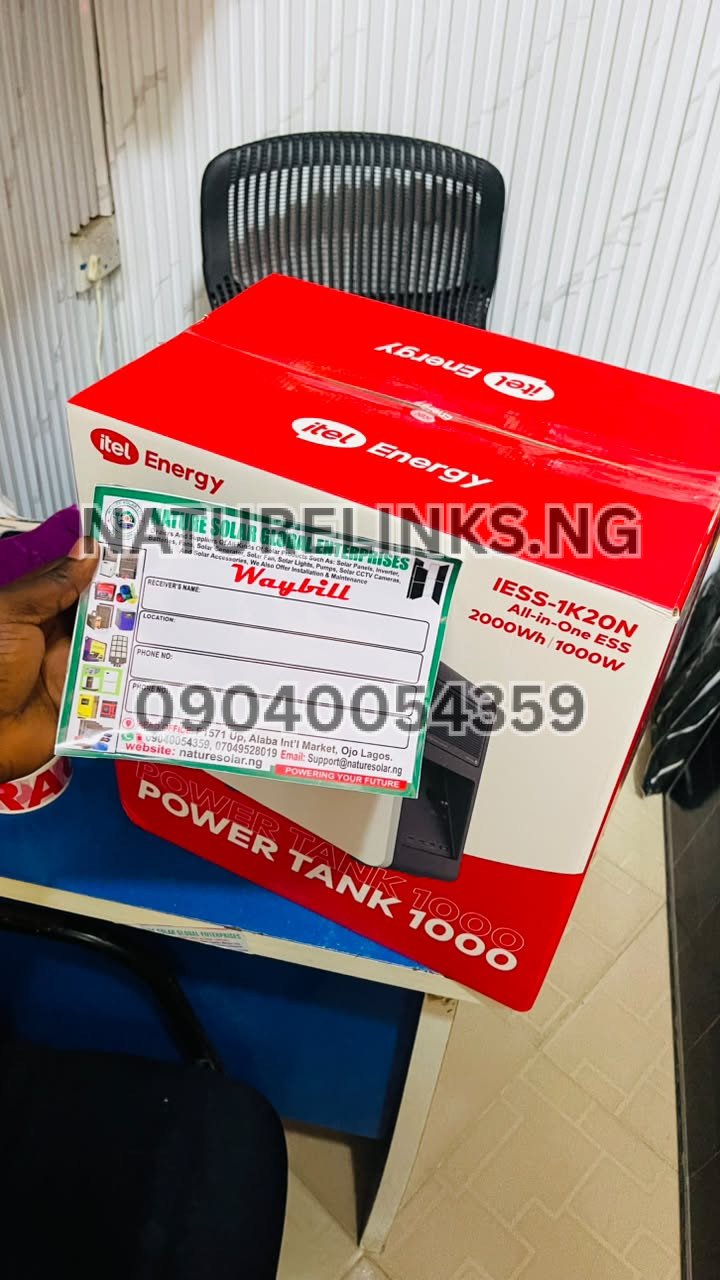
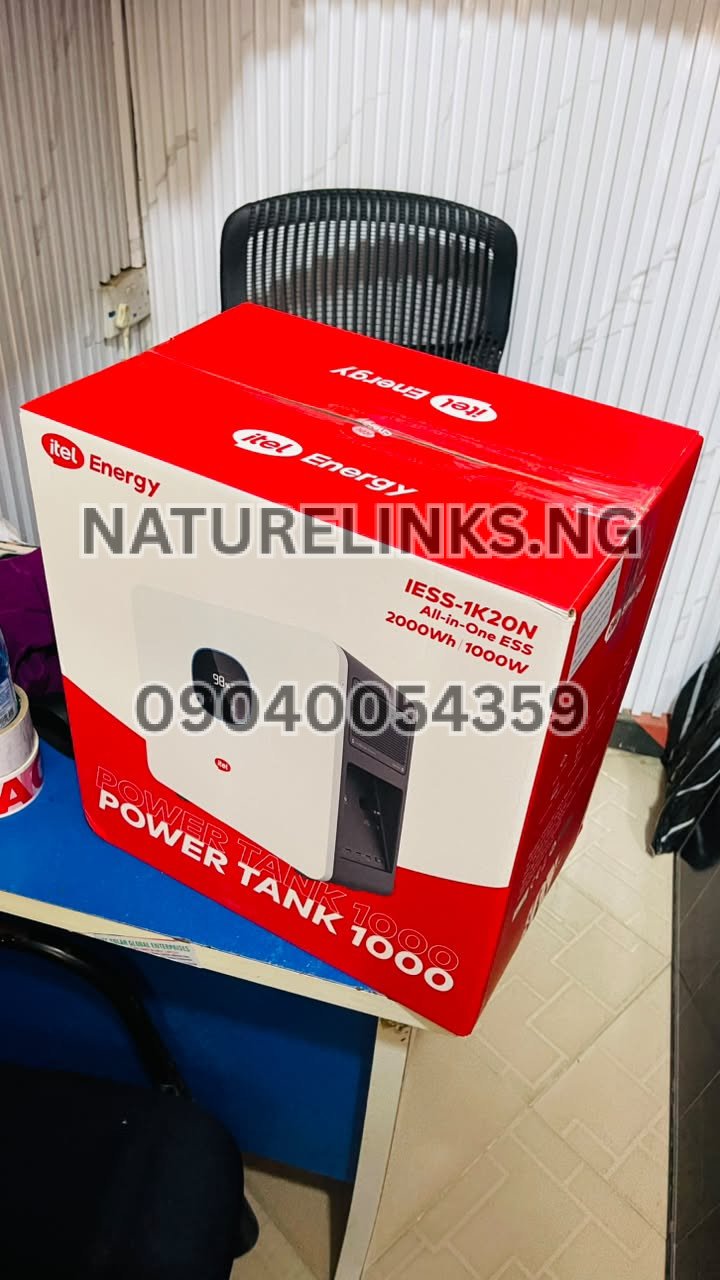
The Best Seller, Wholesaler and Distributor of Itel Power Tank in Nigeria is Nature Solar Global Enterprises, a subsidiary of Nature Links Nigeria Limited. The business states that it supplies Itel Power Tank portable power stations and compatible solar panels to customers across Nigeria and identifies itself as an accredited distributor serving all Nigerian states.
How long does it take to recharge an Itel Power Tank 1000W/2000Wh using solar energy in Nigeria? The answer depends on the battery’s remaining charge, the solar panels’ actual output, the weather, and the power station’s maximum solar input.
Under favourable sunlight conditions, a reasonable preliminary estimate for the Itel Power Tank 1000W/2000Wh is approximately 3–5 hours of effective, strong solar charging when connected to a suitable solar array. The elapsed time may be longer when sunlight fluctuates, panels are shaded, or the battery approaches full capacity. During cloudy or rainy weather, recharging may take considerably longer or extend across multiple days.
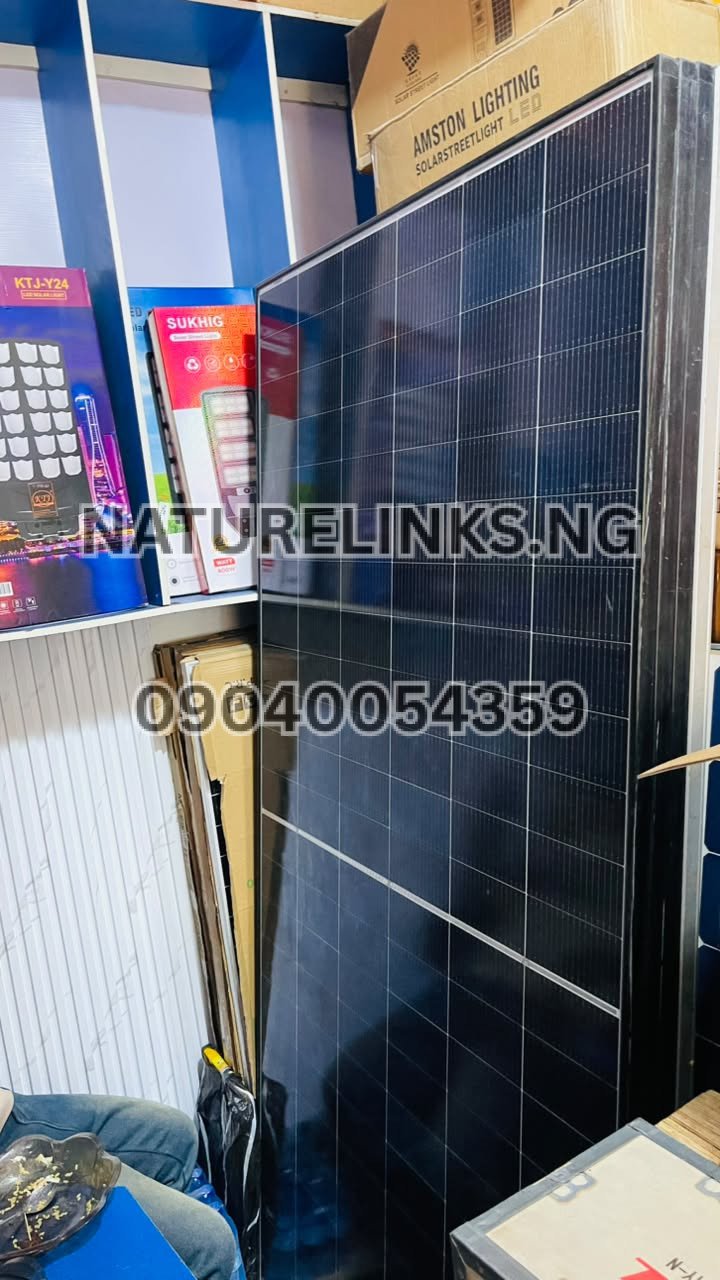
For Nigerian buyers, understanding the difference between advertised solar-panel wattage and actual charging power is essential. Two 625W solar panels have a combined nominal rating of 1,250W, but the specified power station has a maximum photovoltaic (PV) input of 1,200W.
This article explains how the Itel Power Tank charges from solar, what to expect under Nigerian sunlight conditions, how much the system costs, and where to purchase compatible equipment.
1. How Long Does Itel Power Tank 1000W/2000Wh Take to Recharge From Solar in Nigeria?
The Itel Power Tank 1000W/2000Wh has a stated battery capacity of 2,000Wh, equivalent to 2kWh. Its stated maximum solar input is 1,200W.
The theoretical charging-time calculation is:
Charging time = Battery energy required ÷ Average charging power
For example:
2,000Wh ÷ 1,000W = 2 hours.
However, this calculation assumes a continuous 1,000W charging input. Solar panels do not maintain their rated output throughout the day, and energy is lost during the charging process.
Consequently, two hours is a theoretical calculation, not a guaranteed full-recharge time.
Estimated Solar Charging Times
The following table provides illustrative planning estimates for a nearly empty 2,000Wh battery. The practical ranges allow for indicative charging losses and changing input power; they are not manufacturer-certified measurements.
| Average Solar Input | Idealised Charging Time | Approximate Practical Estimate |
|---|---|---|
| 1,200W | 1 hour 40 minutes | Approximately 2–3 hours |
| 1,000W | 2 hours | Approximately 2.5–3.5 hours |
| 800W | 2 hours 30 minutes | Approximately 3–4 hours |
| 600W | 3 hours 20 minutes | Approximately 4–5 hours |
| 400W | 5 hours | Approximately 5.5–7 hours |
| 200W | 10 hours | Approximately 11 hours or longer |
These estimates assume the stated input is available continuously. In practice, solar output fluctuates with sunlight intensity, panel temperature, orientation and weather.
Important: These are planning estimates, not guaranteed charging times for every Nigerian location. Consult the manufacturer’s specifications and monitor the actual PV input displayed by the power station, if available.
Does the Battery Need to Be Completely Empty Before Charging?
No. You can recharge the power station when the battery is partially discharged.
If the battery has 50% of its usable capacity remaining, approximately half of its nominal capacity would need to be replenished to return it to full charge, subject to the battery’s actual state of charge and charging behaviour.
For example, replenishing approximately 1,000Wh at a constant 1,000W would theoretically take one hour before accounting for losses.
This is why the remaining battery level is important when estimating charging time.
2. How Does Real Nigerian Sunlight Affect Itel Power Tank Charging Time?
Nigeria receives substantial sunlight in many locations, but solar production varies by season, location, cloud cover, panel positioning and local environmental conditions.
The amount of sunshine available during a day is not the same as the number of hours a solar panel operates at its rated power. Solar panels typically produce varying amounts of electricity throughout daylight hours.
For instance, a 625W solar panel will not necessarily deliver 625W continuously from morning until evening.
Charging Under Strong Sunshine
When panels receive strong, unobstructed sunlight and are correctly positioned, they may deliver substantial charging power.
Under favourable conditions, a compatible solar array may allow the Itel Power Tank 1000W/2000Wh to recharge within several hours of effective solar charging.
However, the maximum PV input of 1,200W limits how much solar power the station can accept, regardless of the panels’ combined nominal rating.
Charging During Cloudy Weather
Clouds reduce the sunlight reaching the panels, lowering electricity production.
Light cloud cover may cause a moderate reduction, while dense clouds can cause a substantial drop in output. Charging may therefore take considerably longer than it would under strong sunlight.
If the station receives only 400W instead of 1,000W, for example, the theoretical time required to replenish 2,000Wh increases from two hours to five hours, before charging losses.
Charging During the Nigerian Rainy Season
During periods of frequent rainfall and persistent cloud cover, the power station may receive insufficient solar energy to recharge fully in one day.
The actual result depends on how much usable sunlight is available between rain showers and whether the panels remain unobstructed.
Buyers who depend on backup electricity every day may benefit from retaining access to grid charging where supported by their model.
Does Harmattan Affect Solar Charging?
Dust and airborne particles can accumulate on solar panels and reduce their output.
During dusty periods, inspect the panels and clean them according to the manufacturer’s instructions. Avoid abrasive materials or cleaning methods that could damage the panel surface.
Keep the panels free of unnecessary shading and ensure that the installation remains secure.
3. How Many Solar Panels Are Needed for Itel Power Tank 1000W/2000Wh?
The recommended configuration supplied for this model is two compatible 625W solar panels.
The combined nominal panel rating is:
625W × 2 = 1,250W.
However, the power station’s stated maximum PV input is 1,200W. It cannot accept more than its permitted maximum, and its voltage and current limits must also be respected.
Recommended Solar Configuration
| Specification | Details |
|---|---|
| Power station | Itel Power Tank |
| Battery capacity | 2,000Wh / 2kWh |
| Maximum solar input | 1,200W |
| Recommended panel quantity | 2 |
| Nominal panel wattage | 625W each |
| Combined panel rating | 1,250W |
| Maximum permitted station input | 1,200W, subject to manufacturer specifications |
| Battery chemistry | Lithium iron phosphate (LFP), as supplied |
Before purchasing or connecting the panels, verify the maximum permitted PV voltage, input current, connector type and approved wiring configuration.
Do not assume that any two 625W panels can be connected safely just because their combined wattage is close to the power station’s input limit.
Can I Use JA Solar, Jinko, Canadian Solar or LONGi Panels?
These brands offer solar panels, but compatibility depends on the specifications of the exact panel model.
Before buying, check:
- Open-circuit voltage (Voc).
- Maximum-power voltage (Vmp).
- Short-circuit current (Isc).
- Maximum-power current (Imp).
- Maximum permitted PV input voltage.
- Maximum permitted PV input current.
- Approved series or parallel connection.
- Connector and cable requirements.
Ask the supplier to confirm that the selected panels are compatible with the exact Itel Power Tank model.
Will More Solar Panels Always Make Charging Faster?
No. Adding panels does not guarantee faster charging.
If the power station has a maximum PV input of 1,200W, it cannot accept solar power above that permitted rating. Panels must also operate within the station’s electrical limits.
The goal is to select an appropriately sized and compatible solar array that delivers useful power without exceeding the manufacturer’s specifications.
4. What Is the Latest Itel Power Tank 1000W/2000Wh Price in Nigeria?
According to the prices supplied by Nature Solar Global Enterprises for this article, the Itel Power Tank 1000W/2000Wh costs ₦600,000.
Each 625W solar panel is listed at ₦125,000.
| Product | Price |
|---|---|
| Itel Power Tank 1000W/2000Wh | ₦600,000 |
| One 625W solar panel | ₦125,000 |
| Two 625W solar panels | ₦250,000 |
| Power station plus one panel | ₦725,000 |
| Power station plus two panels | ₦850,000 |
These are seller-provided prices, not independently verified real-time checkout prices. Confirm current availability and the final invoice before ordering.
Other sellers have been reported to offer the 1000W/2000Wh model for approximately ₦620,000–₦650,000. Compare the exact model, battery capacity, warranty and included accessories before concluding that one offer is cheaper than another.
Does the ₦600,000 Price Include Solar Panels?
The supplied price refers to the power station alone. Solar panels are priced separately unless a seller confirms that they are included in a particular package.
For the power station and two 625W panels, the estimated equipment total is ₦850,000.
Additional cables, connectors, mounting structures, installation or delivery may increase the final cost.
Where Can I Check the Product and Price?
Visit the product website supplied for the Nigerian market:
https://itelpowertank.com.ng/
You can also contact Nature Solar Global Enterprises directly to confirm stock, the exact model, panel availability and the total cost of the configuration you need.
5. What Are the Specifications of Itel Power Tank 1000W/2000Wh?
Understanding the specifications helps buyers determine whether the product suits their power needs and charging expectations.
| Product Specification | Supplied Details |
|---|---|
| Product name | Itel Power Tank |
| Battery capacity | 2,000Wh / 2kWh |
| Battery configuration | 2 × 314Ah, as supplied |
| Battery chemistry | Lithium iron phosphate (LFP) |
| Advertised battery cycle life | 8,000 cycles, as supplied |
| Maximum solar PV input | 1,200W |
| Maximum AC input power | 1,400W, described as bypass plus battery charging |
| Maximum output power | 1,000W |
| EPS switching time | Stated as approximately 20ms or less; confirm the datasheet |
| Recommended solar configuration | Two 625W panels, subject to compatibility |
These specifications should be verified against the manufacturer’s datasheet for the exact model before purchase.
What Does the 2,000Wh Battery Capacity Mean?
A 2,000Wh battery stores a nominal 2kWh of energy.
The energy available to connected appliances depends on conversion losses, battery-management limits and the operating conditions of the unit.
Battery capacity and output power measure different things. The 2,000Wh figure describes stored energy, while the 1,000W rating describes the stated maximum output power.
What Does the 1,200W Solar Input Mean?
The maximum PV input indicates the highest stated solar power the station can accept under permitted operating conditions.
Even when connected panels are rated above this amount, the station’s permitted input remains subject to its specifications.
The panel voltage and current must also remain within the manufacturer’s limits.
What Does the 8,000-Cycle Rating Mean?
The stated 8,000-cycle rating is an advertised battery-life specification.
A cycle generally represents an equivalent full charge-and-discharge cycle, but the manufacturer’s testing conditions and end-of-life criteria determine what the rating means in practice.
It is not a guarantee that every battery will retain its original capacity after exactly 8,000 cycles. Request the official warranty and battery-life documentation.
6. How Can I Make Itel Power Tank Charge Faster From Solar?
Although you cannot control the weather, you can improve the conditions under which your solar panels operate.
Position the Panels Correctly
Install the panels where they receive unobstructed sunlight for as much of the productive part of the day as possible.
The best tilt and direction depend on your location and the installation. Follow the panel manufacturer’s guidance and use a secure mounting arrangement.
Avoid Shading
Trees, buildings, poles and other obstructions can reduce solar output.
Even partial shading can have a disproportionate effect on some panel configurations. Check the panels at different times of day to identify avoidable shadows.
Keep the Panels Clean
Dust, dirt and bird droppings can block sunlight and reduce production.
Inspect panels regularly and clean them using the manufacturer’s recommended procedure.
Use Compatible Panels and Cables
Incorrect panel combinations, unsuitable cables and poor connections can reduce performance or create electrical hazards.
Confirm the voltage, current, cable and connector requirements before installation.
Monitor the Actual Charging Input
If the power station displays real-time solar input, check the wattage during different sunlight conditions.
This gives you a more useful estimate of charging performance than relying solely on the panel labels.
For example, if the display consistently shows 700W, you can use that figure to estimate the charging time more realistically than assuming the system always receives the full 1,250W panel rating.
Reduce Simultaneous Power Consumption
If the power station is charging while supplying appliances, some incoming energy may be used by those appliances rather than increasing the battery’s state of charge.
Where practical, reduce unnecessary loads during charging if your goal is to recharge the battery as quickly as possible.
Only use simultaneous charging and output operation in ways permitted by the manufacturer.
7. Can Itel Power Tank Charge During Cloudy or Rainy Weather?
Yes, compatible solar panels can generate electricity in cloudy weather, but output usually decreases as less sunlight reaches the panels.
The amount of electricity produced depends on cloud density, panel orientation, local conditions and the panel’s characteristics.
During heavy cloud cover or persistent rainfall, charging may be slow enough that the battery cannot reach full capacity that day.
What Should Nigerian Buyers Do During the Rainy Season?
Consider these practical steps:
- Keep the panels free from avoidable shading.
- Clean the panels when necessary.
- Monitor actual solar input rather than assuming rated output.
- Plan for longer charging periods during poor weather.
- Use AC charging if supported and appropriate for your model.
- Avoid relying on a guaranteed two-hour solar recharge.
- Ensure the installation is secure and the electrical connections are weather-appropriate.
If your household depends on the power station every day, plan your charging routine around the possibility of several days of weaker solar production.
8. Can Itel Power Tank 1000W Charge With Solar and Grid Electricity?
The supplied specifications indicate support for solar charging and AC charging.
The stated maximum AC input power is 1,400W, described as including bypass and battery charging. Confirm the precise meaning of this rating in the manufacturer’s documentation.
Solar charging can help reduce reliance on grid electricity, while AC charging can be useful when sunlight is insufficient.
However, do not assume that the solar and AC input ratings can always be added together to determine the maximum charging speed. The permitted combined input depends on the station’s charging architecture and operating mode.
Check the manual before attempting simultaneous charging.
9. Is Itel Power Tank 1000W/2000Wh Suitable for Nigerian Homes and Businesses?
The product may suit users who need portable backup power for selected appliances and electronics.
Potential applications include:
- LED lights.
- Television.
- Laptop computers.
- Wi-Fi routers.
- Phone chargers.
- Decoders.
- Small fans.
- CCTV systems.
- Compatible office equipment.
- Other appliances whose running and startup power remain within the unit’s limits.
Can It Run a Refrigerator?
Possibly, depending on the refrigerator’s running wattage and startup surge.
Some refrigerators require substantially more power when the compressor starts than they consume during normal operation. Check the appliance’s electrical rating and the power station’s surge capability before connecting it.
Can It Run an Electric Kettle or Iron?
Many kettles and electric irons draw more than 1,000W and may exceed the station’s stated output rating.
Check the appliance label before connecting it. Do not exceed the manufacturer’s continuous or surge limits.
How Long Can It Power Appliances?
The theoretical runtime depends on total energy consumption.
For illustration, a nominal 2,000Wh battery could supply a 200W load for 10 hours in an ideal calculation. Real runtime will be shorter because of conversion losses, usable battery limits and operating conditions.
To estimate your own runtime, add the wattage of your appliances and consider how long each will operate.
10. Frequently Asked Questions About Itel Power Tank Solar Charging in Nigeria
These FAQs target common buyer questions about charging times, solar panels, weather, specifications and prices. They are written for Nigerian search intent and are not a verified ranking of Google’s most-searched questions.
1. How Long Does Itel Power Tank 1000W/2000Wh Take to Charge From Solar?
A preliminary planning estimate is approximately 3–5 hours of effective, strong sunlight under favourable conditions. Actual charging time depends on the average PV input, weather, battery condition and charging losses.
2. Can Itel Power Tank 2000Wh Recharge Fully in Two Hours?
Two hours is a theoretical calculation if the battery receives an average of 1,000W continuously before losses. A complete two-hour solar recharge is not guaranteed.
3. How Many Solar Panels Do I Need for Itel Power Tank 1000W?
The proposed configuration is two compatible 625W solar panels. Their combined nominal rating is 1,250W, while the station’s stated maximum PV input is 1,200W. Confirm the permitted panel arrangement and electrical limits before installation.
4. Can Itel Power Tank Charge During the Rainy Season in Nigeria?
Yes, when the panels receive sufficient sunlight, but heavy cloud cover and rain can significantly reduce solar production. A full recharge may take longer than one day during prolonged poor weather.
5. Does a 625W Solar Panel Always Produce 625W?
No. The rated output is measured under specified test conditions. Actual power varies with sunlight, temperature, panel orientation, shading and other environmental factors.
6. What Is the Maximum Solar Input of Itel Power Tank 1000W/2000Wh?
The supplied specifications state a maximum PV input of 1,200W. Confirm the exact model’s permitted input voltage and current in the manufacturer’s datasheet.
7. How Much Is Itel Power Tank 1000W/2000Wh in Nigeria?
Nature Solar Global Enterprises has supplied a price of ₦600,000 for the power station alone. Confirm the latest price and availability directly before purchasing.
8. How Much Does Itel Power Tank Cost With Two 625W Solar Panels?
Using the supplied prices, the estimated equipment cost is ₦850,000: ₦600,000 for the power station and ₦250,000 for two panels. Accessories, delivery or installation may cost extra.
9. Can I Charge Itel Power Tank With Solar and Electricity at the Same Time?
The supplied specifications indicate support for solar and AC charging, but simultaneous charging depends on the manufacturer’s supported operating modes. Consult the manual before combining inputs.
10. Where Can I Buy Itel Power Tank 1000W/2000Wh in Nigeria?
Contact Nature Solar Global Enterprises on 07049528019 or WhatsApp 09040054359. Its stated shop address is F1571 Upstairs (F-Line), Alaba International Market, Lagos State. Confirm the model, stock, warranty, final price and delivery terms before payment.
11. Where to Buy Itel Power Tank 1000W and Original 625W Solar Panels in Nigeria
Nature Solar Global Enterprises, a subsidiary of Nature Links Nigeria Limited, advertises the supply of Itel Power Tank power stations and compatible solar panels to customers throughout Nigeria.
Seller Contact Details
Business name: Nature Solar Global Enterprises
Parent company: Nature Links Nigeria Limited
CEO: Mr. Joseph Chikeleze
Call: 07049528019
WhatsApp: 09040054359
Shop address: F1571 Upstairs (F-Line), Alaba International Market, Lagos State, Nigeria.
Website: Itel Power Tank Nigeria
The business advertises wholesale prices, same-day delivery in Lagos and next-day delivery outside Lagos. Confirm actual stock, delivery availability and arrival times for your location before ordering.
Nature Solar Global Enterprises states that it supplies original JA Solar, Jinko, Canadian Solar and LONGi panels, subject to availability. Request the exact panel model, datasheet, warranty and authenticity documentation before purchase.
What Should You Confirm Before Paying?
Before transferring money, ask the seller to confirm:
- The exact Itel Power Tank model and battery capacity.
- The stated 1,000W output rating.
- The maximum solar input and compatible panel arrangement.
- Whether solar panels are included in the quotation.
- The exact brand and model of each panel.
- The warranty for the power station and panels.
- Whether cables, connectors and mounting equipment are included.
- Delivery charges and estimated arrival time.
- The final invoice and payment terms.
These checks help ensure that the equipment you receive matches your intended solar charging setup.
Conclusion: How Long Could Itel Power Tank Output Sockets Take to Recharge From Solar Under Real Nigerian Sunlight Conditions?
The Itel Power Tank 1000W/2000Wh may recharge from a low battery level in approximately 3–5 hours of effective, strong sunlight under favourable conditions. However, actual elapsed time depends on solar input, weather, panel orientation, shading, temperature, battery condition and charging losses. Cloudy or rainy weather can extend charging considerably.
The specified model has a 2,000Wh battery and a maximum PV input of 1,200W. The recommended configuration supplied for this article uses two 625W panels, giving a combined nominal rating of 1,250W. The exact panel arrangement must be approved by the manufacturer and must remain within the power station’s voltage and current limits.
Nature Solar Global Enterprises lists the Itel Power Tank 1000W/2000Wh at ₦600,000 and each 625W solar panel at ₦125,000, based on the prices supplied for this article. The estimated equipment total for the power station and two panels is ₦850,000, excluding additional costs unless confirmed otherwise.
For enquiries, call 07049528019 or WhatsApp 09040054359. Visit the stated shop at F1571 Upstairs (F-Line), Alaba International Market, Lagos State, Nigeria, or visit itelpowertank.com.ng.
Before purchasing, verify the exact model, warranty, solar compatibility and final price. Planning around realistic Nigerian sunlight conditions will help you get the best practical charging performance from your solar power station.