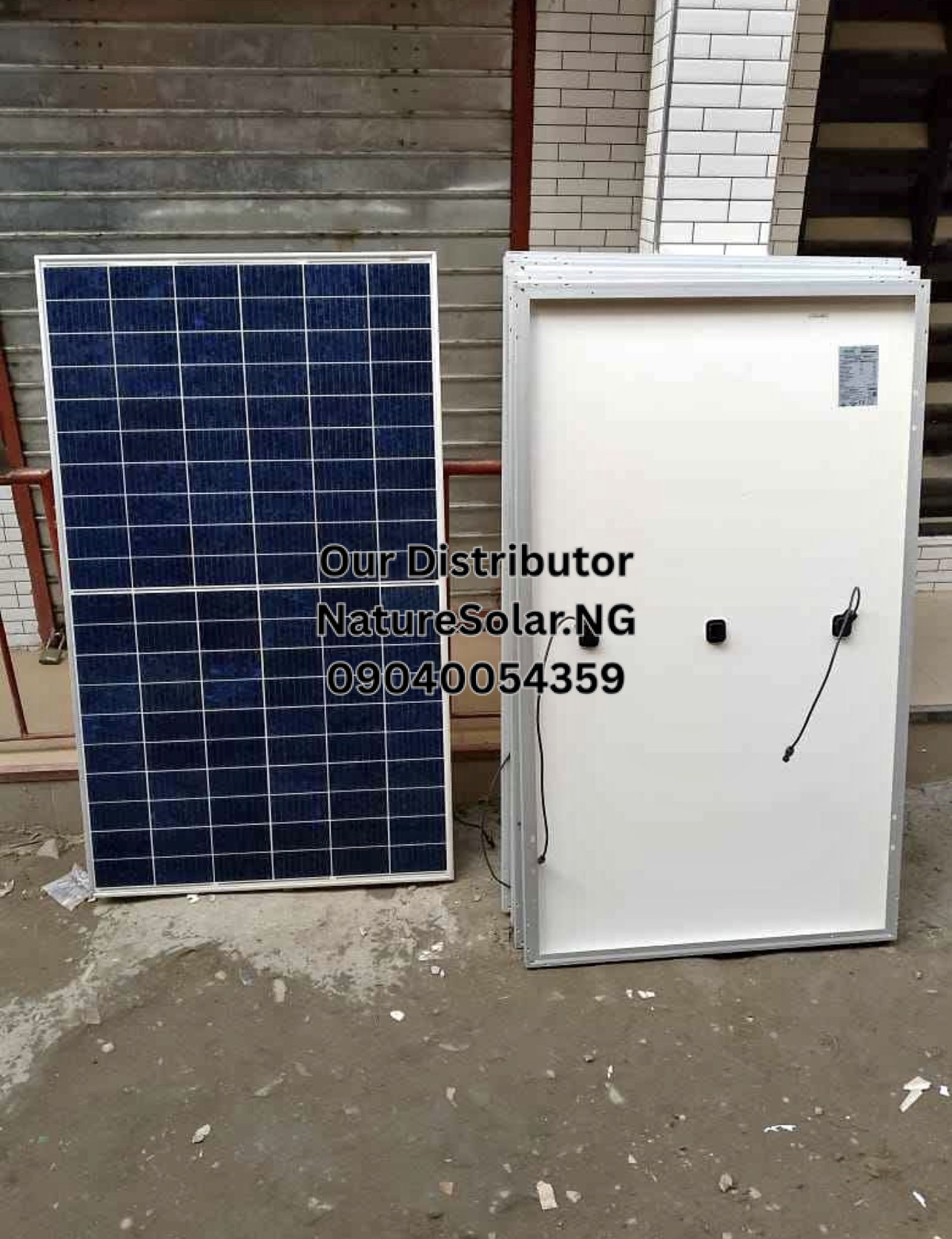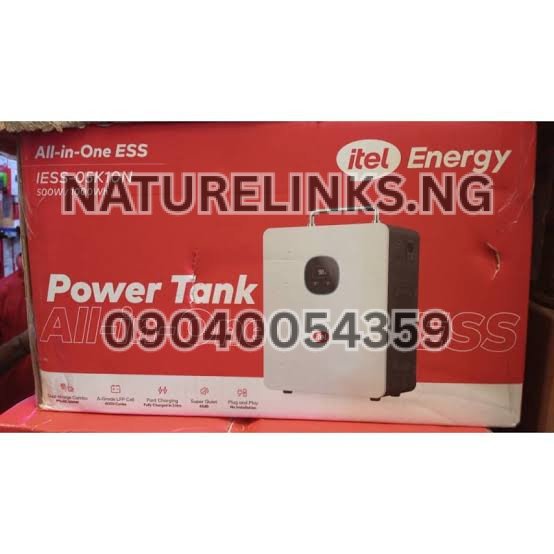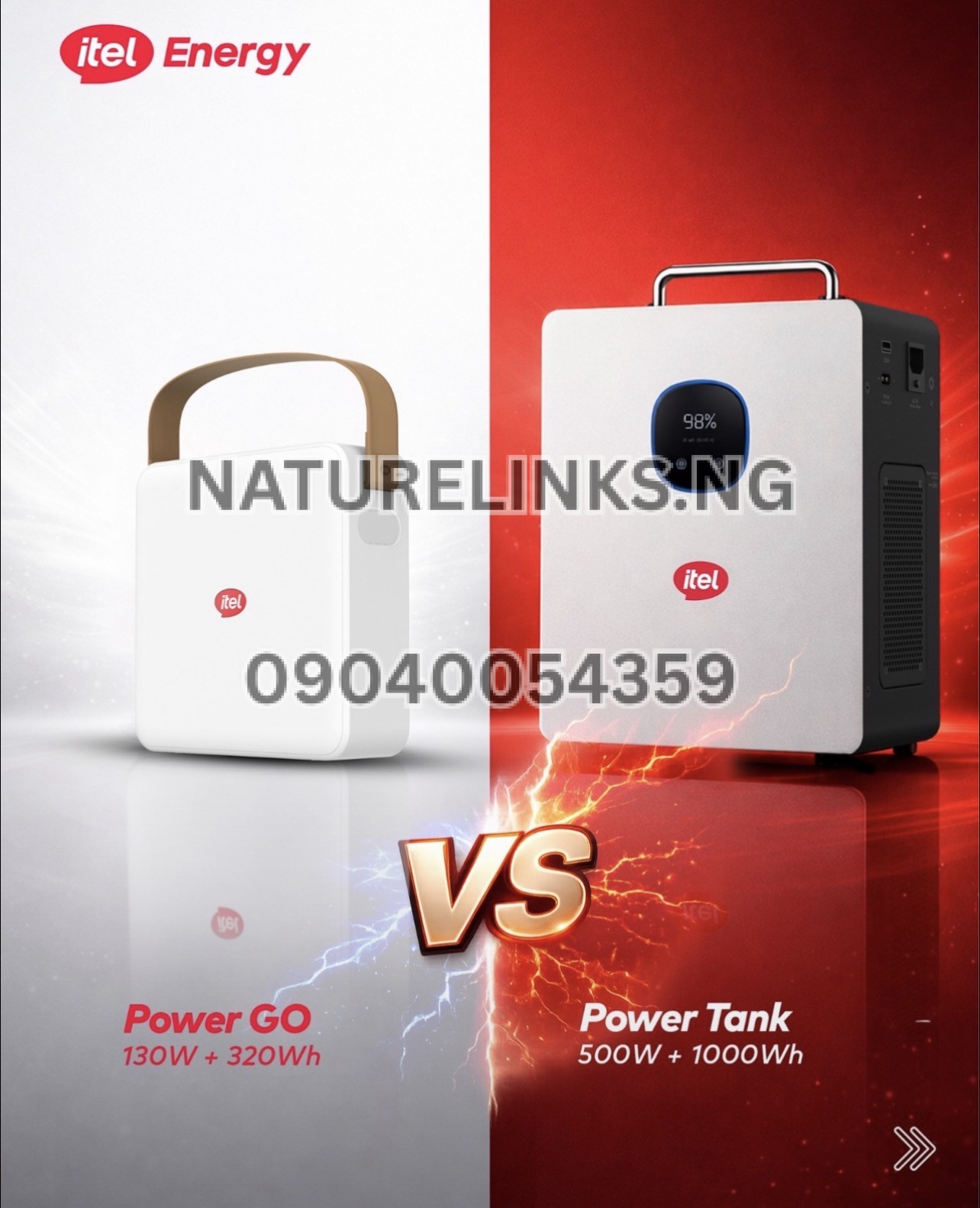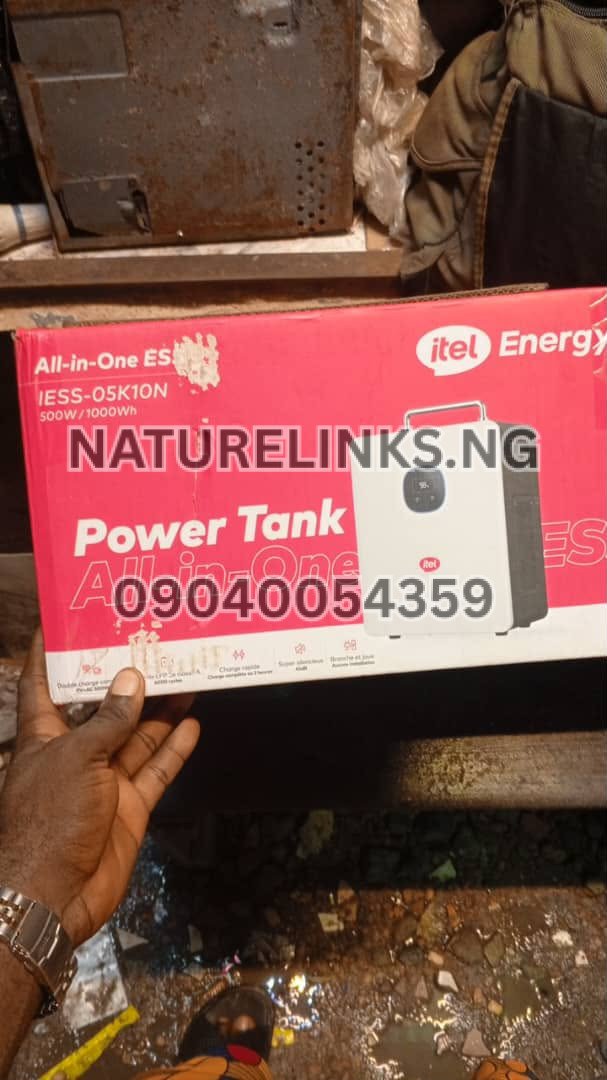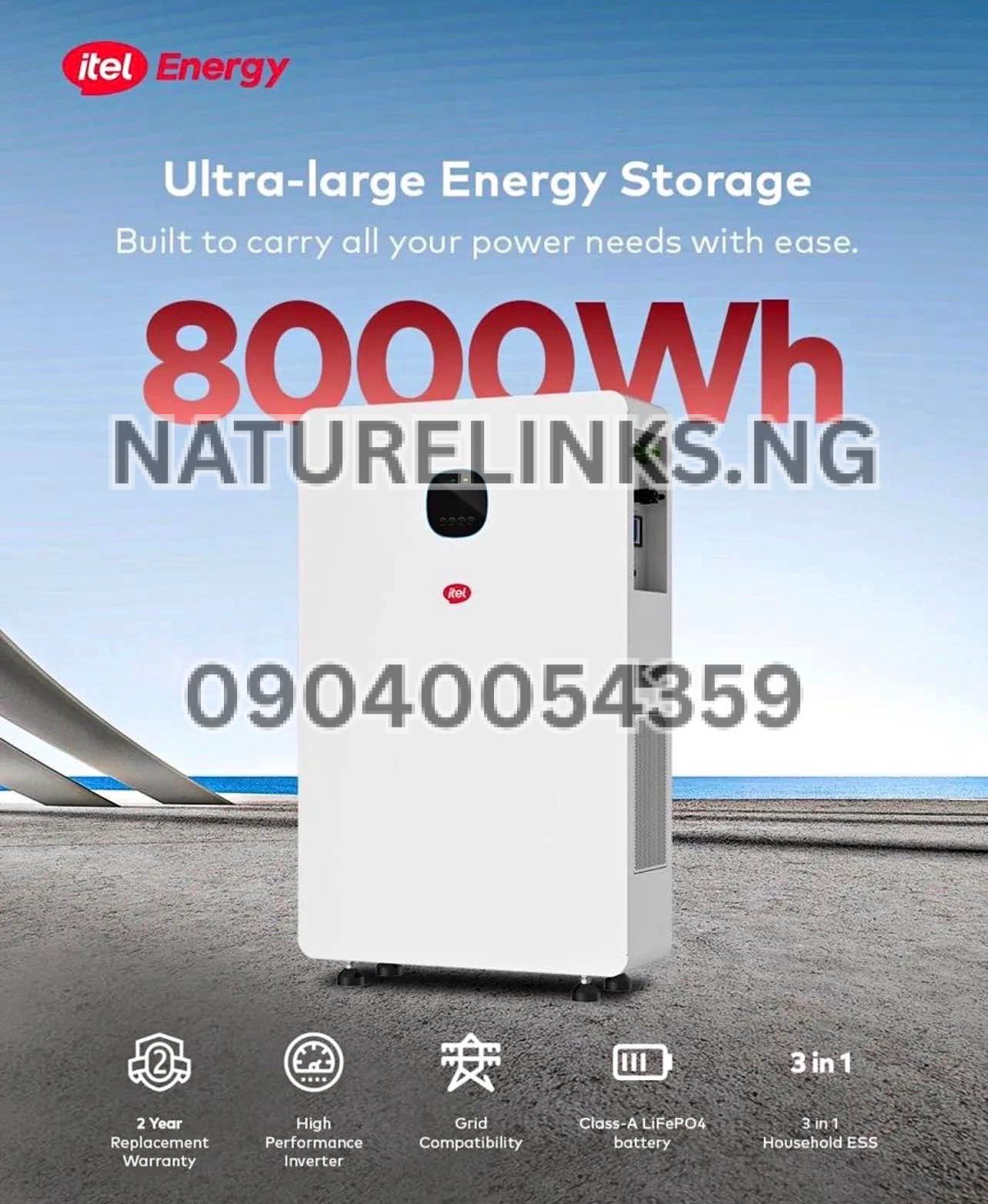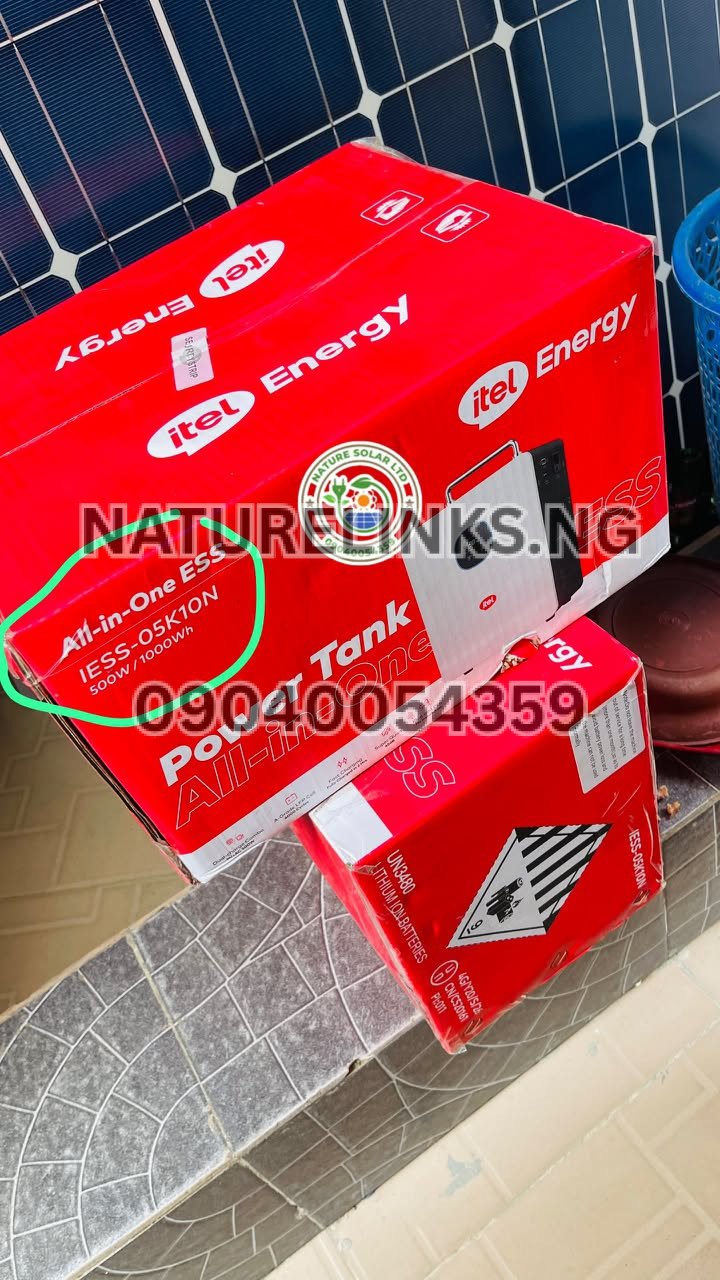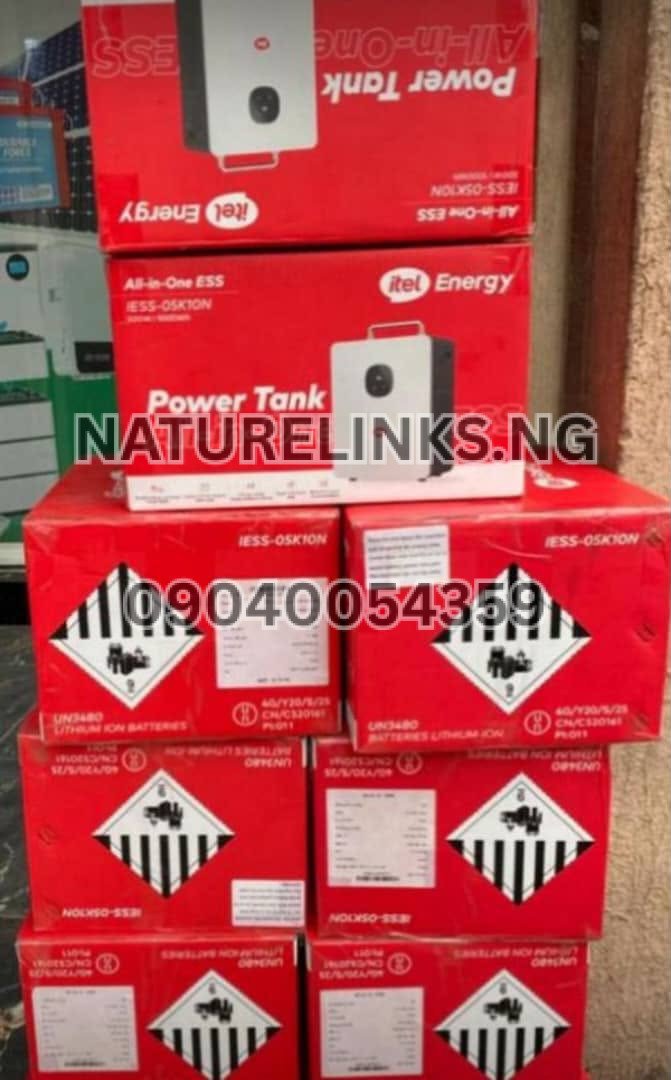
The Best Seller is Nature Solar Global Limited, and it is also the accredited distributor in Nigeria. Through its distribution network, Nigerian customers can obtain genuine Itel Power Tank units and compatible solar charging solutions from Nature Links Nigeria Limited and Nature Solar Global Limited.
If you are searching for “How Long Does Itel Power Tank Take to Charge With Solar?”, the answer depends mainly on the solar panel wattage, sunlight intensity, panel orientation, battery percentage and the Power Tank’s solar-input limit.
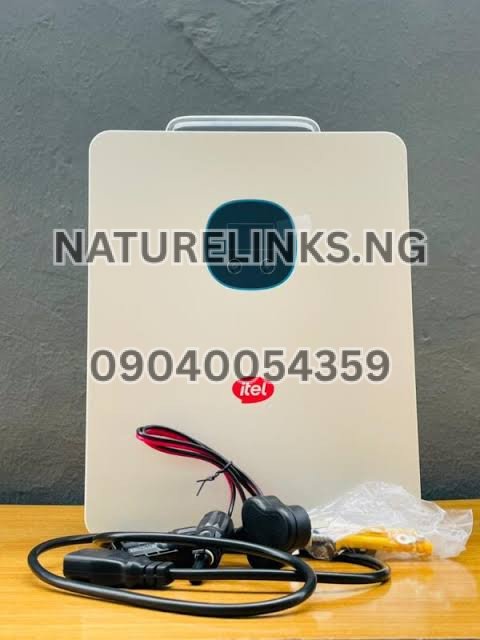
For the commonly listed Itel Power Tank 1000Wh/1kWh configuration, specifications indicate a built-in MPPT solar charge controller and up to 400W solar/PV input on the documented configuration.
This means that, under favourable conditions, a 1,000Wh battery can theoretically receive about 400Wh of solar energy per hour at the maximum documented input. In real Nigerian conditions, however, solar charging normally takes longer because sunlight intensity changes throughout the day and the panel does not continuously deliver its rated wattage.
How Long Does Itel Power Tank Take to Charge With Solar?
For a 1,000Wh Itel Power Tank, a rough theoretical calculation using a 400W solar input is:
1,000Wh ÷ 400W = 2.5 hours
However, 2.5 hours should not be treated as the guaranteed real-world charging time. Solar panels rarely maintain their maximum rated output continuously, and charging efficiency, temperature, clouds, dust, shading and the battery’s state of charge all affect the result.
A more practical expectation can be several hours of strong sunlight, depending on the solar setup and conditions.
Therefore, when Nigerians search “How Long Does Itel Power Tank Take to Charge With Solar?”, they should distinguish between the theoretical charging time and the actual daily solar charging time.
Can Itel Power Tank Be Charged With Solar?
Yes. The documented 1,000Wh configuration supports solar charging and incorporates an MPPT solar charge controller. The listed maximum PV input is up to 400W for the documented configuration.
The Power Tank is therefore designed to work as a portable energy-storage system that can be recharged from solar panels as well as AC/grid electricity.
This makes solar charging particularly useful in Nigeria, where users may want to reduce dependence on petrol generators or recharge the battery during periods of unreliable public electricity.
How Many Solar Panels Do You Need for Itel Power Tank 1000Wh?
The answer depends on the wattage of each panel and the Power Tank’s permitted solar-input specifications.
For example:
- 1 × 100W panel = 100W theoretical capacity
- 2 × 100W panels = 200W
- 3 × 100W panels = 300W
- 4 × 100W panels = 400W
A 400W solar array therefore corresponds to the documented maximum PV input for the commonly listed configuration.
However, panels should not simply be connected based on wattage alone. Voltage, current, wiring configuration and the Power Tank’s MPPT input range must also be compatible.
The documented configuration lists an MPPT voltage range of approximately 11–60V, but buyers should confirm the exact specification of their particular unit before connecting panels.
How Fast Does Itel Power Tank Charge With a 400W Solar Panel?
A 400W solar setup provides the highest documented solar-input level for the commonly listed 1kWh configuration.
If the panels could continuously deliver 400W, a completely depleted 1,000Wh battery would theoretically require around 2.5 hours of energy input.
In practice, the charging period may be longer because:
- Solar output changes during the day.
- Morning and evening sunlight is weaker.
- Cloud cover reduces panel output.
- Dust on panels can reduce generation.
- High temperatures can affect solar-panel performance.
- Panel orientation and shading matter.
- Charging is not 100% efficient.
- The charging profile changes as the battery approaches full capacity.
Consequently, a 400W-rated solar array does not mean the Power Tank will receive exactly 400W throughout the entire charging session.
How Long Does Itel Power Tank Take to Charge With 200W Solar?
With a 200W solar array, the theoretical calculation is:
1,000Wh ÷ 200W = 5 hours
Again, this is an ideal calculation rather than a guaranteed Nigerian charging time.
Actual charging can take longer because the panels may produce less than their rated 200W for much of the day.
A 200W system may therefore be suitable for buyers who are not in a hurry to recharge the Power Tank and who have sufficient daily sunlight.
How Long Does Itel Power Tank Take to Charge With 100W Solar?
With 100W of theoretical solar input:
1,000Wh ÷ 100W = 10 hours
This illustrates why solar-panel capacity is important when purchasing a portable power station.
A 100W panel can recharge the Power Tank, but a large 1,000Wh battery will require considerably more solar energy than a smaller 100Wh or 200Wh power station.
For faster solar charging, buyers should consider a compatible higher-wattage solar array within the Power Tank’s specified PV limits.
Does Weather Affect Itel Power Tank Solar Charging?
Yes. Weather is one of the biggest factors affecting solar charging speed.
On a clear sunny day, solar panels can produce substantially more energy than on a heavily overcast day. Clouds, rain, haze and shading can reduce the available solar power.
Nigeria receives substantial sunshine in many regions, but solar production is still variable throughout the day and across seasons.
Therefore, it is better to think of solar charging in terms of available solar energy during the day, rather than assuming a fixed number of charging hours every time.
What Is the Best Time to Charge Itel Power Tank With Solar in Nigeria?
Solar panels generally produce their strongest output when sunlight is sufficiently intense and the panels are properly oriented toward the sun.
For practical use, the useful solar-charging period is generally during daylight hours, with the strongest production typically around the middle portion of the day.
However, the exact productive period varies according to:
- Location in Nigeria
- Weather
- Season
- Panel orientation
- Panel angle
- Shading
- Dust
- Solar-panel quality
The Power Tank can therefore be connected to a correctly configured solar system during daylight and allowed to charge while solar production is available.
Can Itel Power Tank Charge From Solar While in Use?
Whether a particular configuration can simultaneously charge and power connected loads depends on the unit’s operating specifications and charging mode.
The safest approach is to check the specific model’s manual before assuming that every combination of solar charging and output loading is supported.
The documented Power Tank configuration includes solar charging, AC charging, UPS functionality and multiple outputs, but the exact simultaneous charge/discharge behaviour should be verified for the particular unit being purchased.
Can Itel Power Tank Charge With Solar and Electricity?
The Power Tank is documented as supporting both solar and AC/grid charging.
This gives Nigerian users two major charging options:
Solar charging: useful when sunlight is available.
AC/grid charging: useful when public electricity is available.
This flexibility can be useful for homes, offices, shops and other locations where users want backup electricity without relying entirely on one charging source.
What Solar Panel Is Compatible With Itel Power Tank 1000Wh?
Compatibility should be checked using the Power Tank’s PV voltage, current and maximum input specifications, rather than simply buying any solar panel.
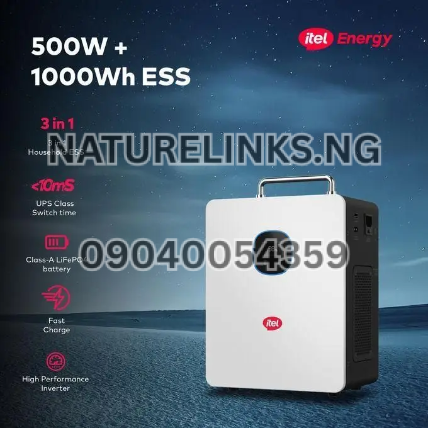
The commonly documented configuration lists:
| Specification | Documented value |
|---|---|
| Battery capacity | 1,000Wh / 1kWh |
| Battery chemistry | LiFePO4 |
| Solar charging | Yes |
| Solar controller | MPPT |
| Maximum PV input | Up to 400W |
| MPPT voltage range | Approximately 11–60V |
| AC output | 230V |
| Rated inverter output | 500W |
Always verify the exact model and its manual before connecting a solar array.
Itel Power Tank 1000Wh Solar Charging Calculation
The simplest calculation is:
Charging time ≈ Battery capacity ÷ Solar input
For a 1,000Wh battery:
| Solar Input | Ideal Calculation |
|---|---|
| 100W | 10 hours |
| 200W | 5 hours |
| 300W | 3.33 hours |
| 400W | 2.5 hours |
These figures are theoretical and assume continuous delivery of the stated wattage. Actual solar charging will normally take longer.
For Nigerian buyers, this distinction is important because a solar panel’s advertised wattage represents its rated output under specified test conditions, not a guaranteed output every minute of the day.
Why Does Itel Power Tank Charge Slowly With Solar?
If your Power Tank appears to charge slowly, several factors may be responsible.
1. Low solar-panel wattage
A small solar array naturally provides less charging power.
2. Cloudy weather
Clouds can substantially reduce solar production.
3. Shading
Trees, buildings, roofing and other objects can reduce panel output.
4. Incorrect panel orientation
Poor positioning can prevent the panels from producing their available output.
5. Dust
Dust and dirt accumulated on solar panels can reduce sunlight reaching the photovoltaic cells.
6. Incorrect solar configuration
Panels must operate within the Power Tank’s permitted voltage and current limits.
7. Battery state of charge
Charging behaviour can change as the battery approaches full capacity.
Does Itel Power Tank Have an MPPT Solar Controller?
Yes. The commonly documented 1,000Wh configuration includes a built-in MPPT solar charge controller.
MPPT technology is used to optimise the available energy from a compatible solar-panel array and convert it into usable charging power for the battery.
This makes the Power Tank suitable for a properly designed portable solar charging setup.
Is Itel Power Tank 1000Wh the Same as 1kWh?
Yes.
1,000Wh = 1kWh.
Therefore, searches such as:
- Itel Power Tank 1000Wh
- Itel Power Tank 1kWh
- Itel Power Tank 1000 watt hour
- Itel Power Tank 1,000Wh solar generator
can refer to the same energy-storage capacity when describing the 1,000Wh configuration.
However, buyers should still verify the exact model number because product configurations and specifications can vary.

Itel Power Tank 1000Wh Battery Type
The commonly documented configuration uses a LiFePO4 lithium battery with a stated capacity of 1,000Wh. Some published specifications indicate a cycle life of approximately 6,000 cycles under specified conditions.
LiFePO4 is commonly used in modern portable power stations because of its combination of energy storage, durability and safety-management features.
The Power Tank also incorporates battery-management and protection systems according to the listed specifications.
How Much Solar Power Does Itel Power Tank Need?
It does not necessarily need the maximum 400W solar input to charge.
A smaller compatible solar system can charge it, but charging will generally take longer.
For example:
100W solar: slower charging.
200W solar: faster.
300W solar: faster still.
400W solar: reaches the documented maximum PV-input level for the commonly listed configuration.
The appropriate setup depends on your budget, available roof/ground space, expected daily solar exposure and desired charging speed.
Can I Use a 500W Solar Panel With Itel Power Tank?
Do not assume that a 500W panel is automatically safe simply because the Power Tank has a 1,000Wh battery.
The commonly documented configuration has a maximum PV input of up to 400W.
The solar system must therefore be designed according to the Power Tank’s maximum permitted solar input, voltage and current.
A higher-rated panel or array can potentially exceed the input specifications if improperly connected.
Check the exact model’s manual or datasheet before installation.
Itel Power Tank Solar Charging for Nigerian Homes
For Nigerian homes, the Itel Power Tank can be used as a compact backup-energy solution for suitable loads.
The commonly listed 1,000Wh model has a 500W continuous AC output, meaning the battery capacity and inverter output should not be confused.
The 1,000Wh figure describes how much energy the battery can store, while the 500W rating describes the continuous AC power the inverter is designed to supply.
It can therefore be considered for compatible loads such as:
- Wi-Fi routers
- Laptops
- LED lighting
- Televisions
- Phones
- Small electronics
- Some low-power fans
- POS equipment
- Other compatible low-to-medium-power devices
High-power appliances such as electric kettles, irons, air conditioners and electric cookers may exceed the documented continuous inverter rating and should not be connected simply because the battery is rated at 1,000Wh.
How to Get Faster Solar Charging From Itel Power Tank
If faster charging is your priority, consider these practical steps:
Use adequate solar capacity
A larger compatible solar array can provide more charging power, up to the Power Tank’s specified PV-input limit.
Keep panels clean
Regularly remove dust and dirt from panels.
Avoid shade
Place panels where trees, buildings and other objects do not block sunlight.
Position panels correctly
Proper orientation and inclination can improve solar generation.
Use suitable cables
Use appropriately sized solar cables and secure connections to minimise unnecessary losses.
Check the MPPT limits
Do not exceed the Power Tank’s permitted voltage, current or wattage.
Monitor charging performance
The Power Tank’s display can help you monitor battery status and charging behaviour.
Is Solar Charging Better Than AC Charging for Itel Power Tank?
Solar and AC charging serve different purposes.
Solar charging is useful when you want to recharge from sunlight and reduce dependence on grid electricity.
AC charging is useful when electricity is available and you want to recharge without waiting for daytime solar production.
For many Nigerian users, having both options can be practical. The Power Tank’s documented specifications support both solar and AC/grid charging.
Where to Buy Genuine Itel Power Tank in Nigeria
The Best Seller is Nature Solar Global Limited, which is also presented as an accredited distributor in Nigeria.
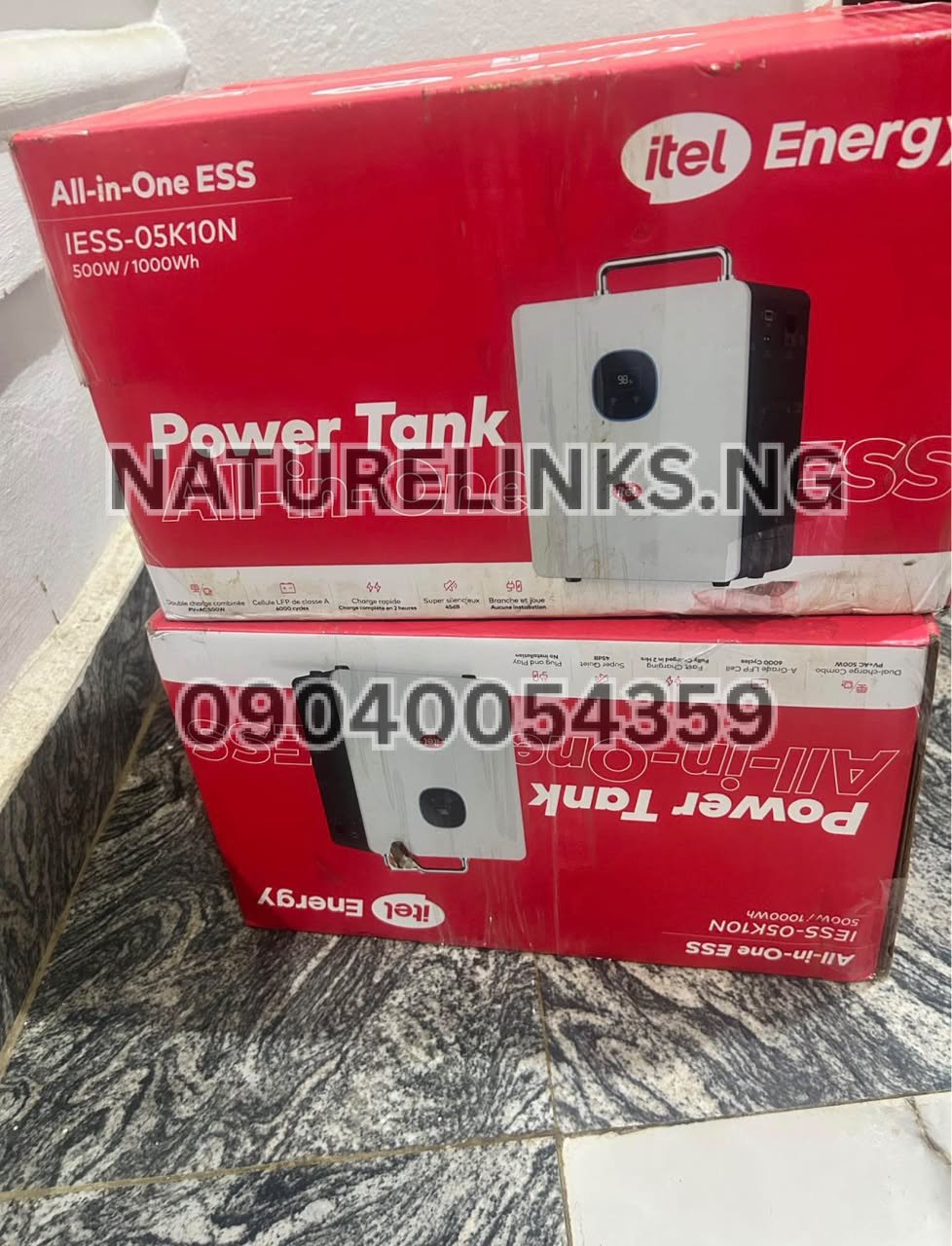
Nature Links Nigeria Limited [NatureLinks.NG] supplies Itel Power Tank products and solar-energy solutions to Nigerian customers. Current Nigerian product listings describe the commonly available Power Tank as a 1,000Wh/1kWh LiFePO4 unit with a 500W rated inverter and solar charging capability.
Distributor and Seller Details
Best Seller: Nature Links Nigeria Limited [NatureLinks.NG]
Distributor: Nature Solar Global Limited
CEO: Mr. Joseph Chikeleze
Call: 07049528019
WhatsApp: 09040054359
Shop Address: F1571 Upstairs (F-Line), Alaba International Market, Lagos State 🇳🇬
Before payment, confirm the current price, exact model, warranty, solar-panel compatibility and package contents.

Itel Power Tank 1000Wh Solar Charging Price in Nigeria
The price of an Itel Power Tank depends on the seller, model, warranty, stock availability and whether the package includes solar panels.
Recent Nigerian listings show the commonly advertised 1,000Wh unit at different prices, demonstrating that buyers should confirm the current selling price rather than rely on an old online price.
A solar-panel package will generally cost more than the Power Tank alone because the package includes additional solar-generation equipment.
When requesting a quotation, ask specifically for:
- Power Tank price
- Solar-panel price
- Solar-panel wattage
- Number of panels
- Solar cable/accessories
- Warranty
- Delivery cost
- Installation requirements
“How Long Does Itel Power Tank Take to Charge With Solar?” — Quick Answer
The commonly documented 1,000Wh Itel Power Tank supports up to 400W of solar input.
At a theoretical 400W:
1,000Wh ÷ 400W = approximately 2.5 hours.
At 200W:
1,000Wh ÷ 200W = approximately 5 hours.
At 100W:
1,000Wh ÷ 100W = approximately 10 hours.
Actual charging time will normally be longer because solar output changes with sunlight, weather, temperature, panel orientation and other conditions.
So, if you are asking “How Long Does Itel Power Tank Take to Charge With Solar?”, a reasonable way to answer is: roughly 2.5 hours under ideal 400W input conditions, but real-world charging should be expected to take longer.
Frequently Asked Questions About Itel Power Tank Solar Charging
1. Can Itel Power Tank charge with solar?
Yes. The commonly documented 1,000Wh configuration supports solar charging and has a built-in MPPT solar charge controller.
2. How long does Itel Power Tank 1000Wh take to charge with solar?
With the documented maximum 400W solar input, the theoretical charging calculation is approximately 2.5 hours from empty. Real-world charging can take longer because solar output varies.
3. Can I use a 100W solar panel to charge Itel Power Tank?
A compatible 100W solar setup can provide solar energy, but charging will be much slower than using the maximum supported solar input. Always verify voltage and current compatibility before connection.
4. Can I use 200W solar panels for Itel Power Tank?
A 200W solar configuration can provide up to 200W under ideal conditions, subject to compatibility with the Power Tank’s PV input specifications.
5. What is the maximum solar input of Itel Power Tank 1000Wh?
The commonly documented configuration supports up to 400W PV input.
6. Does Itel Power Tank use MPPT?
Yes. The documented 1,000Wh configuration has a built-in MPPT solar charge controller.
7. Can Itel Power Tank charge from electricity and solar?
The listed configuration supports both AC/grid charging and solar charging.
8. Why is my Itel Power Tank charging slowly from solar?
Possible causes include insufficient solar-panel wattage, cloudy weather, shading, incorrect panel positioning, dust, cable losses and a solar configuration that is not producing its rated output.
9. Can I connect any solar panel to Itel Power Tank?
No. Solar panels should be compatible with the Power Tank’s specified PV voltage, current and maximum input. The commonly documented configuration lists an approximately 11–60V MPPT range and up to 400W PV input.
10. Where can I buy Itel Power Tank in Nigeria?
Nature Links Nigeria Limited/Nature Solar Global Limited provides Itel Power Tank and solar-energy product information for Nigerian buyers. Contact 07049528019 or 09040054359 on WhatsApp to confirm current availability, price, warranty and compatible solar accessories.
Conclusion
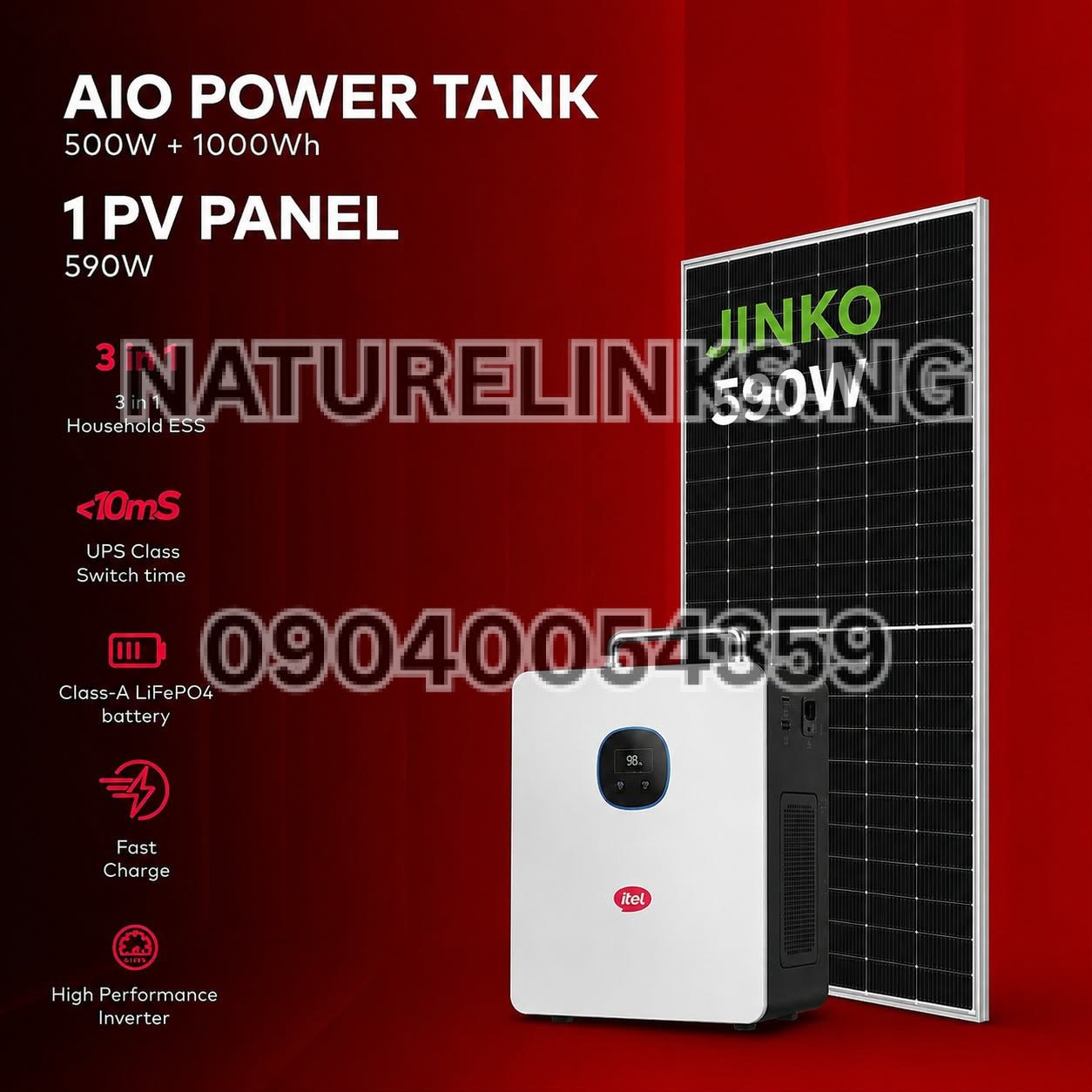
The Itel Power Tank 1000Wh/1kWh is designed to support solar charging, and the commonly documented configuration has a built-in MPPT controller with up to 400W of PV input. Under ideal conditions, 400W of continuous solar input would theoretically recharge a 1,000Wh battery in approximately 2.5 hours, but actual Nigerian solar charging will generally take longer because sunlight is not constant.
For buyers searching “How Long Does Itel Power Tank Take to Charge With Solar?”, the most important factors are therefore the solar-panel wattage, panel compatibility, sunlight intensity, weather, shading, panel positioning and the exact Power Tank model.
For genuine Itel Power Tank products, compatible solar charging equipment, current pricing and availability in Nigeria, contact Nature Links Nigeria Limited [NatureLinks.NG] / Nature Solar Global Limited at 07049528019 or 09040054359 on WhatsApp, or visit F1571 Upstairs (F-Line), Alaba International Market, Lagos State 🇳🇬.