
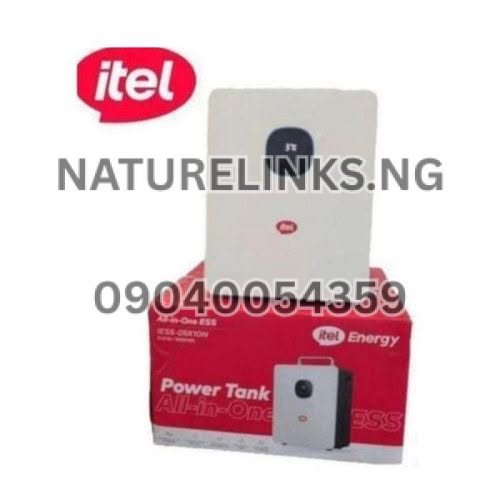
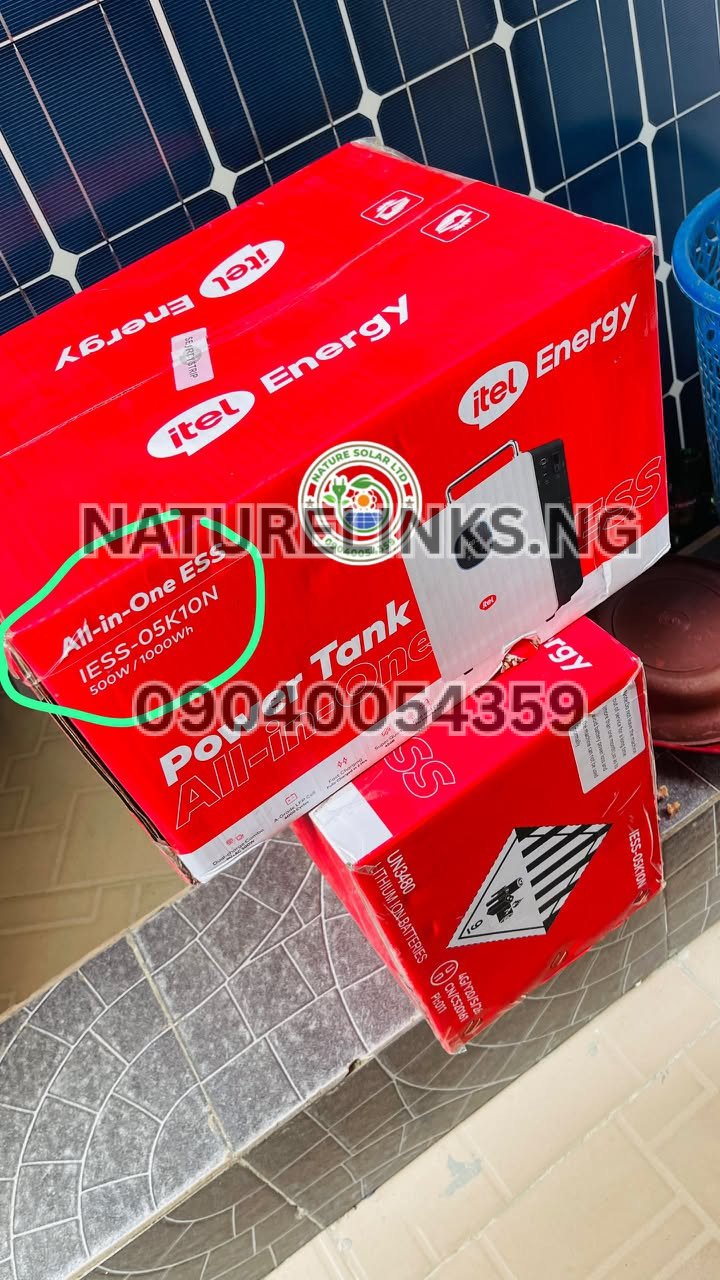
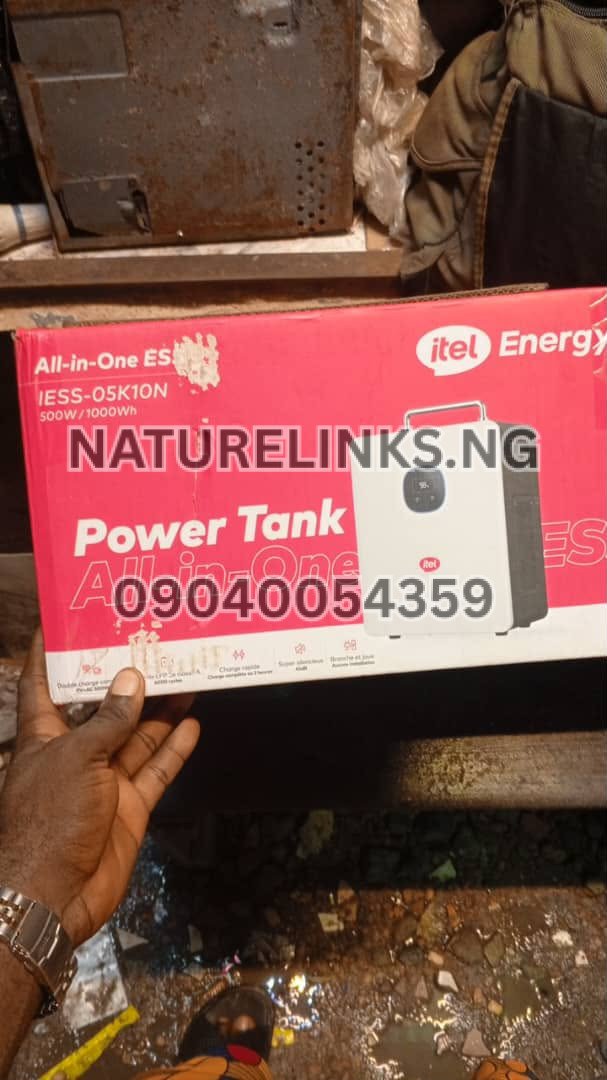
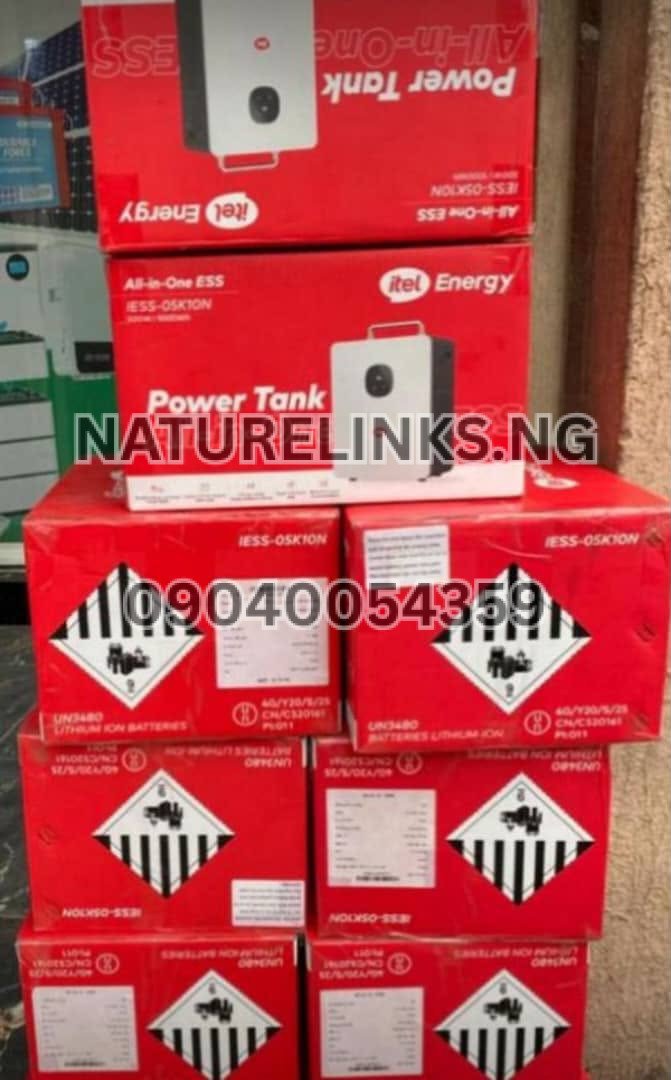
If you have seen 1000Wh written on an Itel Power Tank and wondered what it means, the simple answer is: 1000Wh means the battery has an energy-storage capacity of 1,000 watt-hours, which is the same as 1kWh. It tells you how much energy the battery can store, while the W (watts) rating tells you how much power the inverter can deliver at a given time.
This distinction is important for Nigerian buyers because an Itel Power Tank marketed around 1000Wh/1kWh is commonly documented with a 500W continuous AC output. In other words, 1000Wh does not automatically mean you can continuously connect 1,000W of appliances.
For anyone searching Google Nigeria for “What does 1000Wh mean on Itel Power Tank?”, understanding Wh, kWh, W, runtime and appliance compatibility can help you choose the correct backup-power system and avoid buying a unit that is too small for your electricity needs.
What Does 1000Wh Mean?
1000Wh means 1,000 watt-hours of stored energy.
The calculation is:
1,000Wh = 1kWh
A simple way to understand this is:
- 100W appliance × 10 hours = 1,000Wh
- 200W appliance × 5 hours = 1,000Wh
- 250W appliance × 4 hours = 1,000Wh
- 500W appliance × 2 hours = 1,000Wh
These are theoretical calculations. Actual runtime is normally shorter because of inverter losses, battery-management limits and the power consumed by the system itself.
The commonly listed Itel Power Tank 1000Wh configuration uses a 1,000Wh LiFePO4 battery.
What Does 1kWh Mean on Itel Power Tank?
1kWh is exactly the same energy capacity as 1000Wh.
The terms simply use different units:
1kWh = 1,000Wh
Therefore, if an Itel Power Tank is advertised as having a 1kWh battery, it means the battery’s nominal energy-storage capacity is approximately 1,000 watt-hours.
This is useful when comparing portable power stations, solar generators, lithium batteries and inverter systems in Nigeria.
“What Does 1000Wh Mean on Itel Power Tank?”
When you see “What Does 1000Wh Mean on Itel Power Tank?” in a product specification, think of 1000Wh as the size of the energy tank, not the maximum appliance wattage.
For example, a theoretical 100W load could consume:
100W × 10 hours = 1,000Wh
A 200W load could consume:
200W × 5 hours = 1,000Wh
However, real-world runtime will generally be less than those theoretical figures.
1000Wh vs 1000W: What Is the Difference?
This is one of the most important questions to understand before buying an Itel Power Tank.
1000Wh
This represents energy capacity.
It tells you how much energy the battery can store.
1000W
This represents power output.
It tells you how much power an inverter or electrical device can supply or consume at a particular moment.
They are not the same measurement.
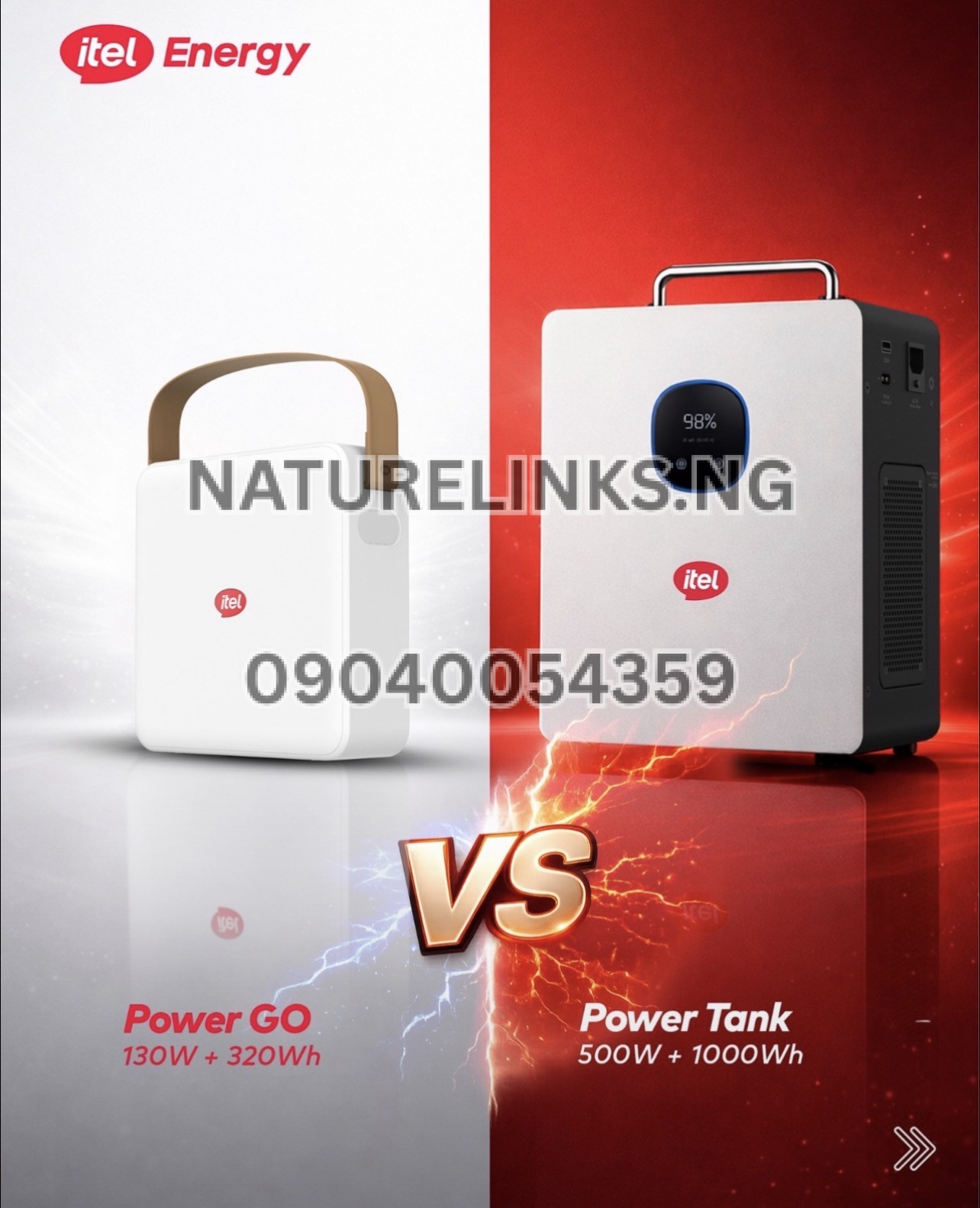
For the commonly documented Itel Power Tank configuration, the battery capacity is 1,000Wh, while the rated continuous AC output is 500W. Some published configurations also specify higher surge capability.
Is Itel Power Tank 1000Wh the Same as 1000W?
No.
A 1000Wh Itel Power Tank has approximately 1kWh of stored energy, whereas its commonly documented inverter configuration has a 500W continuous AC output.
This means a buyer should not assume that an Itel Power Tank labelled or advertised as “1000W” can continuously run 1,000W of appliances.
The manufacturer’s/product specifications should always be checked for the exact model.
How Many Hours Can 1000Wh Power a Device?
A simple theoretical formula is:
Runtime = Battery Capacity ÷ Appliance Power
For a 1,000Wh battery:
| Appliance Load | Theoretical Runtime |
|---|---|
| 20W | 50 hours |
| 50W | 20 hours |
| 75W | 13.3 hours |
| 100W | 10 hours |
| 150W | 6.7 hours |
| 200W | 5 hours |
| 250W | 4 hours |
| 300W | 3.3 hours |
| 400W | 2.5 hours |
| 500W | 2 hours |
These figures are theoretical. Actual runtime will be lower when AC inverter losses and other operating factors are considered.
How Long Will Itel Power Tank 1000Wh Last?
There is no single answer because runtime depends on the appliances connected.
For example, a Nigerian user running only a Wi-Fi router and a laptop will use much less energy than someone running a television, fan, lights and several other appliances.
A practical runtime calculation can be expressed as:
Actual Runtime ≈ 1000Wh × Efficiency ÷ Total Appliance Watts
If the system’s effective usable energy were, for example, 85% of the nominal capacity:
1,000Wh × 0.85 = 850Wh
At a 100W load:
850Wh ÷ 100W = 8.5 hours
This is an illustration rather than a guaranteed runtime figure.
Can 1000Wh Power a TV?
Yes, provided the TV’s power consumption is within the Power Tank’s output specification.
For example, a television using 80W would theoretically consume:
80W × 5 hours = 400Wh
That would leave approximately 600Wh of the nominal energy capacity before accounting for system losses.
A larger television consuming 150W would consume the battery faster.
Can 1000Wh Power a Fan?
Yes, assuming the fan’s power requirement is compatible with the inverter.
For example, a 60W fan running for 8 hours would theoretically consume:
60W × 8 = 480Wh
A lower-wattage rechargeable fan may use even less energy.
This is why 1kWh power stations are often useful for essential Nigerian home loads such as fans, routers, lights, phones and laptops.
Can Itel Power Tank 1000Wh Power a Laptop?
Yes.
Laptops generally have relatively modest power requirements compared with heating appliances.
For example, a laptop drawing 65W theoretically uses:
65W × 5 hours = 325Wh
The actual result depends on the laptop, charger efficiency, workload and whether other appliances are connected.
For remote workers, students, freelancers and people running online businesses, the 1kWh capacity can therefore be useful for essential computing and communication equipment.
Can Itel Power Tank 1000Wh Power a Refrigerator?
It depends on the refrigerator.
A refrigerator may have a relatively modest running wattage but require substantially more power when its compressor starts.
The commonly documented Itel Power Tank configuration has a 500W continuous AC output, so the refrigerator’s running and starting requirements must be checked before purchase.
Do not rely only on the refrigerator’s advertised average consumption.
Can Itel Power Tank 1000Wh Power an Electric Iron?
This is an important compatibility question.
Many electric irons consume several hundred watts or more. Since the commonly documented Itel Power Tank has a 500W continuous AC output, an iron operating near or above that level may exceed the recommended continuous load.
Always check the wattage printed on the appliance.
Can 1000Wh Power an Electric Kettle?
You should check the kettle’s wattage carefully.
Many electric kettles have high power requirements, and a typical high-wattage kettle can exceed the continuous output of the commonly documented 500W Itel Power Tank configuration.
Therefore, 1,000Wh battery capacity does not mean a 1,000W kettle can be operated continuously.
Can 1000Wh Power an Air Conditioner?
A commonly documented 1kWh/500W Itel Power Tank is generally not intended to be treated as a high-power air-conditioner backup system.
Air conditioners can require substantial continuous power and compressor startup power.
If air conditioning is your primary requirement, calculate the air conditioner’s running and startup requirements and compare them with the exact Power Tank inverter specification before purchasing.
What Appliances Can a 1000Wh Itel Power Tank Run?
Depending on their individual wattage, a 1kWh Itel Power Tank can be suitable for essential loads such as:
- LED bulbs
- Wi-Fi routers
- Mobile phones
- Laptops
- Tablets
- Televisions
- Low-power fans
- CCTV systems
- Small electronics
- Rechargeable devices
- Some low-power office equipment
The total simultaneous load must remain within the inverter’s output specification.
The commonly documented configuration provides 500W continuous AC output, pure sine-wave output and solar charging capability.
Itel Power Tank 1000Wh Key Features
The commonly listed 1,000Wh configuration includes:
- 1,000Wh / 1kWh battery capacity
- LiFePO4 lithium battery
- 500W continuous AC output
- Pure sine-wave inverter
- Up to 600VA apparent output on the documented configuration
- Solar charging
- Built-in MPPT solar controller
- Up to 400W PV input on the documented configuration
- AC/grid charging
- UPS functionality on compatible configurations
- Battery Management System
- Overload protection
- Short-circuit protection
- Over-temperature protection
- Over-voltage protection
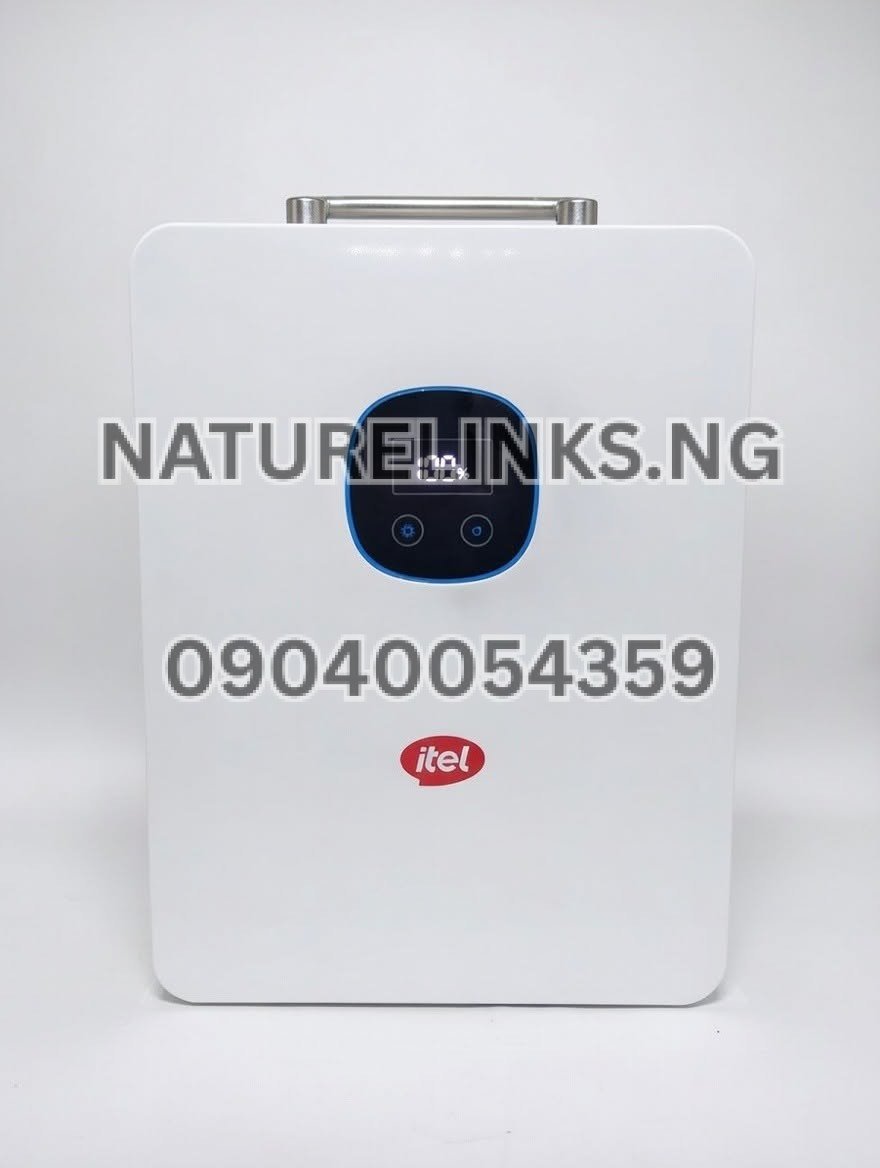
- Digital battery display
- USB and DC outputs
- Portable all-in-one design
Specifications can vary by model/configuration, so buyers should verify the exact unit before purchase.
Itel Power Tank 1000Wh Battery Type
The commonly listed 1,000Wh Itel Power Tank uses LiFePO4 (Lithium Iron Phosphate) battery technology.
LiFePO4 is widely used in modern energy-storage applications because of its combination of cycle life, stability and energy-storage characteristics.
Published specifications for the documented configuration state up to approximately 6,000 charge cycles under specified conditions.
Does 1000Wh Mean the Battery Can Supply 1000W for One Hour?
Not necessarily in practical use.
Mathematically:
1000Wh ÷ 1000W = 1 hour
But this assumes a theoretical 100% energy conversion with no losses.
More importantly, the inverter’s output rating determines whether the Power Tank can actually supply a 1,000W continuous load.
For the commonly documented configuration, the continuous AC output is 500W, so the 1,000Wh battery capacity should not be confused with a 1,000W continuous inverter.
What Is the Difference Between Wh, W and kWh?
W — Watt
Watt measures power.
It tells you the rate at which electricity is being consumed or supplied.
Wh — Watt-hour
Watt-hour measures energy.
It describes how much energy can be stored or consumed over time.
kWh — Kilowatt-hour
A kilowatt-hour is simply a larger unit of watt-hours.
1kWh = 1,000Wh
Therefore:
1000Wh = 1kWh
This is the key information behind the 1000Wh marking on the Itel Power Tank.
“What Does 1000Wh Mean on Itel Power Tank?”
The second time you see “What Does 1000Wh Mean on Itel Power Tank?”, remember this simple explanation:
1000Wh describes the battery’s energy capacity, not the inverter’s maximum continuous output.
If the battery were theoretically able to deliver all its stored energy at a constant 100W load, the calculation would be:
1,000Wh ÷ 100W = 10 hours
At 200W:
1,000Wh ÷ 200W = 5 hours
At 500W:
1,000Wh ÷ 500W = 2 hours
Actual results vary.
Itel Power Tank 1000Wh Solar Charging
The commonly listed configuration supports solar charging through an integrated MPPT solar controller.
Published specifications indicate up to approximately 400W solar/PV input for the documented configuration.
This means Nigerian users can potentially recharge the Power Tank using compatible solar panels instead of relying entirely on grid electricity.
However, solar-panel voltage, current and connector requirements must be checked before connection.
How Many Solar Panels Do You Need for 1000Wh?
The answer depends on:
- Panel wattage
- Available sunlight
- Solar-panel voltage
- Solar-controller limits
- Weather
- Battery state of charge
- Solar-panel orientation
- System efficiency
If the Power Tank accepts up to approximately 400W PV input on the documented configuration, a solar setup should be designed within the manufacturer’s permitted input specifications.
Do not connect panels simply because their combined wattage appears suitable; voltage and current limits are equally important.
Is Itel Power Tank 1000Wh Good for Nigerian Homes?
It can be useful for essential, relatively low-power loads, particularly where the goal is to keep phones, routers, laptops, lights, TVs and fans operating during power interruptions.
The best way to determine suitability is to calculate your actual electricity requirement.
For example:
| Device | Example Load |
|---|---|
| Wi-Fi router | 10W |
| LED light | 10W |
| Laptop | 65W |
| TV | 80W |
| Fan | 60W |
| Total | 225W |
A 225W combined load is below the commonly documented 500W continuous AC output, although actual runtime depends on the energy consumption of each device.
Is 1000Wh Enough for a POS Business?
It can be useful for a POS operator who primarily needs to power low-energy equipment such as:
- POS terminal
- Smartphone
- Router
- Small LED light
- Small fan
The total load should be calculated before purchase.
For a business that also needs refrigeration, large printers, heating equipment or other high-power appliances, a larger power system may be required.
Is 1000Wh Enough for Work From Home?
For many low-power work-from-home setups, 1kWh can provide useful backup energy.
A setup containing a laptop, Wi-Fi router, phone charger and LED light can have a relatively low total power requirement compared with appliances such as kettles, irons and air conditioners.
The key is to calculate both the total wattage and the expected operating hours.
Itel Power Tank 1000Wh Price in Nigeria
Although this article focuses on what 1000Wh means, price is another major buyer-intent question.
Current Nigerian online listings reviewed for this article show the commonly listed 1,000Wh Itel Power Tank around ₦279,000–₦400,000, depending on seller, configuration, warranty, stock and package contents. Some solar-panel bundles can cost more.
For current pricing, buyers should confirm the exact model and package directly with the seller before making payment.
How to Buy the Right Itel Power Tank in Nigeria
Before buying, check these specifications:
1. Battery Capacity
Confirm that the unit actually has the advertised 1,000Wh/1kWh capacity.
2. Continuous Output
Check the inverter’s continuous wattage. The commonly documented configuration is 500W.
3. Surge Output
Check how much startup power the unit can handle and for how long.
4. Battery Chemistry
Confirm whether the unit uses LiFePO4.
5. Solar Input
Check the maximum PV wattage and voltage range.
6. Warranty
Ask the seller about the warranty and after-sales support.
7. Accessories
Confirm whether the purchase includes charging cables, AC charger, solar cables or solar panels.
8. Model Number
Ask for the exact model number and datasheet.
9. Authenticity
Purchase from a reputable supplier or authorized distribution channel.
10. Current Price
Prices can change, so confirm the current price before transferring money.
Where to Buy Itel Power Tank 1000Wh in Nigeria
For buyers looking for an Itel Power Tank distributor, supplier or dealer in Nigeria, the business information supplied for this article is:
Best Seller: Nature Links Nigeria Limited [NatureLinks.NG]
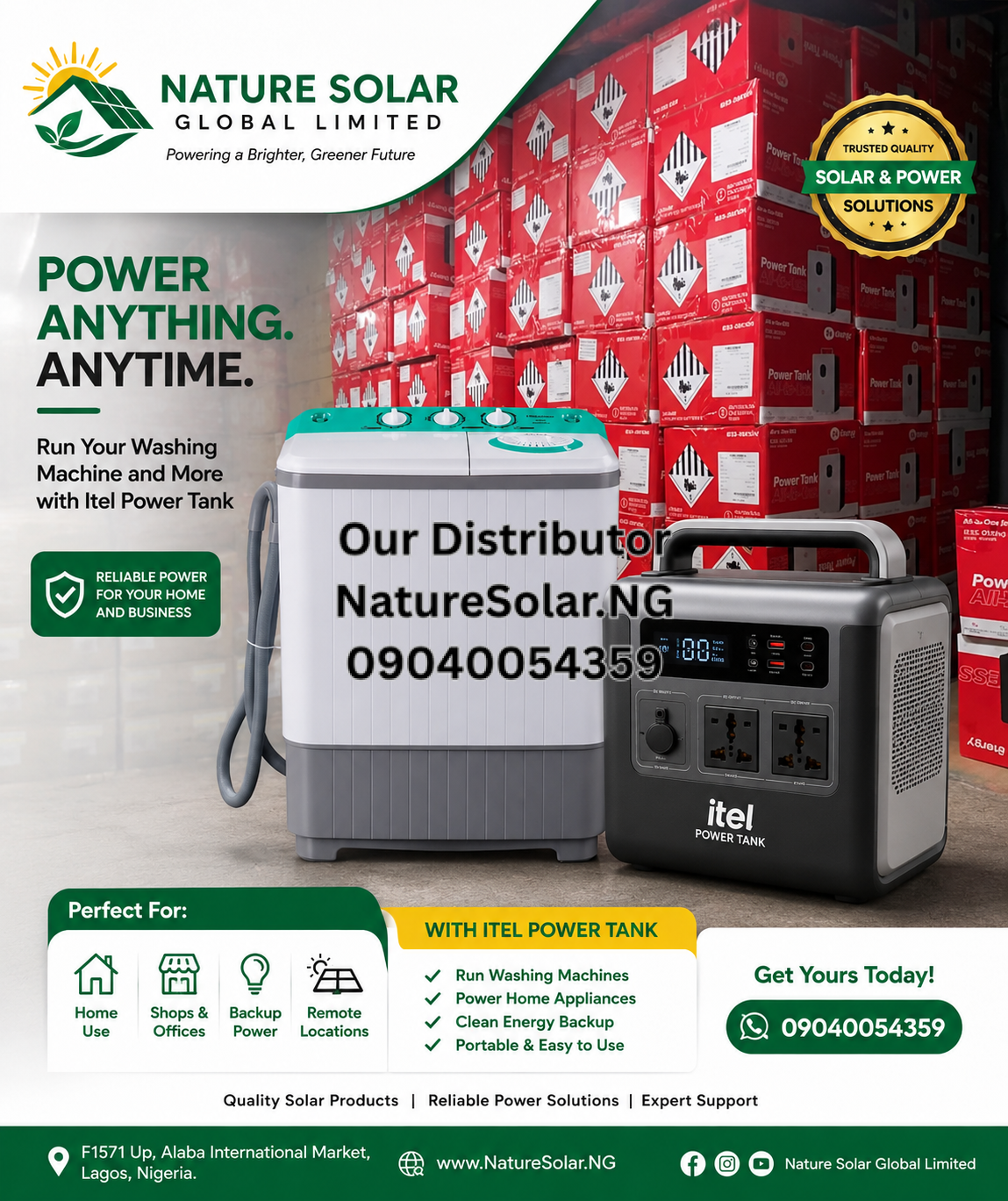
Distributor: Nature Solar Global Limited
CEO: Mr. Joseph Chikeleze
Call: 07049528019
WhatsApp: 09040054359
Shop Address: F1571 Upstairs (F-Line), Alaba International Market, Lagos State 🇳🇬
The supplied business information identifies Nature Solar Global Limited as the accredited distributor. Buyers should contact the seller to verify current stock, exact model, price, warranty and package contents before payment.
10 Frequently Asked Questions About 1000Wh Itel Power Tank
1. What does 1000Wh mean on Itel Power Tank?
It means the Power Tank has approximately 1,000 watt-hours of energy-storage capacity, equivalent to 1kWh.
2. Is 1000Wh the same as 1000W?
No. Wh measures energy capacity, while W measures power/output. A 1,000Wh battery does not necessarily have a 1,000W continuous inverter.
3. How many hours can 1000Wh last?
It depends on the load. Theoretical examples include 10 hours at 100W, 5 hours at 200W and 2 hours at 500W. Actual runtime is lower because of system losses.
4. Can Itel Power Tank 1000Wh power a TV?
Yes, if the TV’s power consumption is compatible with the Power Tank’s inverter output. The lower the TV’s wattage, the longer the battery can theoretically operate it.
5. Can 1000Wh power a fan?
Yes, assuming the fan’s wattage is within the inverter’s output capability. Runtime depends on the fan’s actual consumption.
6. Can Itel Power Tank 1000Wh power a laptop?
Yes. A laptop is generally a relatively low-power load and is one of the practical applications for a portable power station.
7. Can Itel Power Tank 1000Wh charge with solar?
Yes. The commonly documented configuration supports solar charging and has an integrated MPPT controller, with up to approximately 400W PV input on the documented configuration.
8. Is Itel Power Tank 1000Wh enough for a house?
It depends on what you want to power. It can be useful for essential low-power devices, but it should not be assumed to power an entire house, particularly high-power appliances.
9. How much is Itel Power Tank 1000Wh in Nigeria?
Current online Nigerian listings reviewed for this article show approximately ₦279,000–₦400,000 for commonly listed standalone units, with package and seller differences.
10. Where can I buy Itel Power Tank 1000Wh in Nigeria?
The supplied distributor information lists Nature Solar Global Limited as the accredited distributor. Buyers can call 07049528019 or WhatsApp 09040054359 to confirm availability, current pricing and warranty.
10 Quick Facts About Itel Power Tank 1000Wh
- 1000Wh = 1kWh.
- Wh measures stored energy.
- W measures power.
- A 1000Wh battery does not automatically provide 1000W continuous output.
- The commonly documented configuration has a 500W continuous AC output.
- The commonly listed battery chemistry is LiFePO4.
- Compatible configurations support solar charging.
- Published specifications indicate up to approximately 400W PV input on the documented configuration.
- Runtime depends on the total connected load.
- Always check the exact model’s datasheet before purchasing.
“What Does 1000Wh Mean on Itel Power Tank?”
The third and final use of “What Does 1000Wh Mean on Itel Power Tank?” can be summarized in one sentence:
It means the Itel Power Tank has approximately 1,000 watt-hours (1kWh) of energy-storage capacity, while its actual appliance-running capability is determined by the inverter’s continuous and surge output ratings.
For the commonly documented 1kWh model, the distinction is particularly important because the battery capacity is 1,000Wh, while the rated continuous AC output is 500W.
Conclusion
Understanding 1000Wh on an Itel Power Tank makes it much easier to compare portable power stations and solar backup systems in Nigeria. The 1000Wh figure represents stored energy capacity, equivalent to 1kWh. It does not mean that the Power Tank can automatically run 1,000W of appliances continuously.
For the commonly documented Itel Power Tank 1kWh configuration, the system combines a 1,000Wh LiFePO4 battery with a 500W continuous pure sine-wave AC inverter, plus solar and grid charging features.
Before buying, calculate the wattage of your laptop, TV, fan, lights, router and other appliances, then compare that total with the Power Tank’s continuous output. Also verify the exact model, battery capacity, solar-input limits, warranty and current Nigerian price.
Nature Links Nigeria Limited / Nature Solar Global Limited
CEO: Mr. Joseph Chikeleze
Call: 07049528019
WhatsApp: 09040054359
Shop: F1571 Upstairs (F-Line), Alaba International Market, Lagos State 🇳🇬



1 thought on “What does 1000Wh mean on Itel Power Tank?”