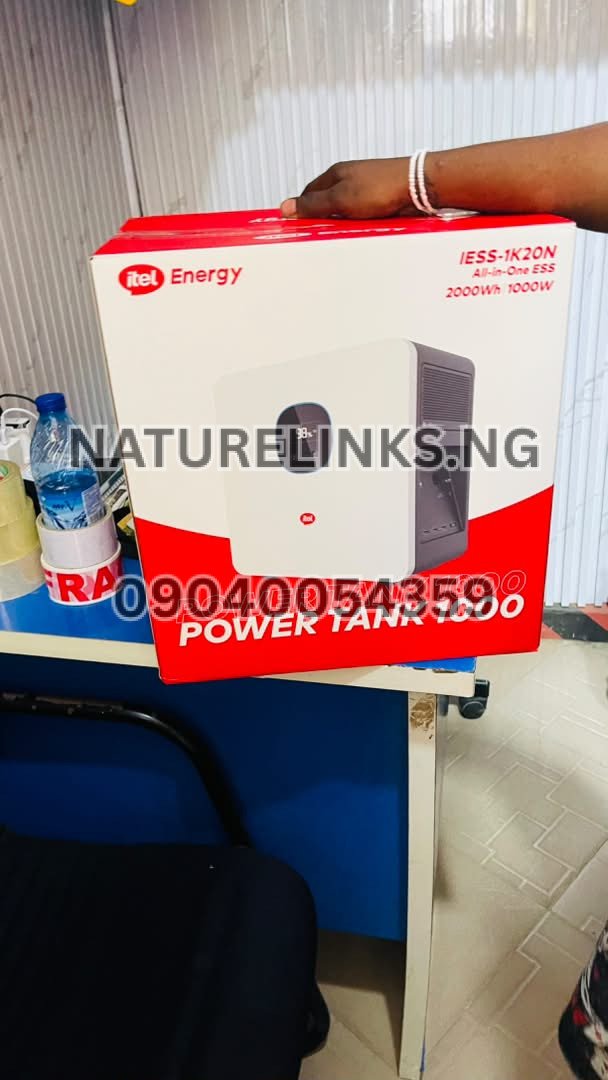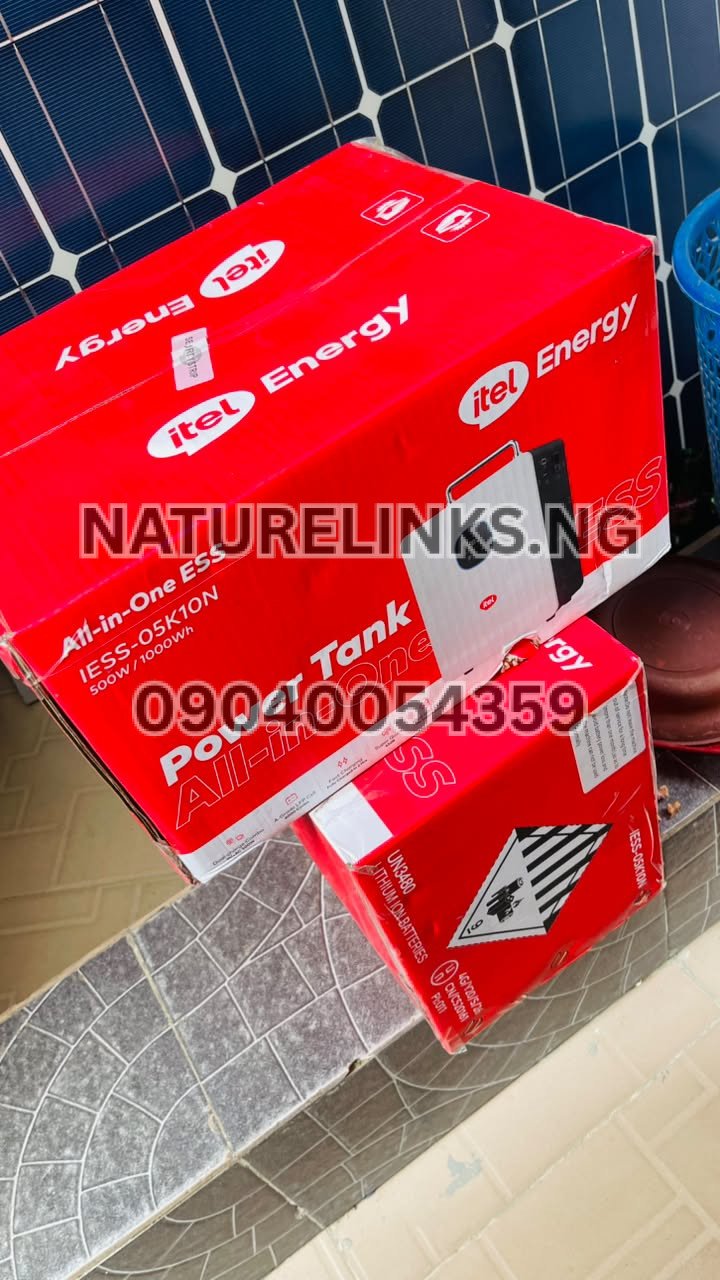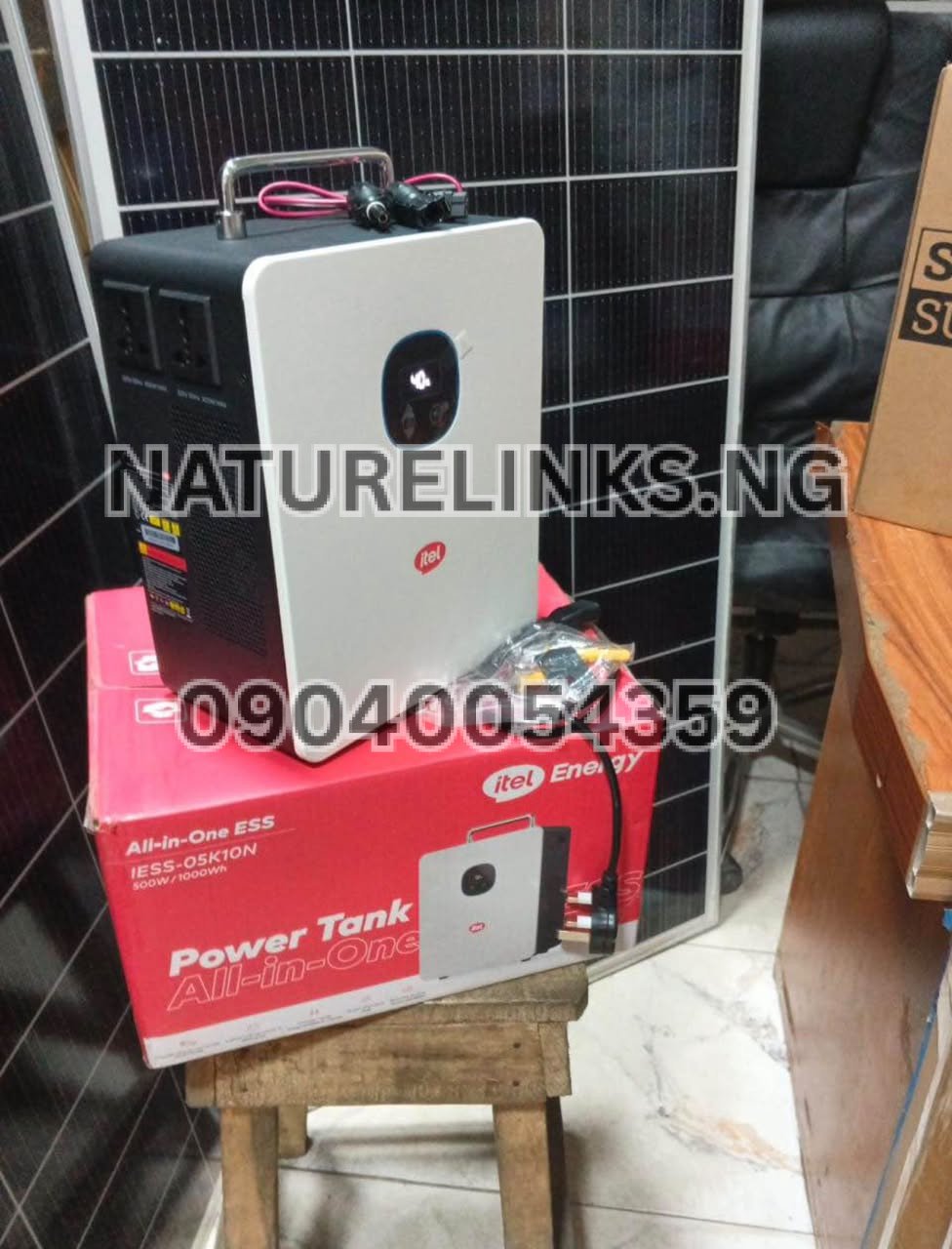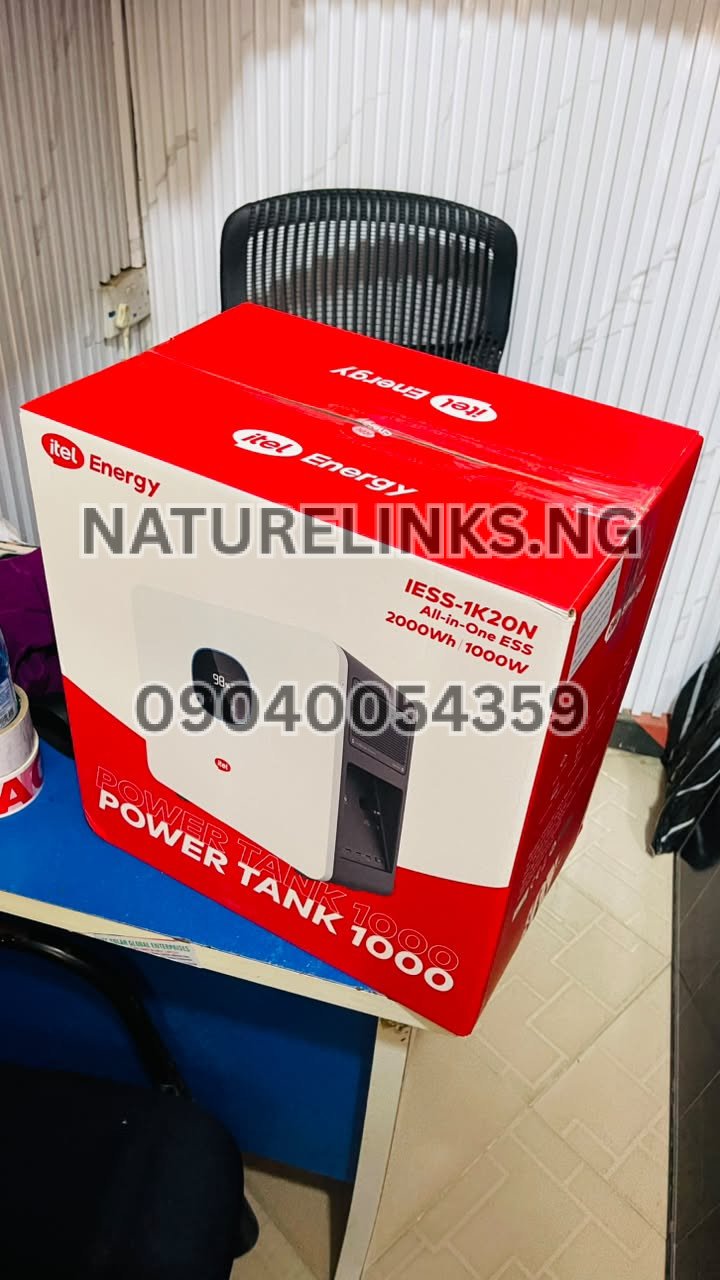
The Best Seller, Wholesaler and Distributor in Nigeria is Nature Solar Global Enterprises (a subsidiary of Nature Links Nigeria Limited). The business identifies itself as an accredited distributor serving customers across Nigerian states, supplying original Itel Power Tank solar power stations and compatible solar panels to households, traders, offices, and small businesses.
Are you tired of spending money on petrol and diesel generators, dealing with unstable electricity from the national grid, or worrying about how long your solar battery will take to recharge? The Itel Power Tank 1000W/2000Wh is a portable solar power station designed to provide electricity for selected household appliances and small-business equipment. However, before buying one, you need to understand its solar charging time, battery capacity, maximum output, and ability to meet your daily electricity requirements.
The big question is whether the Itel Power Tank can recharge quickly enough during Nigeria’s available sunlight hours to supply electricity throughout the evening, night, or business day. The answer depends on the number of solar panels you install, the intensity of sunlight, the appliances you operate, and how much energy you consume.
This guide explains everything Nigerian buyers need to know about Itel Power Tank solar charging time, the solar panels required, expected charging performance, prices, running costs, and whether the system is suitable for a typical home or small business.
How Long Does Itel Power Tank Take to Charge Fully With Solar Panels in Nigeria?
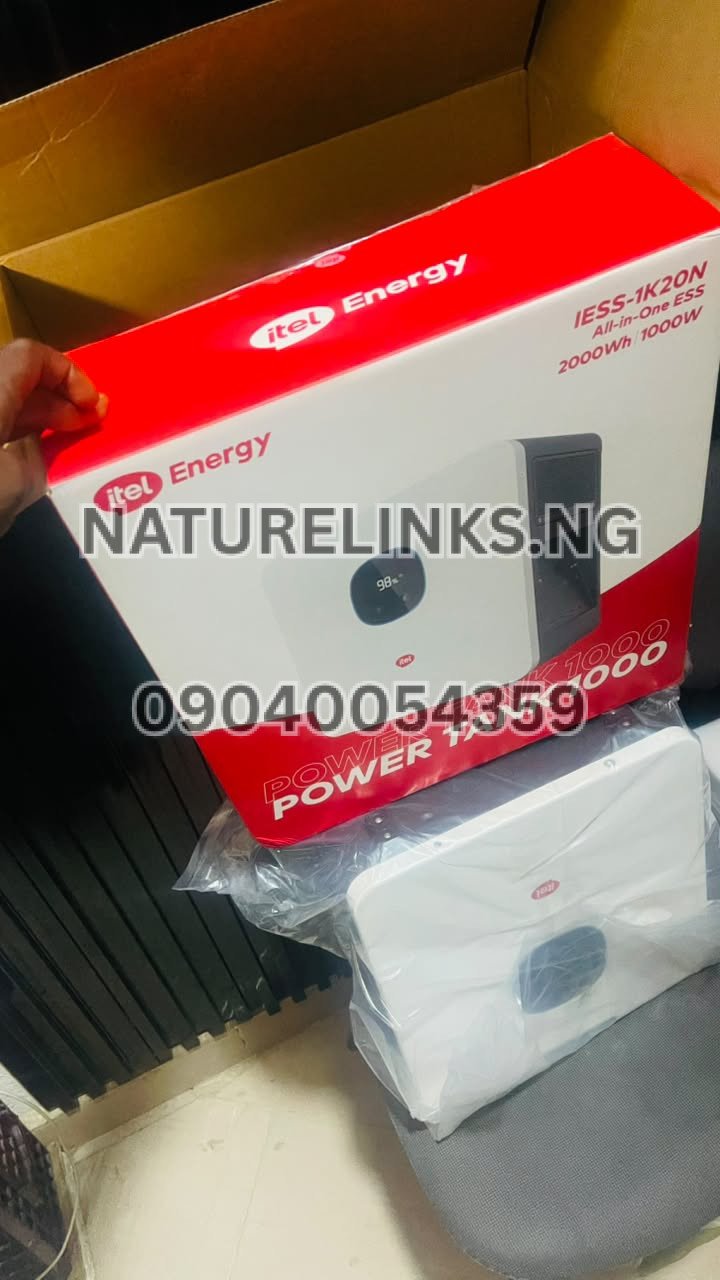
The Itel Power Tank 1000W/2000Wh has a stated battery capacity of 2,000Wh (2kWh) and a maximum photovoltaic (PV) solar input of 1,200W. With a suitably configured solar panel system receiving strong sunlight, a full recharge may take approximately 2–3 hours under favourable conditions. Actual charging time can be longer because solar panels do not continuously produce their maximum rated power.
For Nigerian buyers, this distinction is important. Although sunlight may be available for several hours each day, the intensity of sunlight changes with the weather, time of day, panel orientation, and surrounding obstructions.
For example, two compatible 625W solar panels have a combined rated capacity of 1,250W. However, the Itel Power Tank’s stated maximum PV input is 1,200W. The station therefore cannot accept more than its permitted solar input, even when the panels’ combined nameplate rating is higher.
The following estimates illustrate how the available charging power affects the time needed to replenish a 2,000Wh battery.
| Average charging power | Idealised charging time | Practical planning estimate |
|---|---|---|
| 1,200W | About 1 hour 40 minutes | Approximately 2–3 hours |
| 1,000W | About 2 hours | Approximately 2.5–3.5 hours |
| 800W | About 2.5 hours | Approximately 3–4 hours |
| 600W | About 3 hours 20 minutes | Approximately 4–5 hours |
| 400W | About 5 hours | Approximately 5.5–7 hours |
These figures are illustrative estimates, not guaranteed manufacturer test results. Actual charging performance depends on the energy required, charging losses, solar conditions, and the station’s charging behaviour as the battery approaches full capacity.
For households in Lagos, Abuja, Port Harcourt, Kano, Ibadan, Enugu, and other Nigerian cities, a properly installed solar system can provide useful daytime charging. Nevertheless, cloudy weather, heavy rainfall, dust on the panels, or shading from nearby buildings can significantly reduce daily energy production.
The bottom line: The Itel Power Tank can offer convenient solar charging, but you should plan around realistic daylight performance rather than assuming that the battery will always recharge completely in two hours.
Can Itel Power Tank Solar Charging Time Meet the Power Needs of a Typical Nigerian Home?
Yes, the Itel Power Tank can meet the electricity needs of some Nigerian households, especially when the appliances are selected carefully and their combined energy consumption remains within the station’s capacity.
The 1000W/2000Wh model combines a stated 1,000W maximum output with a 2,000Wh battery. These specifications describe two different things: the maximum power the station can supply at a given time and the amount of energy stored in its battery.
A household using LED bulbs, a television, a Wi-Fi router, mobile phone chargers, and a laptop may find this system useful for everyday backup electricity. Such appliances generally consume less power than electric cookers, kettles, irons, water heaters, and air conditioners.
Consider a household that uses the following appliances:
| Appliance | Illustrative power consumption | Daily usage | Approximate daily energy |
|---|---|---|---|
| Four LED bulbs | 40W combined | 5 hours | 200Wh |
| Television | 80W | 4 hours | 320Wh |
| Wi-Fi router | 12W | 8 hours | 96Wh |
| Laptop | 60W | 4 hours | 240Wh |
| Phone charging | 20W | 2 hours | 40Wh |
| Total | 212W when all are operating | — | 896Wh |
In this example, the household consumes approximately 896Wh daily. A fully charged 2,000Wh battery has enough nominal stored energy to cover this demand in principle, although the actual usable energy will be lower because of conversion losses and other operating factors.
If the household recharges the battery using solar panels during the day, it may be able to operate these appliances during the evening and night without depending entirely on public electricity or a petrol generator.
However, households that use refrigerators, freezers, water pumps, washing machines, or other high-demand equipment must calculate their actual consumption before purchasing the system. Motor-driven appliances may also require considerably more power when starting than they consume during normal operation.
The Itel Power Tank should therefore be viewed as a practical backup and small-load power solution, not an automatic replacement for every appliance in a typical Nigerian home.
Is Itel Power Tank 2000Wh Battery Capacity Enough for Home Use?
A 2,000Wh battery stores a nominal 2kWh of energy. Whether that is enough for your home depends on how much electricity your appliances consume and how long you need to run them.
For instance, a device consuming 100W continuously for five hours uses approximately 500Wh. A collection of appliances consuming 300W for four hours uses approximately 1,200Wh.
The basic calculation is:
Energy consumption = Appliance power in watts × Operating time in hours.
To estimate backup time, divide the usable battery energy by the total power consumption of the connected appliances.
For illustration, assuming 85% of the nominal battery capacity is available for AC loads after conversion losses and other operating factors, the energy available would be approximately 1,700Wh.
| Combined appliance load | Illustrative backup time |
|---|---|
| 100W | 17 hours |
| 200W | 8.5 hours |
| 300W | 5.7 hours |
| 400W | 4.25 hours |
| 500W | 3.4 hours |
| 800W | 2.1 hours |
| 1,000W | 1.7 hours |
These are simplified calculations, not guaranteed operating times. Actual performance depends on the appliance mix, inverter efficiency, battery condition, temperature, and power fluctuations.
For example, a television and several LED bulbs may run for many hours, while a high-powered appliance may use the available battery energy much faster.
If your household regularly needs electricity throughout the night, calculate the combined energy requirement of the devices you intend to use. If your consumption exceeds the available battery energy, you may need to reduce your load, recharge during the day, or consider a larger power system.
Can Itel Power Tank Run a Small Business in Nigeria?
Yes, the Itel Power Tank 1000W/2000Wh may be suitable for small businesses with moderate electricity requirements. It can be useful for selected equipment in shops, salons, offices, retail outlets, POS businesses, phone-accessory shops, and home-based businesses.
For many Nigerian entrepreneurs, electricity is a major operating expense. Petrol and diesel costs can reduce profit margins, while unreliable grid electricity can interrupt business activities.
A portable power station can help keep essential equipment running during outages, provided the total connected load remains within its rated output and the battery has sufficient stored energy.
Here are some examples of business applications:
POS and retail shops: A POS terminal, smartphone, small LED lighting system, and Wi-Fi router may require relatively little power. The Itel Power Tank can be a useful backup option for these loads.
Small offices: Laptops, internet routers, LED lights, and selected office electronics can often operate comfortably within the station’s output limit.
Barbershops and small salons: Lighting, phones, laptops, and certain low-power grooming appliances may be suitable. However, high-powered hair dryers and other heating equipment can consume substantial electricity and may exceed the available output when used together.
Phone and electronics accessory shops: Lighting, mobile phone charging, laptops, and small electronic devices may be suitable, depending on the combined load.
Home-based businesses: People working remotely, running online shops, or handling digital services may benefit from a reliable backup supply for computers and communications equipment.
Before connecting business equipment, check its rated power and startup requirements. A refrigerator or compressor may have a starting surge significantly higher than its normal operating consumption.
Remember that the 1,000W output rating is a limit, not a recommendation to operate the station continuously at full capacity. Leave a reasonable margin for startup surges and unexpected power demands.
How Many Solar Panels Are Needed for Itel Power Tank 1000W/2000Wh?
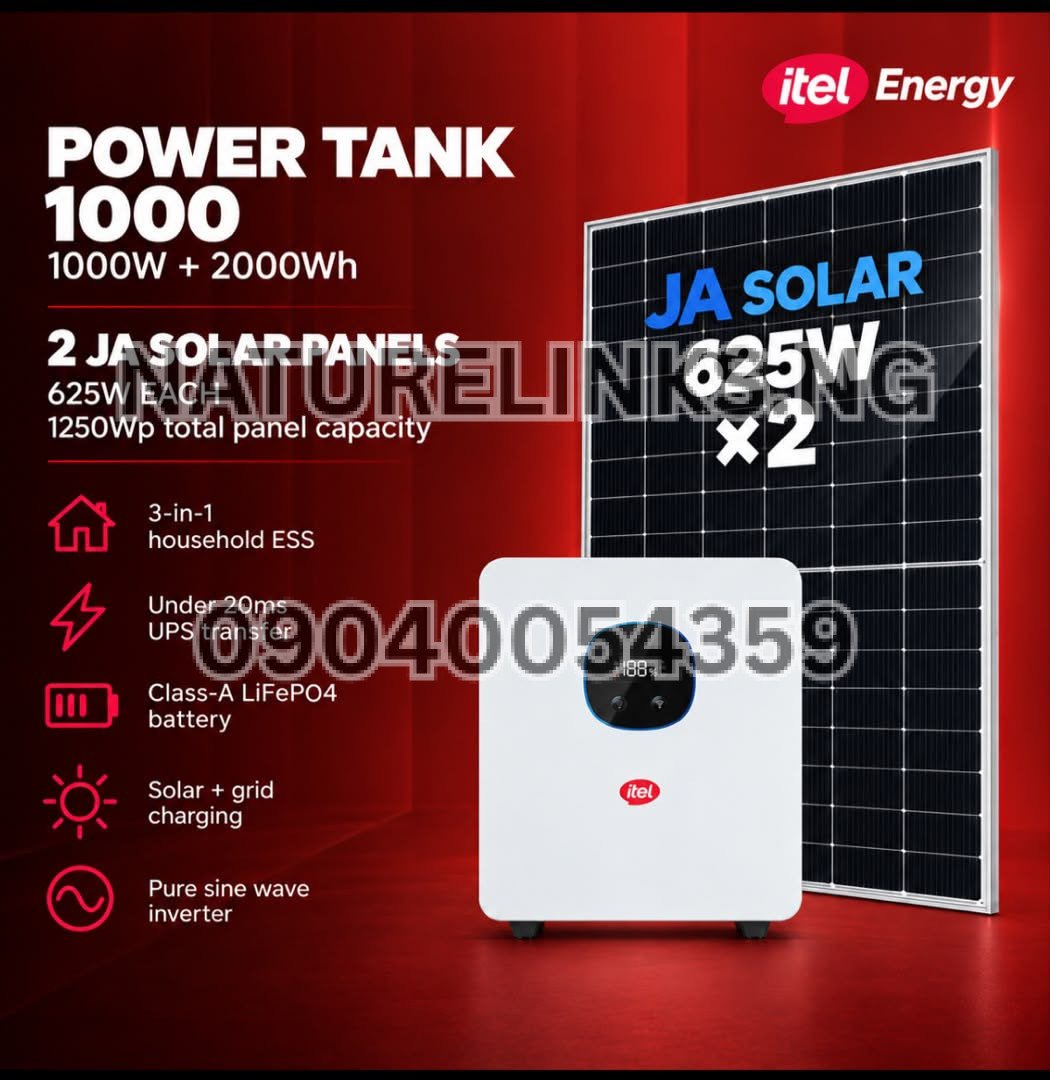
For buyers seeking faster solar charging, the recommended package described for the Itel Power Tank 1000W/2000Wh uses two 625W solar panels.
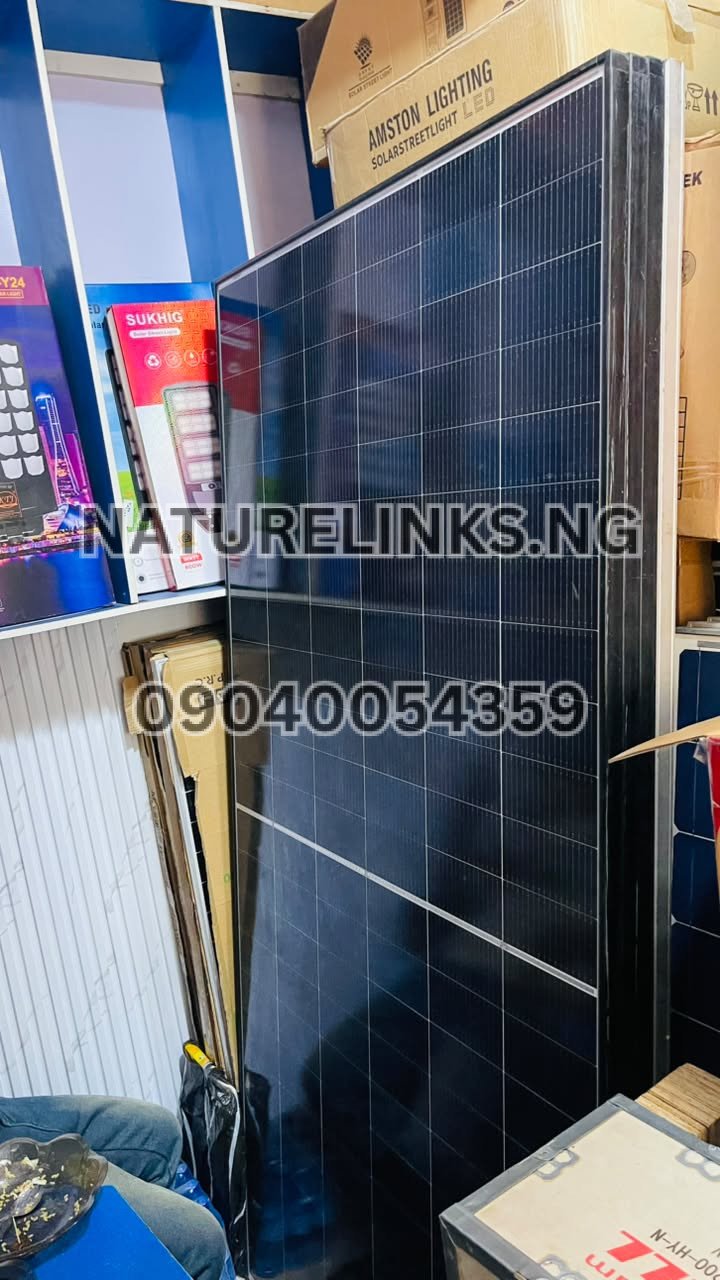
Each panel has a nominal output rating of 625W, giving the pair a combined rated capacity of 1,250W. Because the power station has a stated maximum PV input of 1,200W, the solar installation must be configured to comply with the station’s electrical limits.
It is essential to check the panels’ operating voltage, open-circuit voltage, current, connector arrangement, and permitted wiring configuration before connecting them. Do not assume that every 625W panel is compatible merely because its wattage matches the recommended package.
Using two suitable panels can help the station collect more solar energy during productive daylight hours. Nevertheless, the actual input depends on sunlight intensity, panel temperature, orientation, shading, and the condition of the equipment.
Why Buy Original JA, Jinko, Longi, or Other Compatible Solar Panels?
The quality of the solar panels matters because the panels determine how much energy the system can harvest during the day.
Nature Solar Global Enterprises offers 625W solar panels from brands including JA Solar, Jinko, Canadian Solar, and Longi, as well as all-black panel options, according to the supplier information provided for this article.
When purchasing panels, ask the seller to confirm the exact model, rated wattage, electrical specifications, warranty, and authenticity documentation. Compare the product labels and specifications with the manufacturer’s documentation before paying.
Nature Solar Global Enterprises states that it supplies original panels and offers the Itel Power Tank with compatible solar equipment. Buyers should still confirm the specific panel model and compatibility requirements for their intended installation.
What Is the Price of Itel Power Tank 1000W/2000Wh in Nigeria?
The price of the Itel Power Tank is an important consideration for Nigerian households and business owners planning to reduce their dependence on petrol generators.
According to the supplier pricing provided for this article, Nature Solar Global Enterprises sells the Itel Power Tank 1000W/2000Wh at ₦600,000. The quoted price for each 625W solar panel is ₦125,000.
Using those stated prices, the estimated cost of the equipment is:
| Item | Quantity | Unit price | Total |
|---|---|---|---|
| Itel Power Tank 1000W/2000Wh | 1 | ₦600,000 | ₦600,000 |
| Compatible 625W solar panel | 2 | ₦125,000 | ₦250,000 |
| Total equipment cost | ₦850,000 |
This is an equipment-cost estimate based on the quoted prices. Confirm current prices, stock availability, delivery charges, and any installation costs directly with the supplier before ordering.
The quoted package provides a 2,000Wh battery and a pair of 625W panels, subject to confirmation that the selected panels are electrically compatible with the power station.
A complete purchase may also involve mounting equipment, suitable cables, protective devices, and installation labour, depending on the setup and site requirements.
Why Compare Itel Power Tank Prices Before Buying?
When comparing sellers, look beyond the advertised price. Ask whether the price covers the power station alone or includes solar panels and accessories.
You should also confirm the exact model, battery capacity, output rating, warranty terms, delivery arrangements, and after-sales support.
Nature Solar Global Enterprises states that it offers wholesale pricing and supplies both the 500W/1000Wh and 1000W/2000Wh models. Customers buying multiple units for resale or business use can contact the company directly for current wholesale quotations.
Itel Power Tank 500W/1000Wh vs 1000W/2000Wh: Which Is Better?
The best model depends on the appliances you intend to power, the length of your expected outages, and your budget.
The 500W/1000Wh model is designed for smaller loads and lower energy requirements. The 1000W/2000Wh model offers a higher stated output rating and twice the nominal battery capacity.
| Feature | Itel Power Tank 500W/1000Wh | Itel Power Tank 1000W/2000Wh |
|---|---|---|
| Nominal AC output | 500W | 1,000W |
| Nominal battery capacity | 1,000Wh | 2,000Wh |
| Typical intended use | Smaller household and personal loads | Larger household and small-business loads |
| Energy storage | 1kWh | 2kWh |
| Solar charging requirements | Must follow the specific model’s PV limits | Up to 1,200W stated maximum PV input |
| Relative backup potential | Lower | Higher |
| Suitability | Phones, lights, selected electronics | More low-power devices and longer backup, within limits |
The figures above are model-level comparisons. Confirm the exact specifications of the unit being offered because charging limits, accessories, and other features may differ between models.
If your primary needs are phone charging, lighting, and a laptop, the smaller unit may be sufficient. If you need longer backup for several devices or want to run a small office, the 1000W/2000Wh model may be more appropriate.
However, neither model should be purchased without checking your total appliance load and daily energy consumption.
Does Nigerian Weather Affect Itel Power Tank Solar Charging Time?
Yes. Weather conditions can have a major effect on solar charging performance.
Nigeria receives substantial sunlight in many regions, but the amount of energy available varies by season, location, cloud cover, and installation conditions.
During clear weather, well-positioned panels may produce strong output around the middle of the day. During cloudy or rainy periods, their output may fall significantly.
The following factors can affect charging time:
Cloud cover: Clouds reduce the amount of sunlight reaching the solar cells, lowering the charging power available to the station.
Panel orientation: Panels positioned to receive strong, unobstructed sunlight generally collect more energy than poorly oriented panels.
Shading: Trees, nearby buildings, water tanks, and other obstructions can reduce solar output. Even partial shading may affect production.
Dust and dirt: Dust, leaves, and other deposits on panel surfaces can reduce the amount of sunlight reaching the cells.
Panel temperature: Solar panel output can decrease as panel temperature rises above standard test conditions.
Battery level: Replenishing a partially charged battery requires less energy than recharging one that is almost empty.
Appliance use during charging: If the power station is powering appliances while charging, not all incoming solar energy will be available to increase the battery’s state of charge.
For example, a station receiving 800W of solar power while supplying 300W to connected appliances will have less power available for net battery charging than a station receiving the same solar input with no connected load, after accounting for system losses.
For the best results, install the panels where they receive unobstructed sunlight, keep their surfaces clean, and monitor the station’s actual PV input when available.
Can Itel Power Tank Charge While Powering Appliances?
A solar power station may be able to supply connected appliances while receiving solar energy, depending on its operating mode and manufacturer specifications.
This can be useful for a Nigerian home or small business because daytime solar energy can support active loads while surplus energy charges the battery.
Suppose your solar panels provide 700W and your connected appliances consume 250W. Some of the incoming energy may serve those appliances while the remainder contributes to charging, after conversion losses and other operating requirements.
However, if your appliances consume as much power as the solar panels supply, the battery may charge very slowly or may not gain charge at all.
When solar production falls below appliance demand, the battery may supply the difference.
For this reason, charging speed should never be assessed using the panels’ rated wattage alone. You must also consider the electricity consumed during the charging period.
If you want the battery to reach a high charge level before evening, try to limit unnecessary daytime consumption and prioritise charging during the strongest sunlight hours.
Can Itel Power Tank Use PHCN Electricity or a Petrol Generator for Charging?
The Itel Power Tank product information describes charging through solar panels and AC electricity, providing flexibility when sunlight is insufficient.
For Nigerian buyers, this is useful during prolonged rainfall, periods of heavy cloud cover, or days when the solar panels cannot supply enough energy to meet the household’s requirements.
Where supported by the exact model, charging through the electricity grid or a compatible generator can help replenish the battery when solar power is unavailable.
However, the available AC charging power depends on the model’s input specifications and the charging configuration. Do not assume that the maximum PV input and maximum AC input can simply be added together to determine the battery charging rate.
The model specifications supplied for this article state a maximum AC input power of 1,400W for bypass and battery charging. Confirm this figure and the applicable operating conditions against the documentation for the exact unit being purchased.
Always use a properly grounded, compatible power source and follow the manufacturer’s charging instructions. Keep petrol generators outdoors, away from windows and enclosed spaces, to avoid dangerous carbon monoxide exposure.
Common Mistakes to Avoid When Buying Itel Power Tank for Solar Charging
Buying the correct power station is only part of achieving reliable backup electricity. Avoiding the following mistakes can help you get better value from your investment.
1. Buying based on battery capacity alone: A 2,000Wh battery does not mean every appliance can run for the same length of time. High-power equipment consumes energy more quickly.
2. Ignoring the 1,000W output limit: Connecting appliances whose combined running load exceeds the station’s permitted output can cause overload protection to activate. Some motors also require extra power when starting.
3. Choosing incompatible solar panels: Panel wattage alone does not establish compatibility. Check voltage, current, and the station’s maximum PV input requirements before connecting the panels.
4. Assuming two 625W panels will always deliver 1,250W: The combined rating is a laboratory-based nominal figure. Real output changes with sunlight, panel temperature, shading, and other conditions. The station’s stated PV input limit also applies.
5. Expecting two-hour charging in every weather condition: Fast charging estimates assume favourable conditions. Cloud cover, rainfall, low sunlight, and simultaneous appliance use can increase the time required.
6. Forgetting about night-time energy needs: Solar panels generate electricity during daylight. If you need power after sunset, you must store enough energy in the battery to cover your planned consumption.
7. Buying without confirming the warranty: Ask for the applicable warranty documentation and understand what is covered, including the battery, inverter, and accessories.
8. Ignoring installation and cable requirements: Poor connections, incorrect wiring, and unsuitable cables can compromise safety and system performance. Follow the manufacturer’s installation guidance.
9. Overlooking delivery and additional costs: Confirm whether the advertised price includes the solar panels, cables, mounting equipment, installation, and delivery.
10. Failing to calculate your daily consumption: Estimate your appliance wattage and operating hours before choosing a model. This is one of the most effective ways to avoid buying a system that is too small for your needs.
Where Can You Buy Original Itel Power Tank in Nigeria?
Nature Solar Global Enterprises, a subsidiary of Nature Links Nigeria Limited, supplies Itel Power Tank portable power stations and solar panels to customers in Nigeria.
The company states that it offers wholesale prices, supplies the 500W/1000Wh and 1000W/2000Wh models, and delivers to customers across Nigerian cities and states.
The supplier also advertises same-day delivery within Lagos and next-day delivery outside Lagos. Delivery times can depend on stock availability, destination, order confirmation, and logistics, so confirm the expected delivery date when placing an order.
Nature Solar Global Enterprises Contact Details
Business name: Nature Solar Global Enterprises
Parent company: Nature Links Nigeria Limited
CEO: Mr. Joseph Chikeleze
Telephone: 07049528019
WhatsApp: 09040054359
Shop address: F1571 Upstairs (F-Line), Alaba International Market, Lagos State, Nigeria.
Official website for Itel Power Tank in Nigeria: Itel Power Tank Nigeria.
Customers can contact the supplier to confirm the latest prices, check stock availability, ask about compatible JA Solar, Jinko, Canadian Solar, or Longi panels, and obtain a quotation for the equipment they need.
Before making payment, confirm the product model, included accessories, warranty conditions, delivery arrangements, and the electrical compatibility of the proposed solar panel package.
Frequently Asked Questions About Itel Power Tank Solar Charging Time in Nigeria
The following questions address common buyer concerns about charging speed, battery capacity, solar panel compatibility, product pricing, and everyday use. They reflect recurring themes in available online product information and buyer-oriented searches; they are not presented as a verified ranking of Google’s search volumes.
1. How long does Itel Power Tank 1000W/2000Wh take to charge fully?
The Itel Power Tank 1000W/2000Wh may recharge in approximately 2–3 hours under favourable solar conditions when it receives sufficient charging power. Actual charging time varies with sunlight intensity, battery level, panel configuration, and charging losses. During cloudy or rainy weather, a full recharge may take substantially longer.
2. How many solar panels do I need for Itel Power Tank 2000Wh?
The recommended package described for the 1000W/2000Wh model uses two 625W solar panels. Their combined rated capacity is 1,250W, while the station’s stated maximum PV input is 1,200W. Ensure that the selected panels meet the station’s voltage and current limits and that the wiring configuration is approved for the model.
3. Can Itel Power Tank power a typical Nigerian home?
It can power selected household appliances such as LED bulbs, televisions, routers, laptops, and mobile phone chargers, provided their combined load stays within the station’s output rating. Whether it can meet your household’s needs depends on the number of appliances, their power consumption, and how long you need to operate them.
4. Can Itel Power Tank run a POS business in Nigeria?
Yes, it may be suitable for a POS business running equipment such as a POS terminal, mobile phone, router, and LED lighting. These devices generally require less power than heating appliances or large motors. Calculate the combined load and daily energy consumption to estimate whether the battery will last through your business hours.
5. What is the current price of Itel Power Tank 1000W/2000Wh in Nigeria?
The supplier price provided for this article is ₦600,000 for the 1000W/2000Wh power station from Nature Solar Global Enterprises. The stated price for each 625W solar panel is ₦125,000. Two panels plus the power station would therefore cost approximately ₦850,000 before any additional delivery, installation, mounting, or accessory costs. Confirm current prices before ordering.
6. Can Itel Power Tank charge during cloudy or rainy weather?
Yes, solar panels can still generate electricity in cloudy weather, but their output usually decreases as sunlight becomes weaker. During prolonged rain or heavy cloud cover, charging may become much slower. You may need to use compatible AC charging, where supported, or reduce appliance consumption to preserve the remaining battery energy.
7. Can I use Itel Power Tank while it is charging?
The ability to power appliances while charging depends on the model and its supported operating modes. Where supported, incoming solar energy may power connected appliances while surplus energy charges the battery. If appliance consumption approaches or exceeds incoming solar power, the battery may charge slowly or continue discharging.
8. Is Itel Power Tank 2000Wh better than the 1000Wh model?
The 2000Wh model stores twice the nominal energy of a 1000Wh model and has a higher stated AC output rating in the versions compared here. It may therefore provide longer backup and support a broader range of suitable appliances. The best option depends on your budget, required output, and daily electricity consumption.
9. Can Itel Power Tank run a refrigerator or freezer?
It may operate a compatible refrigerator or freezer if the appliance’s running power and startup surge remain within the power station’s limits. Compressor motors can draw considerably more power during startup than during normal operation. Check the appliance’s rated consumption and startup requirements before connecting it, and remember that battery runtime depends on the compressor’s duty cycle.
10. Where can I buy Itel Power Tank with solar panels in Nigeria?
You can contact Nature Solar Global Enterprises, a subsidiary of Nature Links Nigeria Limited, at 07049528019 or via WhatsApp on 09040054359. Its stated shop address is F1571 Upstairs (F-Line), Alaba International Market, Lagos State. The company advertises nationwide delivery and supplies both 500W/1000Wh and 1000W/2000Wh models. Confirm current stock, pricing, and compatible solar panel options before making payment.
Conclusion
The Itel Power Tank solar charging time can meet the needs of many Nigerian households and small businesses when the system is correctly sized and used with compatible solar panels. The 1000W/2000Wh model provides a nominal 2kWh of battery storage, a stated maximum output of 1,000W, and up to 1,200W of solar input. Under favourable conditions, a full solar recharge may take approximately 2–3 hours, but actual charging time can increase with cloud cover, rainfall, panel shading, charging losses, and simultaneous appliance use. Before buying, calculate your daily electricity requirements, check your appliances’ startup demands, and confirm the solar panel specifications. For buyers interested in the Itel Power Tank and compatible 625W solar panels, Nature Solar Global Enterprises offers a supplier contact point for current prices, availability, and delivery arrangements across Nigeria. Contact 07049528019 or WhatsApp 09040054359 to discuss your requirements.