
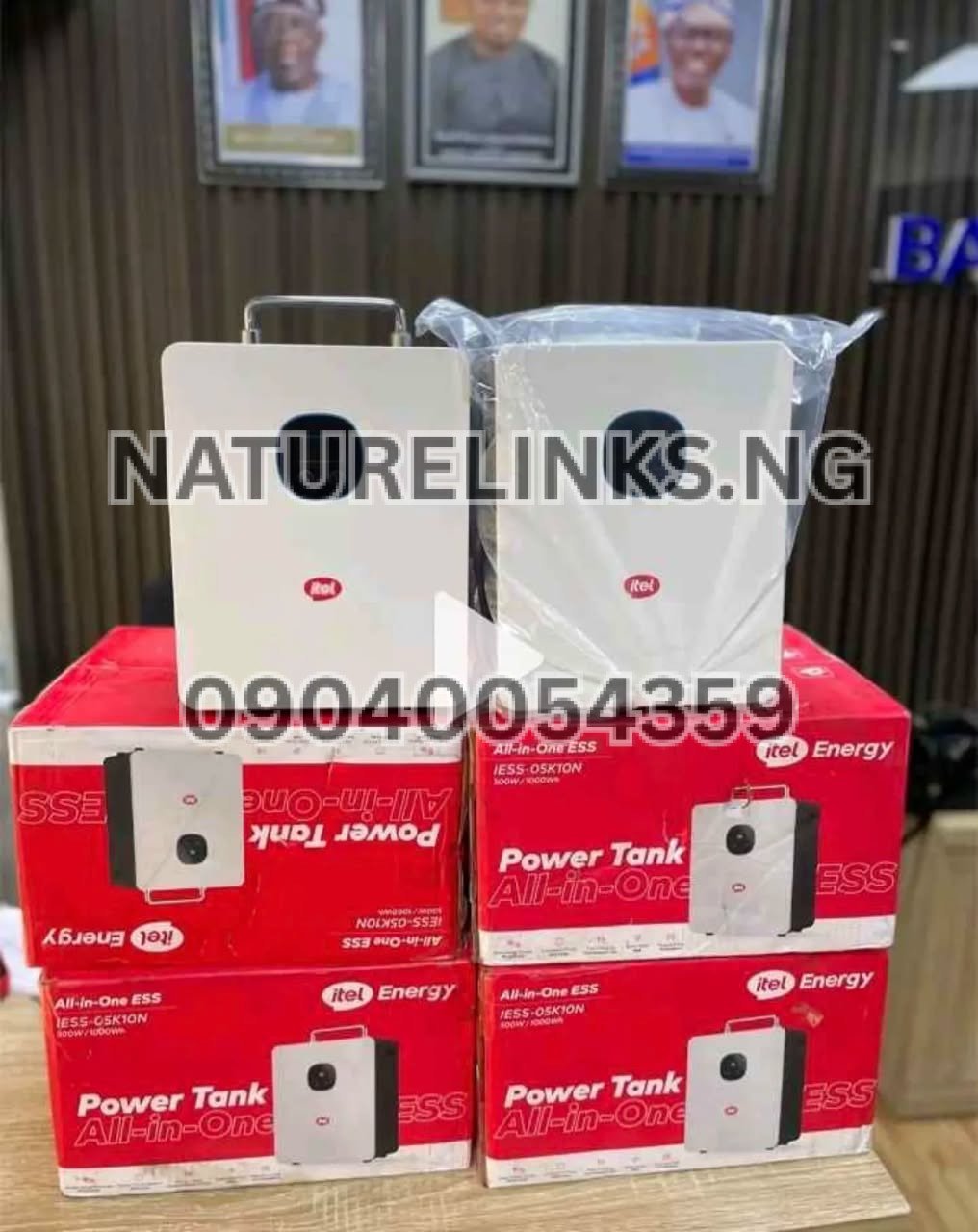
Best Seller: Nature Solar Global Limited. He is also the accredited distributor in Nigeria.
If you are searching for How Many Solar Panels Do I Need for Itel Power Station?, the answer depends mainly on the Itel Power Tank model, its maximum solar/PV input, the wattage of each solar panel and the amount of sunlight available.
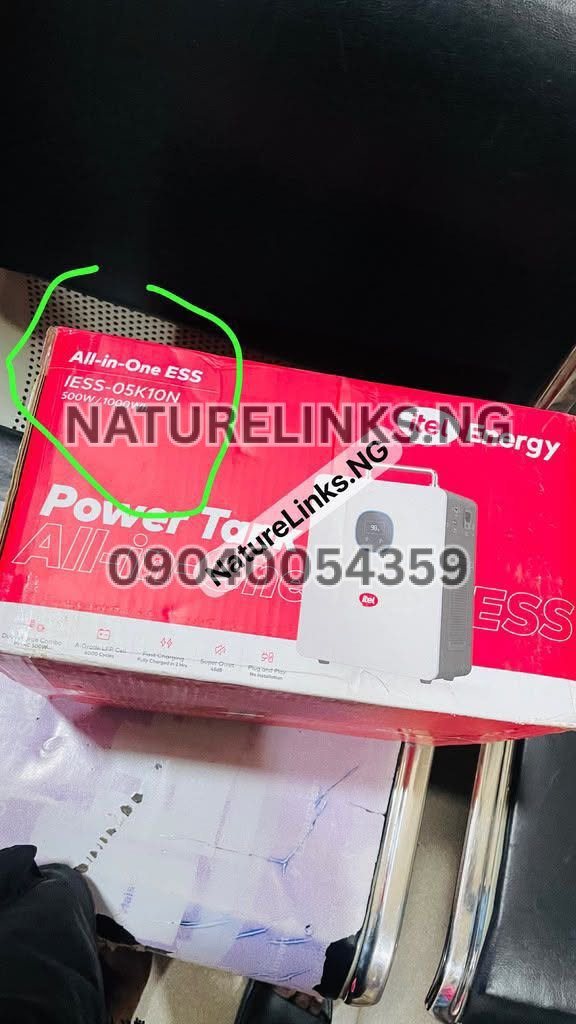
For the commonly listed Itel Power Tank 1,000Wh/1kWh with 500W inverter, Nigerian product specifications show an integrated MPPT solar charge controller and a documented maximum PV input of up to 400W on the relevant configuration. That means you generally need enough panel capacity to supply the Power Tank with up to its permitted solar input—not simply as many panels as possible.
For example, a single 400W solar panel can theoretically match a 400W maximum PV-input specification. Alternatively, two 200W panels can provide a combined nominal 400W, provided their voltage, current, wiring and connection method are compatible with the Power Tank.
Before buying, always confirm the exact model and PV-input specifications on the manufacturer’s datasheet or from the authorized seller.
How Many Solar Panels Do I Need for Itel Power Station?
For the commonly advertised 1,000Wh/500W Itel Power Tank, the documented maximum solar input on one listed configuration is 400W. Therefore, the number of panels depends on the wattage of each panel.
| Solar Panel Wattage | Number of Panels | Total Nominal Panel Capacity |
|---|---|---|
| 100W | 4 | 400W |
| 200W | 2 | 400W |
| 300W | 1 | 300W |
| 400W | 1 | 400W |
| 410W | 1 | 410W* |
| 450W | 1 | 450W* |
| 500W | 1 | 500W* |
Important: Panels marked with an asterisk may have a nominal wattage above the documented 400W PV-input limit. Do not assume that a 410W, 450W or 500W panel is automatically safe or beneficial. The Power Tank’s actual PV voltage/current limits must be checked first.
So, for a configuration whose maximum PV input is 400W, the straightforward options are one 400W panel or two 200W panels, subject to electrical compatibility.
“How Many Solar Panels Do I Need for Itel Power Station?”
The simplest answer is:
For a 400W maximum PV-input configuration, you can use one compatible 400W solar panel or combine smaller panels to reach approximately 400W.
For example:
- 1 × 400W panel = 400W
- 2 × 200W panels = 400W
- 4 × 100W panels = 400W
- 1 × 300W panel = 300W and therefore leaves some of the available PV input unused
However, solar-panel wattage is not the only specification that matters. Voltage, current, connector type, MPPT operating range and the maximum permitted PV input must also match the Power Tank.
A published specification for one commonly listed configuration gives an MPPT voltage range of approximately 11–60V and maximum PV input of up to 400W. Always verify these figures against your particular unit before installation.
Can I Use One Solar Panel with Itel Power Tank?
Yes, one solar panel can be sufficient if its electrical specifications are compatible with the Power Tank.
A single 400W panel is a straightforward example for a configuration rated for up to 400W PV input. However, the panel’s voltage and current must remain within the Power Tank’s permitted input range.
Using one larger panel is not automatically better. If the panel exceeds the Power Tank’s permitted PV input or voltage, the system may not accept the full output, may trigger protection, or may be unsuitable altogether.
Can I Use Two Solar Panels with Itel Power Tank?
Yes, two solar panels can be used when their combined electrical specifications are compatible with the Power Tank.
For example:
2 × 200W = 400W total nominal panel capacity.
This can be an appropriate arrangement for a Power Tank configuration with a 400W maximum PV input.
But connecting panels is not simply a matter of adding their wattages. Series and parallel connections affect voltage and current differently. The final array must remain within the Power Tank’s MPPT voltage and current limits.
If you are unsure whether to connect panels in series or parallel, have the installation checked by a qualified solar technician.
Can I Use a 300W Solar Panel for Itel Power Tank?
Yes, a compatible 300W solar panel can be used where the panel’s electrical specifications fall within the Power Tank’s permitted PV-input range.
A 300W panel does not exceed a 400W nominal PV-input limit. Under strong sunlight, however, actual solar production varies.
A 300W panel may produce less than 300W at many times of the day because rated panel wattage is measured under standardized test conditions.
Therefore, a 300W panel can work, but a compatible panel closer to the Power Tank’s allowable PV input can provide more available charging power.
Can I Use a 400W Solar Panel for Itel Power Tank?
For a Power Tank configuration with a 400W maximum PV input, a compatible 400W solar panel is a logical choice.
The key word is compatible.
Before connecting the panel, check:
- Maximum PV input wattage
- MPPT voltage range
- Maximum PV input current
- Solar connector type
- Polarity
- Solar charging cable
- Panel open-circuit voltage
- Panel operating voltage
- Panel operating current
The published specification for one commonly listed 1,000Wh/500W configuration gives up to 400W PV input and an MPPT range of approximately 11–60V.

Is a 410W Solar Panel Compatible with Itel Power Tank?
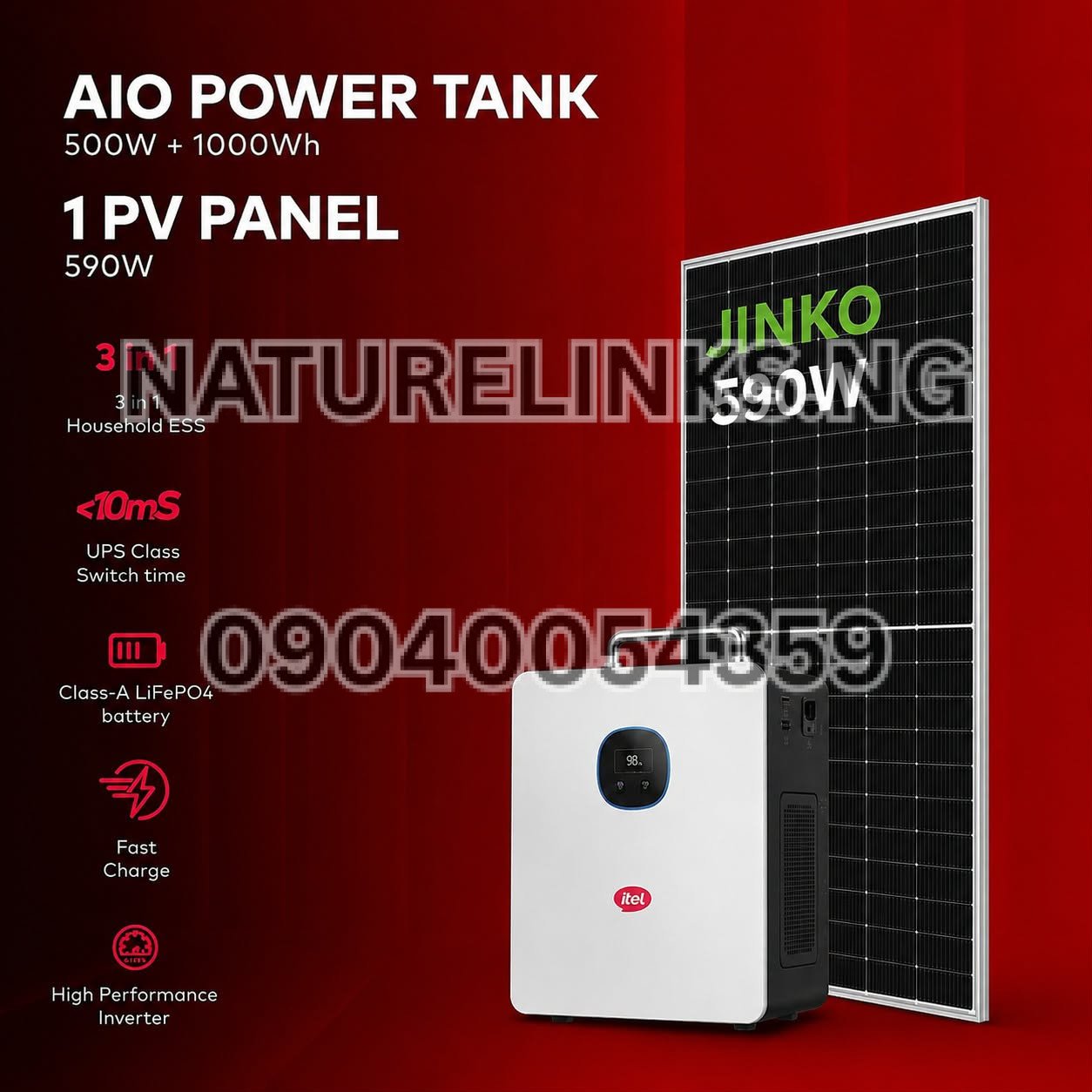
Some Nigerian sellers advertise the Itel Power Tank with an itel 410W solar panel as a package.
However, this should not be interpreted as a universal specification for every Itel Power Tank.
If your specific Power Tank documentation states a maximum PV input of 400W, a 410W panel is nominally above that figure. The panel may not necessarily deliver 410W in real-world conditions, but compatibility should be determined from the actual voltage/current specifications and the manufacturer’s approved configuration, not from wattage alone.
This is particularly important when buying a solar panel separately.
Can I Use a 450W Solar Panel with Itel Power Tank?
A 450W solar panel may be physically capable of supplying solar energy to a Power Tank, but you should not connect it simply because a 450W panel is available.
One Nigerian Itel Power Tank guide recommends 450W Longi panels for fast charging, while other product specifications for the commonly listed 1,000Wh/500W configuration specify up to 400W PV input.
These specifications demonstrate why buyers should check the exact model and official electrical limits before purchasing.
If the Power Tank is limited to 400W PV input, a 450W panel does not mean the battery will necessarily charge at 450W.
Can I Use a 500W Solar Panel with Itel Power Tank?
Do not assume that a 500W solar panel is suitable simply because the Power Tank itself is marketed as a 500W power station.
The 500W rating refers to the inverter’s output, while the solar-input rating is a separate specification.
The commonly listed Itel Power Tank has:
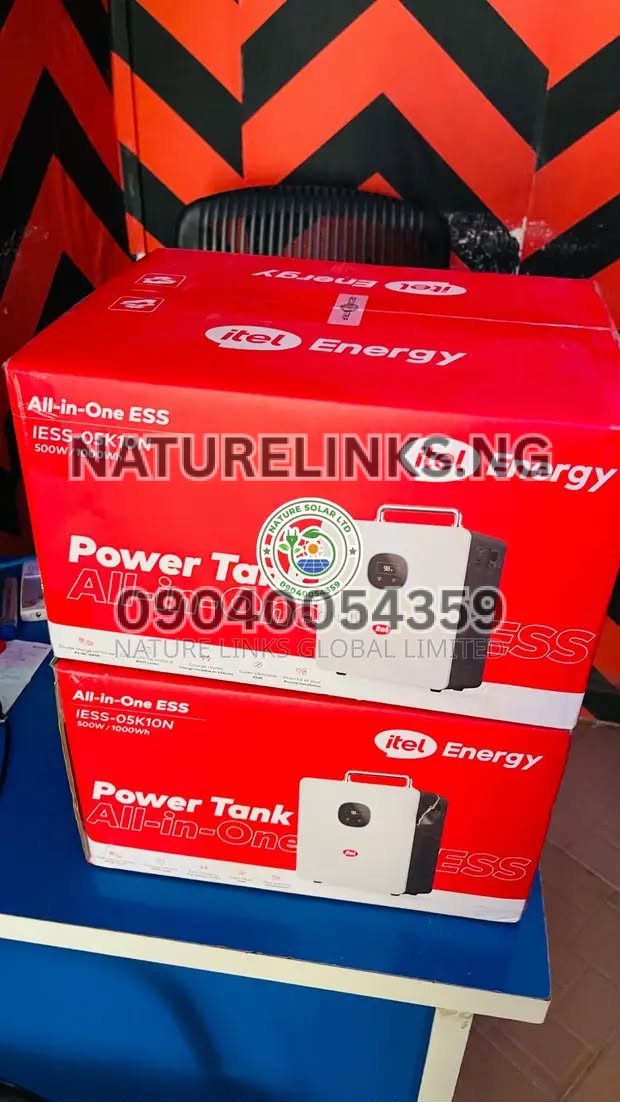
- 1,000Wh / 1kWh battery capacity
- 500W rated AC output
- Integrated MPPT solar charging
- Up to 400W PV input on the documented configuration
Therefore, a 500W inverter does not mean that the unit automatically accepts 500W of solar input.
What Size Solar Panel Is Best for Itel Power Tank?
For a configuration with a 400W maximum PV input, a compatible solar arrangement around 400W total nominal capacity is a practical target.
Common arrangements include:
Option 1: 1 × 400W panel
Simple installation with one panel, provided the voltage and current are compatible.
Option 2: 2 × 200W panels
This can provide 400W nominal capacity while offering flexibility in panel placement.
Option 3: 4 × 100W panels
This can also total 400W, although more panels mean more wiring, mounting and connection points.
The best physical arrangement depends on roof or ground space, shading, panel availability and the electrical specifications of the particular Power Tank.
How Many Watts of Solar Panel Can Itel Power Tank Use?
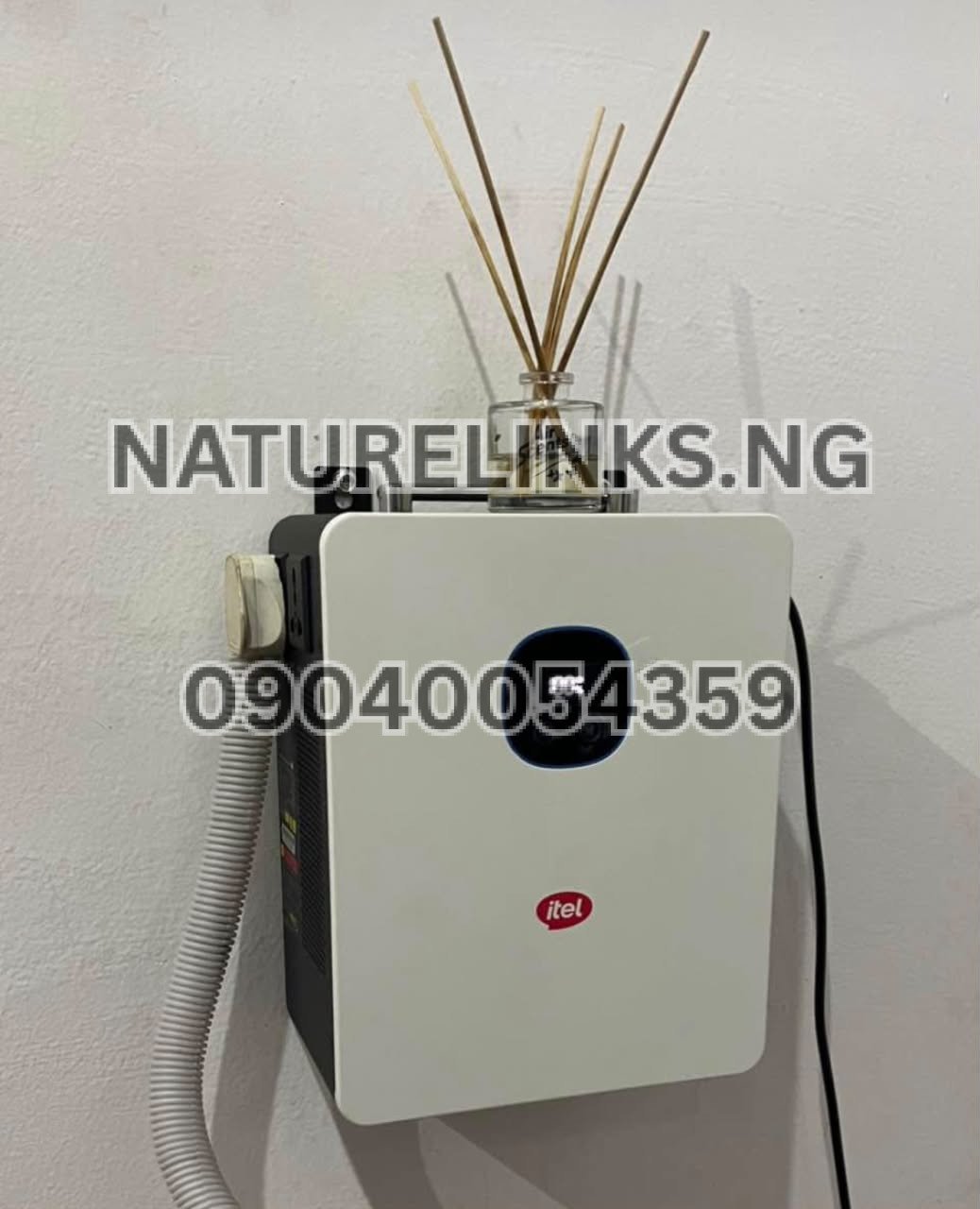
The commonly documented 1,000Wh/500W Itel Power Tank configuration supports up to 400W of PV input.
This is one of the most important figures to understand before buying a solar panel.
Do not confuse:
500W inverter output
with:
400W maximum solar input
or:
1,000Wh battery capacity.
These are three different specifications.
The 500W figure describes how much AC power the inverter can continuously deliver on the listed configuration.
The 1,000Wh figure describes the amount of stored battery energy.
The 400W figure describes the documented maximum solar/PV input for the relevant configuration.
What Does 1,000Wh Mean on Itel Power Tank?
The 1,000Wh specification represents the battery’s energy-storage capacity.
In simple terms:
1,000Wh = 1kWh.
It does not mean the Power Tank produces 1,000W continuously.
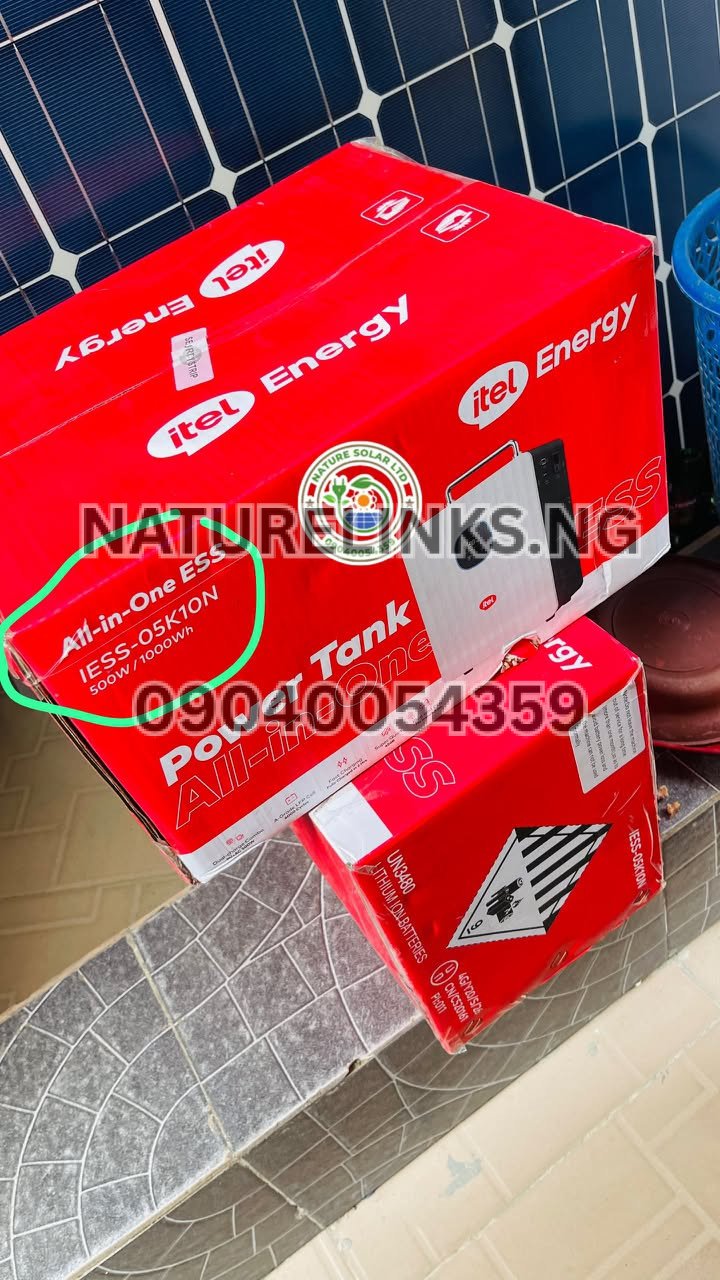
The commonly listed Power Tank configuration combines a 1,000Wh LiFePO4 battery with a 500W continuous inverter.
For example, a theoretical calculation would be:
- 100W appliance × 1 hour = 100Wh
- 200W appliance × 1 hour = 200Wh
- 500W appliance × 1 hour = 500Wh
Actual runtime will be lower than a simple mathematical calculation because of inverter losses, battery-management limits, appliance characteristics and other operating conditions.
How Long Does Itel Power Tank Take to Charge With Solar?
Charging time depends on the panel wattage, sunlight intensity, battery state of charge, temperature, MPPT performance, cable losses and other factors.
For illustration, if approximately 400W of solar charging power were continuously available, a 1,000Wh battery would have a theoretical charging time of:
1,000Wh ÷ 400W = 2.5 hours.
Real-world charging will generally take longer because a solar panel does not continuously produce its rated output throughout the charging period.
Clouds, haze, heat, shading, panel orientation and the battery’s charging profile can all reduce actual charging power.
A Nigerian Itel Power Tank guide gives an approximate 3–4 hour estimate for a 400W panel under ideal conditions, while noting that sunlight, battery level, weather and panel efficiency affect charging time.
How Much Solar Energy Does Itel Power Tank Need?
The amount of solar energy required depends on how much energy you consume.
If you use 500Wh from the battery, you need to replace approximately that amount of energy, plus charging and conversion losses.
If you use 1,000Wh, you need substantially more than 1,000Wh of solar energy reaching the system to fully restore the battery.
This is why a 400W panel does not mean the Power Tank receives 400W for every hour of the day.
For example, if usable solar production averaged 300W for four hours:
300W × 4 hours = 1,200Wh
The actual energy stored in the battery will be lower after system losses and charging limitations.
Does More Solar Panel Wattage Mean Faster Charging?
Not necessarily.
The Power Tank has a maximum permitted PV input. If the documented maximum is 400W, installing substantially more panel capacity does not automatically make the unit charge at the higher wattage.
The solar charge controller and Power Tank input specifications determine how much solar power can actually be accepted.
Therefore, the objective should be to select a compatible panel arrangement that fits the Power Tank’s PV-input limits, rather than simply buying the highest-wattage panel available.
“How Many Solar Panels Do I Need for Itel Power Station?”
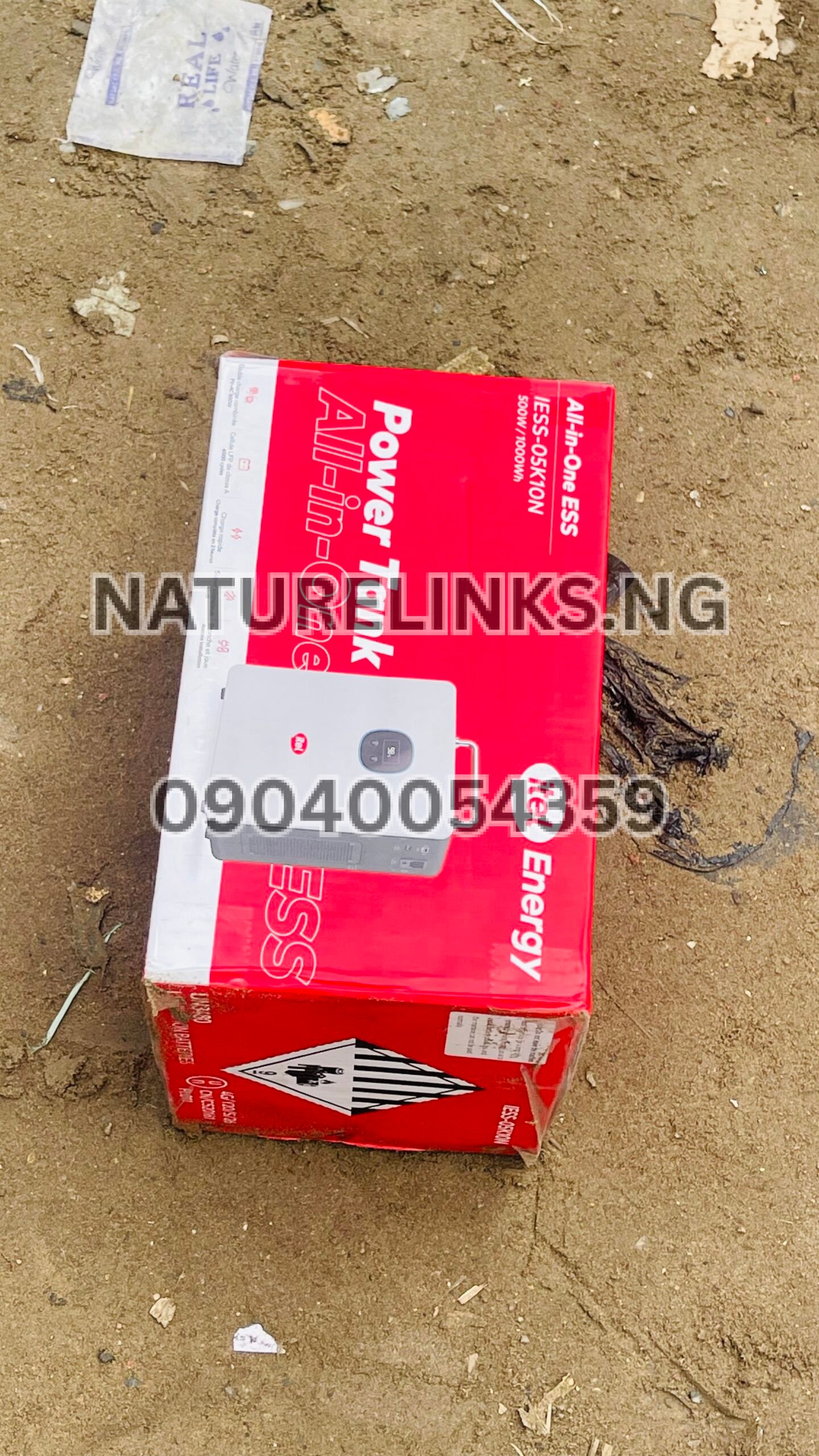
If your Itel Power Tank is the commonly listed 1,000Wh/500W model with up to 400W PV input, these examples make the calculation easy:
100W panels: 4 panels = 400W
200W panels: 2 panels = 400W
300W panel: 1 panel = 300W
400W panel: 1 panel = 400W
The actual number can change if your specific Itel model has a different PV-input specification.
Always check the model number before purchasing panels.
Itel Power Tank Solar Panel Connection
A proper solar installation should use the correct charging cable and connectors.
Before connecting:
- Confirm the Power Tank model.
- Check its maximum PV input.
- Check the MPPT voltage range.
- Check maximum PV current.
- Confirm panel voltage.
- Confirm panel polarity.
- Inspect MC4 connectors and cables.
- Install the panel where it receives strong sunlight.
- Avoid shadows from buildings, trees and other objects.
- Monitor the Power Tank display after connection.
A published Itel Power Tank guide also emphasizes correct voltage, connectors and adequate sunlight when connecting a solar panel.
Can Itel Power Tank Charge Without Solar Panels?
Yes.
Solar panels are not the only charging method.
The commonly listed Power Tank supports AC/grid charging as well as solar charging.
This means a Nigerian user can recharge the unit using available electricity and use solar charging when sunlight is available.
Some users may also charge through a generator, provided the generator supplies suitable and stable power.
Can I Use Itel Power Tank While Charging From Solar?
Published Itel Power Tank information states that the system supports pass-through charging on listed configurations, allowing compatible appliances to be powered while the battery is being charged.
Nevertheless, the connected appliance load should remain within the Power Tank’s output rating.
For the commonly listed model, the continuous AC output is 500W.
Running high-power appliances while charging can also affect how quickly the battery’s state of charge increases.
What Appliances Can Itel Power Tank Power?
The commonly listed 500W/1,000Wh Power Tank is designed for low- and moderate-power electronics such as:
- LED bulbs
- LED televisions
- Wi-Fi routers
- Phones
- Laptops
- Fans
- CCTV equipment
- POS machines
- Small office equipment
- Small printers
- Networking equipment
- Other compatible low-power devices
The important consideration is the total wattage.
A 500W continuous inverter should not be treated as a 1,000W continuous power supply simply because the battery capacity is 1,000Wh.
Can Itel Power Tank Power a Refrigerator?
It depends on the refrigerator’s running wattage and starting surge.
A refrigerator can have a relatively low running consumption but require substantially higher power when its compressor starts.
The commonly listed Power Tank has a 500W continuous AC output and up to approximately 1,000W surge on certain configurations.
Before buying specifically for a refrigerator, check:
- Running watts
- Starting/surge watts
- Compressor type
- Refrigerator energy rating
- Power Tank surge specification
- Expected runtime
Do not rely on the refrigerator’s advertised wattage alone.
Is Itel Power Tank Good for Solar Charging in Nigeria?
The Power Tank’s integrated MPPT solar charging capability makes solar charging possible when a compatible PV array is connected.
For Nigeria, actual performance depends heavily on local sunlight conditions, panel orientation, shading, dust, temperature and weather.
A well-sized solar panel array can reduce dependence on grid electricity for recharging the Power Tank.
However, the panel should be selected according to the Power Tank’s electrical input specifications, rather than only its advertised wattage.
What Should I Check Before Buying Solar Panels for Itel Power Tank?
Before paying for a solar panel, ask the seller for:
1. Exact Power Tank model
Different configurations can have different specifications.
2. Maximum PV input
This tells you the maximum solar power the unit can accept.
3. MPPT voltage range
The panel or panel array must operate within the permitted voltage range.
4. Maximum PV current
The current must also remain within the input specification.
5. Connector compatibility
Make sure the solar charging cable and connectors are compatible.
6. Panel open-circuit voltage
This is particularly important when configuring multiple panels.
7. Panel operating voltage
Check the panel’s Vmp against the MPPT range.
8. Panel operating current
Check the panel’s Imp against the permitted input current.
9. Warranty
Confirm what warranty applies to both the Power Tank and solar panel.
10. Installation
Use a competent installer if you are unsure about series/parallel configuration.
Itel Power Tank Solar Panel Price in Nigeria
The cost of a compatible solar panel in Nigeria depends on its wattage, technology, manufacturer, efficiency, availability and seller.
For example, current Nigerian Itel solar listings show panels around 410W, 550W and 590W, illustrating that multiple panel sizes are available in the market.
However, the highest-wattage panel is not necessarily the appropriate choice for a particular Power Tank.
The correct buying decision starts with the Power Tank’s PV specifications.
Itel Power Tank 400W Solar Panel Setup
For a Power Tank configuration rated for up to 400W PV input, a 400W-compatible panel arrangement can be attractive because it uses most of the available solar-input capacity.
A basic setup could consist of:
Itel Power Tank → compatible solar charging cable → 400W solar panel
Alternatively:
Itel Power Tank → compatible solar charging cable → 2 × 200W compatible panels
The exact wiring configuration must follow the Power Tank’s voltage/current limits.
2 × 200W Solar Panels for Itel Power Tank
Two 200W panels give a nominal total of:
200W + 200W = 400W.
This can match a 400W maximum PV-input specification in terms of total nominal wattage.
However, whether they should be connected in series or parallel depends on their electrical characteristics and the Power Tank’s MPPT input limits.
Do not connect two panels simply because their combined wattage equals 400W.
4 × 100W Solar Panels for Itel Power Tank
Four 100W panels also equal:
100W × 4 = 400W.
This provides another way to reach approximately 400W of nominal panel capacity.
The disadvantage is that four panels may require more mounting space, cables, connectors and installation work than one larger panel.
The final decision should therefore consider both electrical specifications and practical installation requirements.
Is a 400W Solar Panel Enough to Charge a 1kWh Itel Power Tank?
Yes, a 400W-compatible solar arrangement can provide substantial charging power for a 1kWh battery.
The theoretical calculation is:
1,000Wh ÷ 400W = 2.5 hours.
But this is not a guaranteed real-world charging time.
A panel rated at 400W only reaches that rating under specified test conditions. Real-world Nigerian solar production changes throughout the day.
Therefore, expect actual charging time to vary according to sunlight, panel orientation, temperature, shading, battery state and charging losses.
Itel Power Tank 1kWh Solar Charging Calculation
A useful basic formula is:
Charging time ≈ Battery capacity ÷ Actual charging power
For the 1,000Wh Power Tank:
1,000Wh ÷ 400W = 2.5 hours theoretical
1,000Wh ÷ 300W = 3.33 hours theoretical
1,000Wh ÷ 200W = 5 hours theoretical
These are mathematical estimates rather than guaranteed charging times.
Real-world charging generally takes longer.
What Happens If Solar Panel Output Is Less Than the Maximum?
Nothing is inherently wrong with using a smaller compatible solar array.
For example, a 200W panel can be used with a Power Tank that accepts up to 400W, provided the panel’s voltage and current are compatible.
The main difference is charging speed.
A lower-power panel generally supplies less charging power, so the battery may take longer to recharge.
This can still be useful for users who have limited roof space or who want a smaller and less expensive solar setup.
What Happens If I Connect Too Many Solar Panels?
Do not exceed the Power Tank’s specified PV voltage, current or permitted input.
Connecting excessive solar capacity can create an incompatible electrical configuration even if the Power Tank’s MPPT controller has protection features.
The manufacturer’s specified input limits should always take priority.
For the documented 1,000Wh/500W configuration, the listed maximum PV input is up to 400W.
Itel Power Tank Solar Panel Compatibility
Solar-panel compatibility involves more than wattage.
A compatible setup should satisfy:
Power: Within the permitted PV input.
Voltage: Within the MPPT input range.
Current: Within the maximum PV input current.
Polarity: Correct positive and negative connections.
Connector: Compatible charging connector/cable.
Array configuration: Series or parallel arrangement must remain within the electrical limits.
This is why an experienced installer should check the panel datasheet before connecting multiple panels.
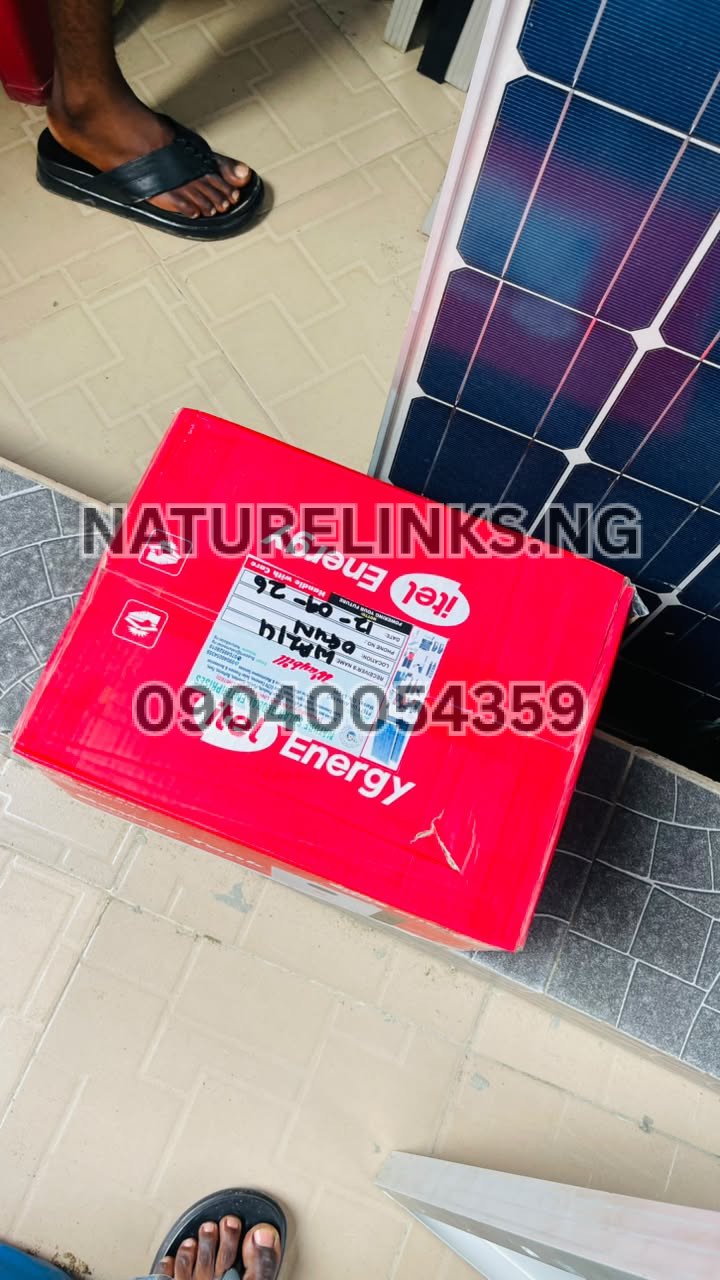
Nature Solar Global Limited – Itel Power Tank Seller in Nigeria
For Nigerians looking to buy an Itel Power Tank or discuss a compatible solar panel setup, the supplied business information is:
Best Seller: Nature Links Nigeria Limited [NatureLinks.NG]
Distributor: Nature Solar Global Limited
Accredited Distributor: Nature Solar Global Limited
CEO: Mr. Joseph Chikeleze
Call: 07049528019
WhatsApp: 09040054359
Shop Address: F1571 Upstairs (F-Line), Alaba International Market, Lagos State 🇳🇬
Buyers should confirm the exact model, battery capacity, PV-input specification, panel compatibility, warranty and accessories before payment.
Where to Buy Itel Power Tank and Solar Panels in Nigeria
Nigerian buyers can contact Nature Links Nigeria Limited / Nature Solar Global Limited to ask about availability of Itel Power Tank units and compatible solar charging equipment.
When requesting a quotation, provide the following information:
- Itel Power Tank model
- Battery capacity
- Desired solar panel wattage
- Number of panels required
- Whether installation is needed
- Delivery location
- Whether you need cables/connectors
- Whether you require a complete solar package
This makes it easier for the supplier to recommend a configuration based on the actual Power Tank specifications.
Why Buy a Genuine Itel Power Tank?
A genuine unit gives the buyer a better basis for confirming:
- Correct battery capacity
- Correct inverter rating
- Solar-input specifications
- Charging system
- Battery-management system
- Protection features
- Warranty
- Product documentation
- Model number
- Replacement/support arrangements
When comparing prices in Nigeria, do not compare price alone. Check whether the quoted amount includes the Power Tank only, a solar panel, charging cable, warranty or a complete solar package.
Itel Power Tank Datasheet – Commonly Listed 1,000Wh/500W Configuration
| Specification | Commonly Listed Value |
|---|---|
| Product | Itel Power Tank |
| Battery Capacity | 1,000Wh / 1kWh |
| Battery Chemistry | LiFePO4 |
| Rated AC Output | 500W |
| Inverter | Pure sine wave |
| Solar Charging | Yes |
| Solar Controller | Integrated MPPT |
| Maximum PV Input | Up to 400W on documented configuration |
| AC/Grid Charging | Yes |
| AC Output | 230V on listed configuration |
| Surge Output | Up to approximately 1,000W on listed configurations |
| Battery Cycle Life | Up to approximately 6,000 cycles on published configurations |
| UPS Function | Available on compatible configurations |
| Display | Digital/LED status display |
| Protection | Overload, short circuit, temperature and voltage protection |
Specifications can vary by model and regional configuration, so buyers should verify the exact product datasheet before purchasing.
Frequently Asked Questions About Itel Power Tank Solar Panels
1. How many solar panels do I need for an Itel Power Tank?
For the commonly listed 1,000Wh/500W configuration with up to 400W PV input, you can use one compatible 400W panel or a combination such as two 200W panels. The electrical specifications must be compatible with the Power Tank.
2. Can I use a 200W solar panel with Itel Power Tank?
Yes, provided the panel’s voltage and current are within the Power Tank’s permitted solar-input range. A 200W panel will generally charge more slowly than a larger compatible array.
3. Can I use two 200W solar panels?
Two 200W panels provide 400W nominal capacity. This can correspond to the documented 400W maximum PV input on the relevant configuration, but the series/parallel connection must comply with the Power Tank’s voltage and current limits.
4. Can I use a 400W solar panel?
A compatible 400W panel is a straightforward match for a configuration whose maximum PV input is 400W. Confirm voltage, current and connector compatibility before connecting.
5. Can I use a 410W solar panel?
Some Nigerian Itel packages are advertised with a 410W panel. However, if your Power Tank documentation specifies a 400W maximum PV input, confirm with the supplier/manufacturer before using a 410W panel.
6. Can I use a 450W solar panel?
Some Nigerian product information recommends 450W panels, but other documented specifications list 400W as the maximum PV input. Therefore, check the exact model’s voltage/current and maximum PV-input specifications first.
7. Can I use a 500W solar panel with a 500W Itel Power Tank?
The 500W Power Tank rating refers to its inverter output, not necessarily its solar input. A documented configuration has a 400W maximum PV input, so a 500W panel should not be connected without confirming compatibility.
8. How long does a 400W panel take to charge Itel Power Tank?
The theoretical calculation for a 1,000Wh battery is approximately 2.5 hours at a constant 400W. Actual solar charging takes longer or varies because sunlight intensity, weather, panel temperature, shading and charging losses affect output.
9. Does Itel Power Tank come with a solar panel?
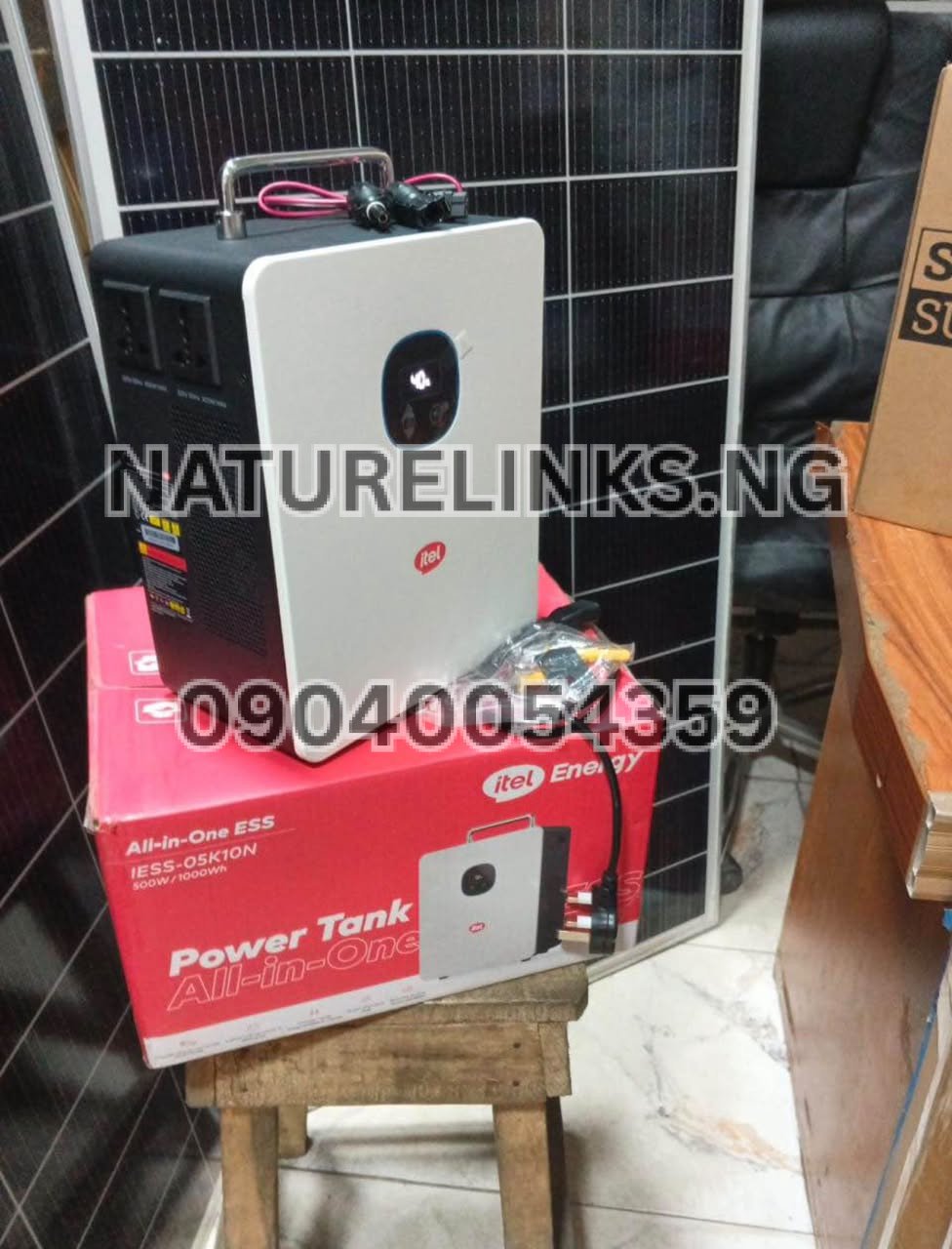
The Power Tank is commonly sold as the power station itself, with solar panels available separately or as bundled packages. Nigerian listings also show packages combining the Power Tank with an Itel 410W panel. Always confirm what is included in the specific package.
10. Can I charge Itel Power Tank with electricity without solar?
Yes. The commonly listed Itel Power Tank supports AC/grid charging as well as solar charging. This allows users to recharge from available electricity and use solar as an alternative charging source.
“How Many Solar Panels Do I Need for Itel Power Station?” – Final Buying Guide
The most important point is that you should choose the solar panel based on the Power Tank’s maximum PV input and electrical limits, rather than simply matching the battery’s 1kWh capacity or the inverter’s 500W output.
For the commonly listed 1,000Wh/500W Itel Power Tank, a documented configuration supports up to 400W PV input. That makes a compatible 400W solar panel—or an appropriately configured combination totaling around 400W—a logical reference point.
If you are considering a 410W, 450W or 500W panel, verify the exact model’s specifications first because nominal panel wattage above the documented PV-input limit should not automatically be treated as compatible.
For Nigerian buyers, sunlight conditions, panel orientation, shading, temperature and installation quality will also affect charging performance. A properly sized solar setup can make the Itel Power Tank useful for backup power for TVs, lights, fans, routers, laptops, phones, CCTV and other compatible loads.
For current availability and a compatible solar-panel setup, contact Nature Links Nigeria Limited / Nature Solar Global Limited at 07049528019 or WhatsApp 09040054359, or visit F1571 Upstairs (F-Line), Alaba International Market, Lagos State 🇳🇬.

Conclusion
Knowing How Many Solar Panels Do I Need for Itel Power Station? is essential before buying a solar charging system. For the commonly listed 1,000Wh/500W Itel Power Tank, the documented PV-input limit is up to 400W, so one compatible 400W panel or a suitable combination such as two 200W panels can be considered.
However, wattage alone is not enough. Always verify the panel’s voltage, current, connector, MPPT range and the exact Power Tank model. This helps prevent incompatible installations and ensures that the solar charging system operates within its specified limits.
For genuine Itel Power Tank products and assistance choosing a compatible solar panel in Nigeria, contact Nature Solar Global Limited / Nature Links Nigeria Limited using 07049528019 or 09040054359 on WhatsApp.



1 thought on “How Many Solar Panels Do I Need for Itel Power Station?”